Hard Skills vs Soft Skills on a Resume: What Employers Want in 2026


You've probably heard that you need both hard skills and soft skills on your resume. But how many of each? Where do they go? And which type actually gets you past the ATS and into an interview?
A 2026 survey of over 1,000 U.S. hiring managers found that 62% consider hard and soft skills equally important, while another 24% say soft skills now matter *more*. Meanwhile, 70% of employers are actively using skills-based hiring — up from 65% last year — which means your skills section isn't just filler anymore. It's the first thing getting scanned, parsed, and scored.
This guide breaks down exactly what hard skills and soft skills are, gives you concrete examples for every major industry, and shows you how to balance both types so your resume actually reflects what employers are screening for right now.
What Are Hard Skills?
Hard skills are specific, teachable abilities you can measure and verify. They're the technical competencies you pick up through education, training, certifications, or hands-on practice. Think of them as the "can you do this job?" skills.
A hiring manager can test hard skills. They can ask you to write a SQL query, build a financial model, or demonstrate proficiency in Figma. There's a clear right-or-wrong quality to them, which is why ATS software can screen for them so effectively.
Examples of hard skills by category:
- Programming & Development: Python, JavaScript, React, SQL, cloud architecture (AWS, Azure, GCP)
- Data & Analytics: Statistical modeling, Tableau, Power BI, machine learning, A/B testing
- Marketing & Content: SEO, Google Analytics, paid media buying, email marketing platforms, CMS management
- Finance & Accounting: Financial modeling, GAAP compliance, QuickBooks, Bloomberg Terminal, risk assessment
- Design: Figma, Adobe Creative Suite, wireframing, prototyping, design systems
- Project Management: Agile/Scrum methodology, Jira, MS Project, earned value management
- Healthcare: Electronic health records (EHR), medical coding (ICD-10), phlebotomy, patient assessment
The key trait of every hard skill: someone could quiz you on it, and you'd either pass or fail.
What Are Soft Skills?
Soft skills are behavioral and interpersonal abilities that shape *how* you work — with others, under pressure, and across changing circumstances. They're harder to quantify than hard skills, which is exactly why so many candidates list them poorly on their resumes.
You can't really test "leadership" the way you can test someone's Excel proficiency. But hiring managers absolutely evaluate soft skills — they just do it through behavioral interview questions, reference checks, and how you describe your accomplishments on paper.
The soft skills hiring managers ranked highest for 2026:
- Communication (written and verbal)
- Professionalism and work ethic
- Time management
- Accountability
- Resilience and adaptability
- Problem-solving
- Critical thinking
- Attention to detail
- Collaboration
- Leadership and mentorship
Notice what's *not* on this list: vague buzzwords like "team player" or "self-starter." Employers want specific behavioral evidence, not personality adjectives.
Why Employers Care About Both (And Where Each Type Wins)
Here's the tension: companies can teach you a new software tool in a few weeks, but they can't easily train accountability or critical thinking. That's why 92% of hiring professionals say soft skills are equally or more important than hard skills.
But that doesn't mean you should load your resume with soft skills and skip the technical stuff. Hard skills get you *past the ATS*. Soft skills get you *through the interview*. You need both to actually land the job.
Where hard skills win:
- ATS keyword matching and automated screening
- Technical assessments and skills tests
- Roles with strict certification or tool requirements (engineering, healthcare, accounting)
- Early-career positions where you need to prove baseline competency
Where soft skills win:
- Behavioral interview rounds
- Leadership and management roles
- Client-facing and cross-functional positions
- Promotions and internal mobility (your boss already knows your technical skills)
The candidates getting hired in 2026 are what LinkedIn calls "skill stackers" — people who combine technical competence with human capabilities. Their 2026 Skills on the Rise report identified five high-growth skill clusters: AI & Automation, Data & Analytics, IT & Cybersecurity, Business & Growth, and People & Leadership. Notice how the list blends hard and soft across every cluster.

Hard Skills vs Soft Skills: A Side-by-Side Breakdown
This table reveals something important: hard skills and soft skills don't belong in the same place on your resume. More on that below.
The Right Balance: How Many of Each Should You Include?
There's no universal formula, but here's a practical framework based on how recruiters actually evaluate resumes:
For your skills section: Aim for roughly a 2:1 ratio of hard skills to soft skills — or even 3:1. Your skills section is primarily scanned by ATS software looking for technical keywords. Load it with the hard skills from the job description first, then add 2-3 relevant soft skills if the posting specifically mentions them.
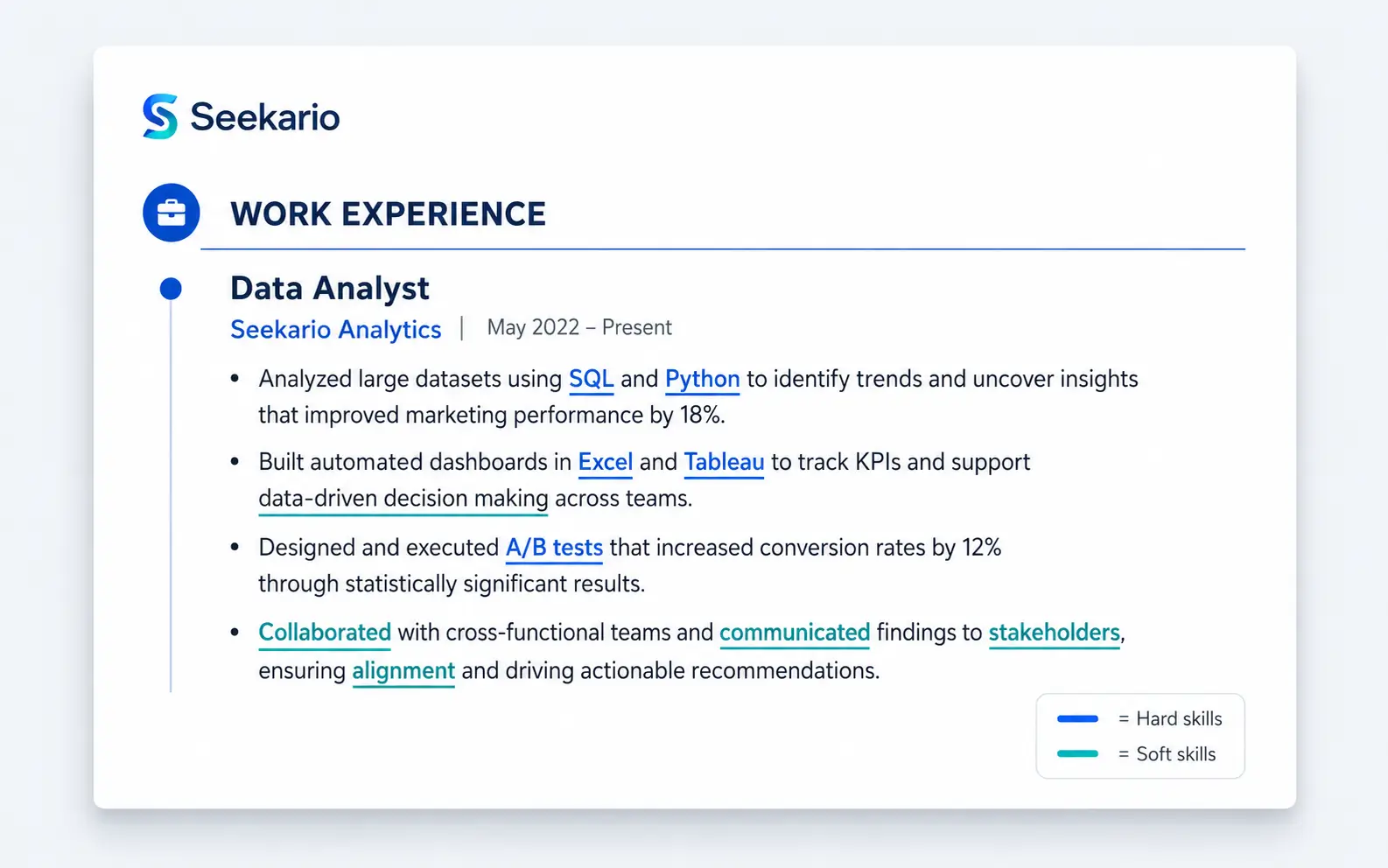
For your work experience bullets: Flip the ratio. Each bullet should demonstrate a hard skill *and* a soft skill working together. When you write "Led a cross-functional team of 8 to migrate the company's data pipeline from on-premise to AWS, reducing processing time by 40%," you're showing leadership (soft), cloud architecture (hard), and results orientation (soft) simultaneously.
Adjust by role type:
- Technical roles (engineer, analyst, designer): 70% hard / 30% soft
- Hybrid roles (product manager, consultant, project manager): 50% hard / 50% soft
- Leadership roles (director, VP, C-suite): 40% hard / 60% soft
- Client-facing roles (sales, account management, recruiting): 40% hard / 60% soft
The job posting itself is your best guide. Count the hard skill requirements versus soft skill requirements and mirror that ratio on your resume. Seekario's AI Resume Checker can analyze this balance for you and flag when your skills mix doesn't match what a specific role demands.
Industry-Specific Skill Breakdowns
Technology & Engineering
Must-have hard skills: Programming languages (Python, Java, Go), cloud platforms, CI/CD pipelines, system design, version control (Git)
Must-have soft skills: Problem decomposition, async communication, technical mentorship, cross-team collaboration
Data & Analytics
Must-have hard skills: SQL, Python/R, statistical modeling, data visualization (Tableau, Power BI), machine learning frameworks
Must-have soft skills: Storytelling with data, stakeholder management, translating technical findings for business audiences
Marketing & Communications
Must-have hard skills: SEO/SEM, Google Analytics, marketing automation (HubSpot, Marketo), A/B testing, content management systems
Must-have soft skills: Persuasive writing, creative thinking, brand voice consistency, campaign management under tight deadlines
Finance & Accounting
Must-have hard skills: Financial modeling, ERP systems (SAP, Oracle), regulatory compliance (SOX, IFRS), advanced Excel, Bloomberg Terminal
Must-have soft skills: Attention to detail, ethical judgment, clear communication of complex financial data, risk assessment
Healthcare
Must-have hard skills: EHR systems (Epic, Cerner), medical coding (ICD-10, CPT), clinical protocols, HIPAA compliance, patient assessment
Must-have soft skills: Empathy, crisis decision-making, interdisciplinary collaboration, patient communication
Project & Product Management
Must-have hard skills: Agile/Scrum frameworks, Jira/Asana, roadmapping tools, budgeting, risk analysis
Must-have soft skills: Stakeholder alignment, conflict resolution, prioritization under ambiguity, cross-functional influence
How to Prove Soft Skills on Your Resume (Without Just Listing Them)
This is where most resumes fall apart. Listing "excellent communication skills" does absolutely nothing. Every candidate claims that. Here's how to actually demonstrate soft skills through your experience bullets:
Instead of listing "leadership":
> Managed a team of 12 engineers across 3 time zones, delivering the product migration 2 weeks ahead of schedule with zero critical defects.
Instead of listing "problem-solving":
> Identified a recurring billing discrepancy affecting 15% of enterprise accounts and designed an automated reconciliation workflow that recovered $340K in lost revenue.
Instead of listing "communication":
> Presented quarterly analytics reports to the C-suite, translating complex user behavior data into 3 strategic recommendations that drove a 22% increase in retention.
Instead of listing "adaptability":
> Pivoted the team's roadmap mid-quarter when a key API partner deprecated their service, delivering an alternative integration within 3 weeks with no customer-facing disruption.
The pattern: name the situation, describe your specific action, and quantify the result. Every bullet becomes proof of both a hard skill (the technical work) and a soft skill (how you approached it).
If writing bullets like these feels difficult, Seekario's AI Resume Tailor can help reframe your experience into achievement-driven language that showcases both skill types simultaneously.
The AI Skills Factor: The New Third Category
The 2026 job market has effectively created a third skill category that sits between hard and soft: AI literacy. LinkedIn's Skills on the Rise report flagged AI literacy, prompt engineering, and AI business strategy among the fastest-growing skills across *all* industries — not just tech.
Here's how AI skills break down:
Hard AI skills (technical, testable): Prompt engineering, LLMOps, AutoML, AI model fine-tuning, workflow automation with AI tools
Soft AI skills (judgment-based, contextual): Knowing when to use AI vs. human judgment, evaluating AI output quality, responsible AI practices, communicating AI-assisted decisions to stakeholders
If you're using AI tools in your current role — and statistically, you probably are — mention it on your resume. Frame it as a productivity multiplier, not a replacement for your expertise. "Used AI-assisted code review to reduce bug rates by 30% while maintaining team code quality standards" is far stronger than "proficient in AI tools."
Common Mistakes When Listing Hard and Soft Skills
Mistake 1: Dumping soft skills in your skills section. ATS software doesn't scan for "teamwork." Reserve your skills section for hard, keyword-rich terms and demonstrate soft skills through your experience bullets.
Mistake 2: Listing skills you can't back up. If you write "Python" but can't pass a basic coding screen, you're setting yourself up for an embarrassing interview. Only list hard skills you could confidently discuss or demonstrate.
Mistake 3: Using the same skills list for every application. 70% of employers now use skills-based hiring, and they're looking for *specific* skills mentioned in *their* job description. A generic skills section tells recruiters you didn't read the posting.
Mistake 4: Ignoring the job description's language. If the posting says "stakeholder management" and you write "working with people," the ATS won't make that connection. Mirror the exact terminology from the job ad.
Mistake 5: Skipping emerging skills. Not including AI-related skills when they're relevant to your role signals that you haven't kept pace with your industry's evolution. Even a line about AI-assisted workflows shows awareness.
Seekario's AI Resume Builder can help you avoid these mistakes by generating ATS-optimized skills sections that pull the right keywords from any job description.
FAQ
What's the difference between hard skills and soft skills?
Hard skills are technical, measurable abilities you learn through training or education — things like programming languages, accounting software, or data analysis tools. Soft skills are behavioral and interpersonal qualities like communication, leadership, and problem-solving that shape how you work with others and handle challenges. Both types appear on strong resumes, but they belong in different sections.
Should I put more hard skills or soft skills on my resume?
It depends on the role. For technical positions, lean toward a 70/30 hard-to-soft ratio. For leadership or client-facing roles, balance shifts closer to 50/50 or even 40/60 favoring soft skills. Always match the ratio to what the job posting emphasizes — count the skill requirements and mirror that balance.
How do I show soft skills on a resume without just listing them?
Demonstrate them through your work experience bullets using the action-result format. Instead of writing "strong communication skills," describe a specific instance: "Presented quarterly findings to C-suite executives, securing approval for a $2M budget increase." The story proves the skill better than any adjective.
Do ATS systems scan for soft skills?
Most ATS software focuses on hard skills, technical terms, and specific keywords from the job description. Soft skills like "teamwork" or "communication" rarely trigger ATS matches unless the job posting specifically lists them as required qualifications. That's why your skills section should prioritize hard skills, while soft skills shine in your experience bullets.
What are the most in-demand skills for 2026?
According to LinkedIn's 2026 Skills on the Rise report, the fastest-growing skill clusters are AI & Automation (prompt engineering, workflow automation), Data & Analytics, IT & Cybersecurity, Business & Growth, and People & Leadership. Hiring managers rank communication, professionalism, time management, and resilience as the top soft skills, while software tools proficiency, data analysis, and cybersecurity lead hard skill demand.
Getting Your Skills Balance Right
The hard skills vs soft skills debate isn't really a debate at all — you need both, and the strongest resumes weave them together so tightly that every bullet demonstrates technical ability *and* professional judgment simultaneously.
Start with the job description. Count the hard skill requirements, count the soft skill mentions, and build your resume to reflect that ratio. Load your skills section with ATS-friendly hard skills and technical keywords. Then use your experience bullets to *show* soft skills through specific achievements and outcomes.
If you want a faster way to nail this balance, Seekario's AI Resume Scanner analyzes your resume against any job description and tells you exactly where your hard and soft skill mix needs adjustment — so you can stop guessing and start targeting.