How to List Skills on a Resume: Hard Skills, Soft Skills & Examples (2026)

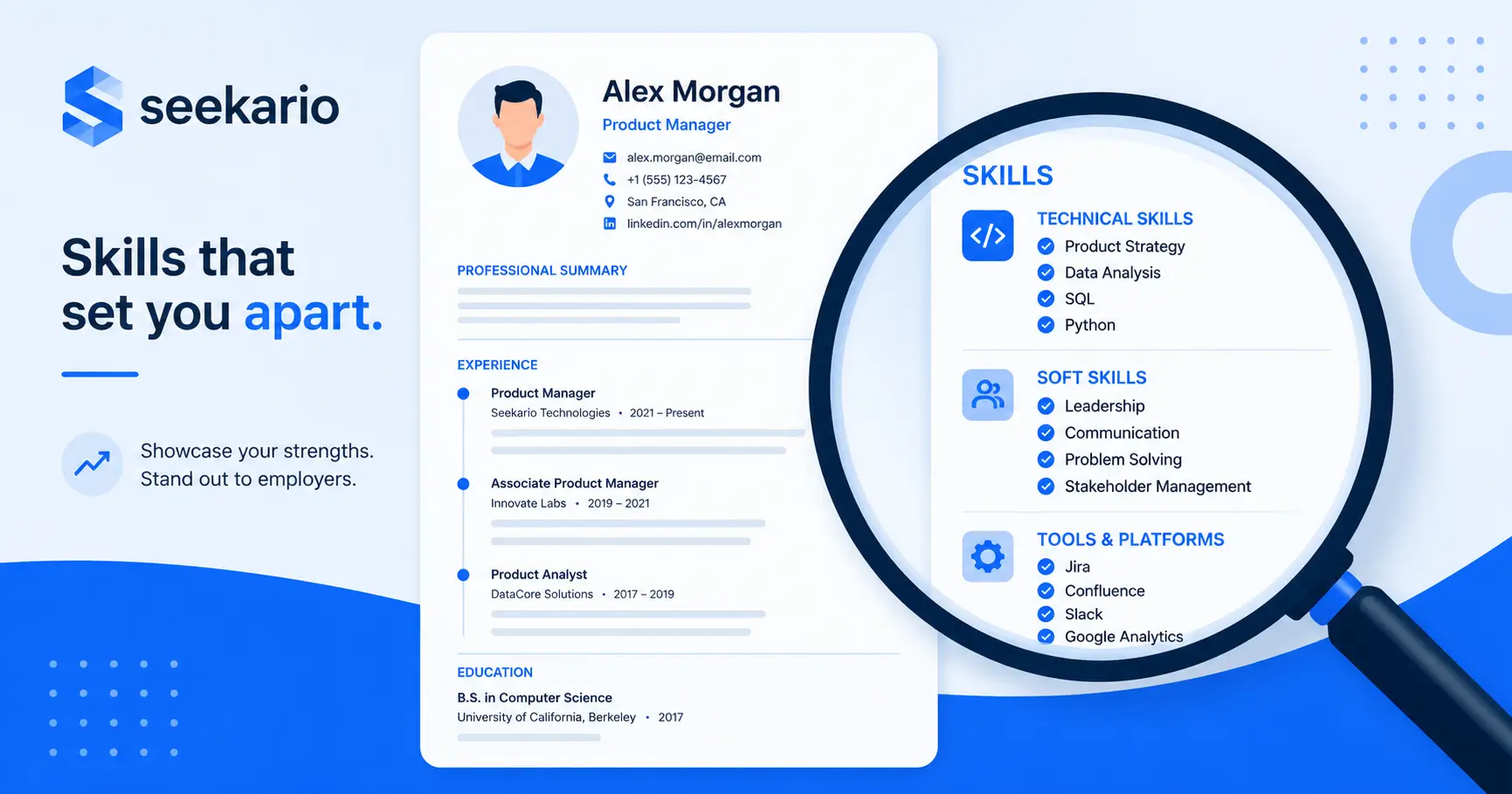
Your skills section does more heavy lifting than any other part of your resume. It's the first thing ATS software scans, and it's where recruiters spend a disproportionate amount of their 7-second initial review. Get it right and you land interviews. Get it wrong and your resume disappears into a database, never to be seen again.
The challenge? Knowing which skills to include, how to organize them, and where the line falls between "strategic" and "keyword stuffing." This guide breaks it all down with real examples, 2026 hiring data, and a framework you can apply to any job description.
Why Your Skills Section Matters More Than You Think (Especially for ATS)
Here's a stat that should get your attention: 99.7% of Fortune 500 companies use an Applicant Tracking System to filter resumes before a human ever sees them. Your skills section is where most of that filtering happens.
ATS software matches keywords from the job description against what's on your resume. A dedicated skills section with comma-separated or bullet-pointed entries parses correctly across major ATS platforms at over 95% accuracy. Bury those same skills in paragraph form inside your work experience, and parsing rates drop significantly.
But ATS compatibility is only half the story. Recruiters who do see your resume use the skills section as a quick-reference checklist. LinkedIn's 2026 hiring data shows that nearly half of recruiters now explicitly use skills data to evaluate candidates, prioritizing demonstrable abilities over traditional degrees or linear career paths.
Your skills section serves three purposes simultaneously:
- ATS gatekeeper — matching keywords to get your resume past automated filters
- Recruiter shortcut — giving hiring managers a scannable snapshot of your capabilities
- Interview roadmap — setting up talking points you're prepared to discuss in depth
Skip the skills section or treat it as an afterthought, and you're undermining all three.
For a complete breakdown of every resume section and how they work together, see our Complete Guide to Resume Sections.
Hard Skills vs. Soft Skills: What Goes Where
Not all skills belong in the same place on your resume. Understanding the difference between hard and soft skills — and where each type performs best — is the key to a resume that works for both machines and humans.
Hard skills are teachable, measurable abilities tied to specific tools, technologies, or methodologies. Think Python, financial modeling, Adobe Photoshop, or HIPAA compliance. These are what ATS software is primarily scanning for, and they're what prove you can do the technical work the job requires.
Soft skills are behavioral competencies — how you communicate, collaborate, lead, and solve problems. Think critical thinking, stakeholder management, or conflict resolution.
Here's the framework that works:
Put hard skills in your dedicated skills section. They parse cleanly through ATS, and recruiters can verify them at a glance.
Demonstrate soft skills in your work experience bullets. Listing "communication" as a standalone skill tells a recruiter nothing. Writing "Presented quarterly analytics reports to C-suite, resulting in three new data-driven initiatives" proves communication through action.
The recommended balance for your skills section is roughly 70% hard skills and 30% soft skills. According to a 2025 employer survey, 62% of hiring managers give equal weight to both categories when making hiring decisions — but they want to see soft skills backed by evidence, not just listed.
Quick Reference: Hard vs. Soft Skills
Hard Skills (Skills Section)
- Programming languages (Python, SQL, Java)
- Software platforms (Salesforce, SAP, Tableau)
- Certifications (PMP, AWS, CPA)
- Technical methodologies (Agile, Six Sigma)
- Tools (Google Analytics, Figma, AutoCAD)
Soft Skills (Experience Section)
- Leadership and team management
- Cross-functional collaboration
- Problem-solving and critical thinking
- Verbal and written communication
- Adaptability and resilience
Technical Skills by Industry: What Employers Actually Search For
Generic skills lists won't cut it. What gets you past ATS in healthcare won't help in fintech. Here are the technical skills employers are actively searching for in 2026, organized by industry.

Software Engineering & IT: Python, JavaScript/TypeScript, cloud platforms (AWS, Azure, GCP), Kubernetes, Docker, CI/CD pipelines, REST APIs, microservices architecture, Git
Data & Analytics: SQL, Python, R, Tableau, Power BI, Apache Spark, dbt, machine learning frameworks (TensorFlow, PyTorch), statistical modeling
Marketing & Growth: Google Analytics 4, SEO/SEM, HubSpot, Marketo, A/B testing, marketing automation, content management systems, paid media (Google Ads, Meta Ads)
Finance & Accounting: Financial modeling, Excel (advanced), Bloomberg Terminal, QuickBooks, ERP systems (SAP, Oracle), regulatory compliance, risk analysis
Healthcare: Electronic Health Records (Epic, Cerner), HIPAA compliance, clinical research protocols, medical coding (ICD-10, CPT), patient care documentation
Project Management: Jira, Asana, Monday.com, MS Project, Agile/Scrum, Waterfall, stakeholder management, budgeting and forecasting
Don't list every skill in your industry. Pick the 8-12 that align most closely with the specific job description you're targeting. Seekario's AI Resume Tailor can analyze a job posting and highlight exactly which skills to prioritize on your resume.
AI Skills in 2026: The New Baseline Employers Expect
This is the section most other resume guides skip — and it's the one that matters most right now.
LinkedIn's 2026 "Skills on the Rise" report placed AI literacy at the top of the fastest-growing skills globally. AI engineering, AI business strategy, and responsible AI practices are the three fastest-growing skill clusters. Demand for AI and machine learning skills surged 245% year over year, knocking "communication" from its decade-long hold on the #1 most in-demand skill position.
What does this mean for your resume? AI literacy is no longer a nice-to-have — it's the 2026 equivalent of "proficient in Microsoft Office" from ten years ago. Employers now list AI literacy as a priority even for non-technical roles.
Here's how to approach AI skills on your resume based on your role:
For technical roles (engineers, data scientists, analysts):
- List specific tools and frameworks: TensorFlow, PyTorch, Hugging Face, LangChain
- Include AI methodologies: prompt engineering, fine-tuning, RAG (retrieval-augmented generation)
- Mention deployment experience: MLOps, model monitoring, A/B testing AI features
For non-technical roles (marketing, HR, operations, sales):
- List AI-powered tools you use daily: ChatGPT, Claude, Copilot, Jasper, Midjourney
- Describe how you apply AI: "Used AI-assisted analytics to reduce report generation time by 60%"
- Highlight structured prompting: ability to guide AI tools through multi-step workflows
For management and leadership roles:
- Emphasize AI strategy: evaluating, selecting, and implementing AI solutions
- Show governance awareness: responsible AI, bias mitigation, data privacy
- Demonstrate ROI thinking: how AI initiatives connect to business outcomes
The key is specificity. "AI proficient" means nothing. "Built automated data pipeline using Python and OpenAI API, reducing manual analysis time from 8 hours to 45 minutes" means everything.
How to Format Your Skills Section (3 Proven Layouts)
The format you choose affects both ATS parsing and recruiter readability. Here are three layouts that work, with guidance on when to use each.
Layout 1: Simple Comma-Separated List
```
Skills: Python, SQL, Tableau, AWS, Docker, Agile, Financial Modeling, Stakeholder Management
```
Best for: ATS-heavy applications, one-page resumes, roles where a clean format matters. Parses at 95%+ accuracy across all major ATS platforms.
Layout 2: Categorized Skills
```
Technical: Python, SQL, R, Tableau, Power BI
Cloud & DevOps: AWS, Docker, Kubernetes, CI/CD
Methodologies: Agile, Scrum, Six Sigma
```
Best for: Technical roles with diverse skill requirements, experienced professionals with broad skill sets. Makes it easy for recruiters to find what they need.
Layout 3: Skills with Proficiency Indicators
```
Python (Expert) | SQL (Expert) | Tableau (Advanced) | R (Intermediate) | Kubernetes (Intermediate)
```
Best for: Roles where proficiency level matters (e.g., multilingual positions, engineering roles). Use sparingly — only when the job description specifically asks for proficiency levels.
Regardless of format, keep these rules in mind:
- 8-12 skills is the sweet spot. Fewer looks thin; more looks unfocused.
- Front-load the most relevant skills. Recruiters read left to right, top to bottom.
- Use the exact terminology from the job description. If they say "project management," don't write "managing projects."
- Skip the progress bars and star ratings. They don't parse through ATS and they're subjective to the point of being meaningless.
Skills to Avoid Listing on Your Resume
Some skills actively hurt your resume. They waste space, signal inexperience, or make you look out of touch. Remove these immediately:
Obvious skills nobody needs to see: Microsoft Word, email, typing, internet research. These are assumed competencies in 2026. Listing them suggests you don't have stronger skills to highlight.
Vague buzzwords without context: "Team player," "hard worker," "detail-oriented," "go-getter." These are opinion-based, unverifiable, and add zero information. Every candidate thinks they're detail-oriented.
Outdated technologies: Flash, Visual Basic 6, FrontPage, Windows XP administration. Unless the job specifically requires legacy systems, outdated tech signals you haven't kept your skills current.
Skills you can't back up: If you list "fluent in Spanish" and the interviewer switches to Spanish, you'd better be ready. If you list "advanced Excel" and can't build a pivot table, you've damaged your credibility on everything else.
Soft skills as standalone entries: "Communication," "leadership," "problem-solving" as line items in your skills section look generic. Move them to your experience bullets where you can prove them with results.
A good litmus test: if a skill wouldn't make a recruiter say "yes, this person can do the job," it doesn't belong in your skills section.
How to Match Your Skills to Any Job Description (Step by Step)
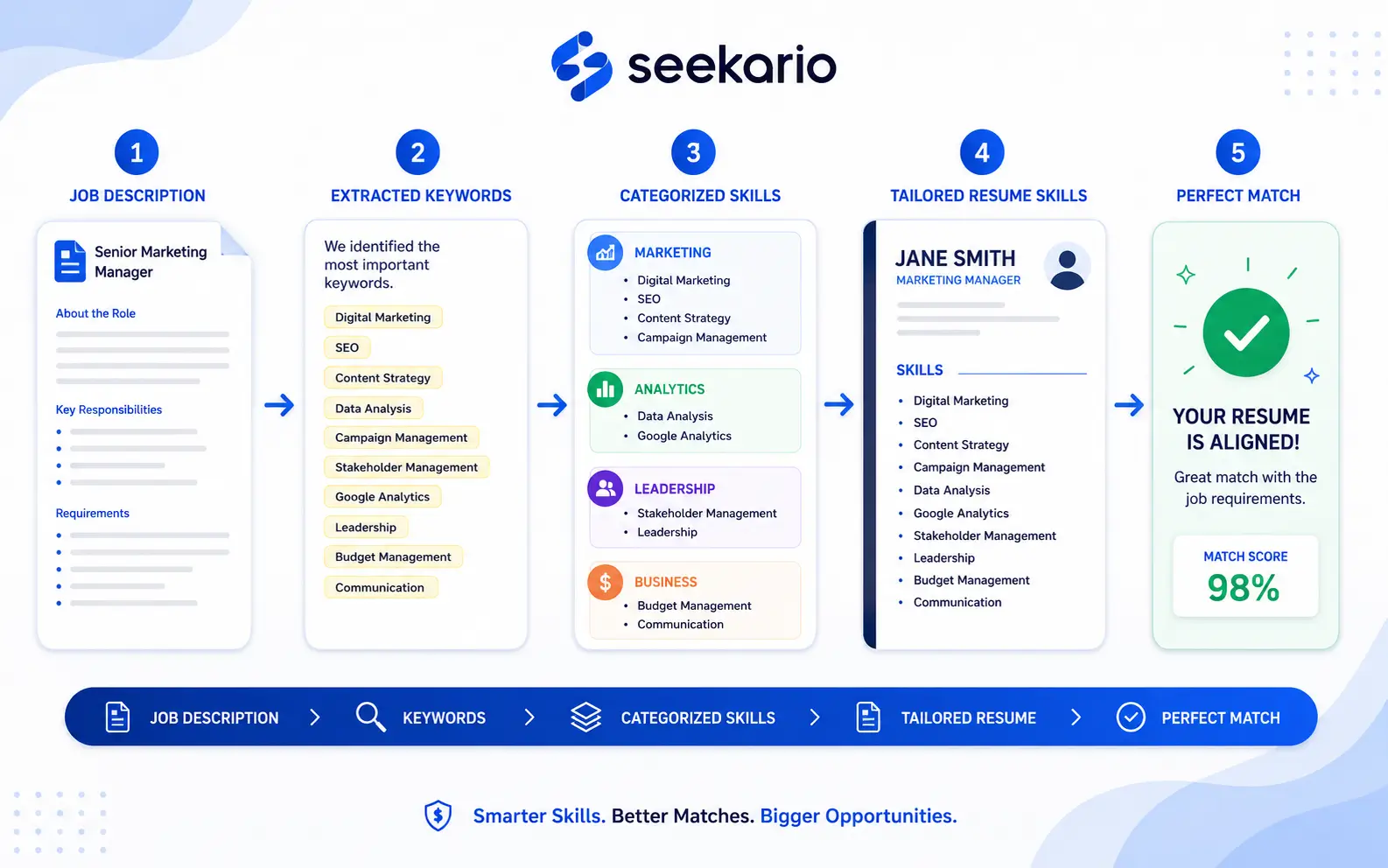
The most effective skills section is one that's tailored to each specific role. Here's a five-step process for extracting and matching skills from any job posting.
Step 1: Pull the job description apart. Copy the entire posting into a document. Highlight every skill, tool, technology, and competency mentioned.
Step 2: Separate required from preferred. Job descriptions typically have "required qualifications" and "preferred qualifications." Required skills are your priority — every one you genuinely have should appear on your resume.
Step 3: Identify repeated keywords. If "cross-functional collaboration" appears three times in a job description, it's a priority for the hiring team. Skills mentioned multiple times should be prominent on your resume.
Step 4: Mirror the exact language. If the JD says "Salesforce CRM," don't write "CRM software." If it says "stakeholder management," don't write "working with stakeholders." ATS systems often fail to match synonyms, and recruiters appreciate consistency.
Step 5: Add context in your experience section. For each skill in your skills section, make sure at least one bullet point in your work experience demonstrates that skill in action with a measurable result.
This process takes 10-15 minutes per application when done manually. Seekario's AI Resume Tailor automates it — paste a job description and your resume, and it identifies skill gaps, suggests additions, and restructures your skills section to match.
Frequently Asked Questions
How many skills should I list on my resume?
Aim for 8-12 skills in your dedicated skills section. This gives you enough coverage to match job description keywords without diluting your strongest qualifications. If you're applying to a highly technical role, you can push to 15, but organize them into categories so the section stays scannable.
Should I list soft skills on my resume?
Yes, but not in your skills section. Soft skills like communication, leadership, and problem-solving are most effective when demonstrated through your work experience bullets with specific results. For example, instead of listing "leadership," write "Led 12-person cross-functional team to deliver product launch 2 weeks ahead of schedule."
Do I need to include AI skills on my resume in 2026?
In most cases, yes. LinkedIn's 2026 data shows AI literacy is now the fastest-growing skill globally, and employers list it as a priority even for non-technical roles. At minimum, mention AI-powered tools you use regularly. For technical roles, include specific frameworks, methodologies, and deployment experience.
How do I list skills if I'm changing careers?
Focus on transferable skills that apply across industries — project management, data analysis, stakeholder communication, process improvement. Then add any new technical skills you've gained through courses or certifications. Seekario's AI Resume Scanner can analyze your resume against a target role and identify which transferable skills to emphasize.
Should I use a skills rating system (bars, stars, percentages) on my resume?
No. Skill ratings are subjective (what does "4 out of 5 stars in Python" actually mean?), they don't parse through ATS software, and they can inadvertently highlight weaknesses. If you rate yourself 3/5 in a required skill, you've just told the recruiter you're not fully qualified. Stick to listing skills without ratings.
Build a Skills Section That Actually Gets You Interviews
Your skills section isn't a dumping ground for every competency you've ever developed. It's a strategic tool — one that needs to be tailored to every application, balanced between hard and soft skills, and updated to reflect what employers actually search for in 2026.
The non-negotiables: prioritize hard skills that match the job description, demonstrate soft skills through your experience bullets, include AI literacy skills appropriate to your role, and format everything for clean ATS parsing.
If manually tailoring your skills section for every application feels overwhelming, Seekario's AI Resume Tailor does the heavy lifting. Paste any job description, upload your resume, and get a skills section optimized for that specific role — with keyword matching, gap analysis, and formatting that works across every major ATS platform.