How to Write a Cover Letter for an Internship (With Examples)


Most students skip the cover letter. That's a mistake — especially for internships, where you don't have years of experience to let your resume do the talking. A strong internship cover letter fills the gap between what you've done in class and what you can do on the job. It shows hiring managers you've researched their company, understand the role, and have the drive to contribute from day one.
Here's how to write one that actually gets read, plus real examples you can adapt for your own applications.
Why Internship Cover Letters Matter More Than You Think
Hiring managers reviewing internship applications face a unique challenge: every candidate has limited experience. GPAs and coursework blend together. A cover letter is your chance to stand out by showing personality, motivation, and critical thinking that a resume can't capture.
A well-written cover letter signals three things recruiters look for in interns. First, you can communicate clearly in writing — a skill every employer values. Second, you've done your homework on the company and the role. Third, you're connecting your academic work and activities to real business needs.
Even when a posting says "cover letter optional," submitting one puts you ahead of applicants who didn't bother.
The Structure of a Winning Internship Cover Letter
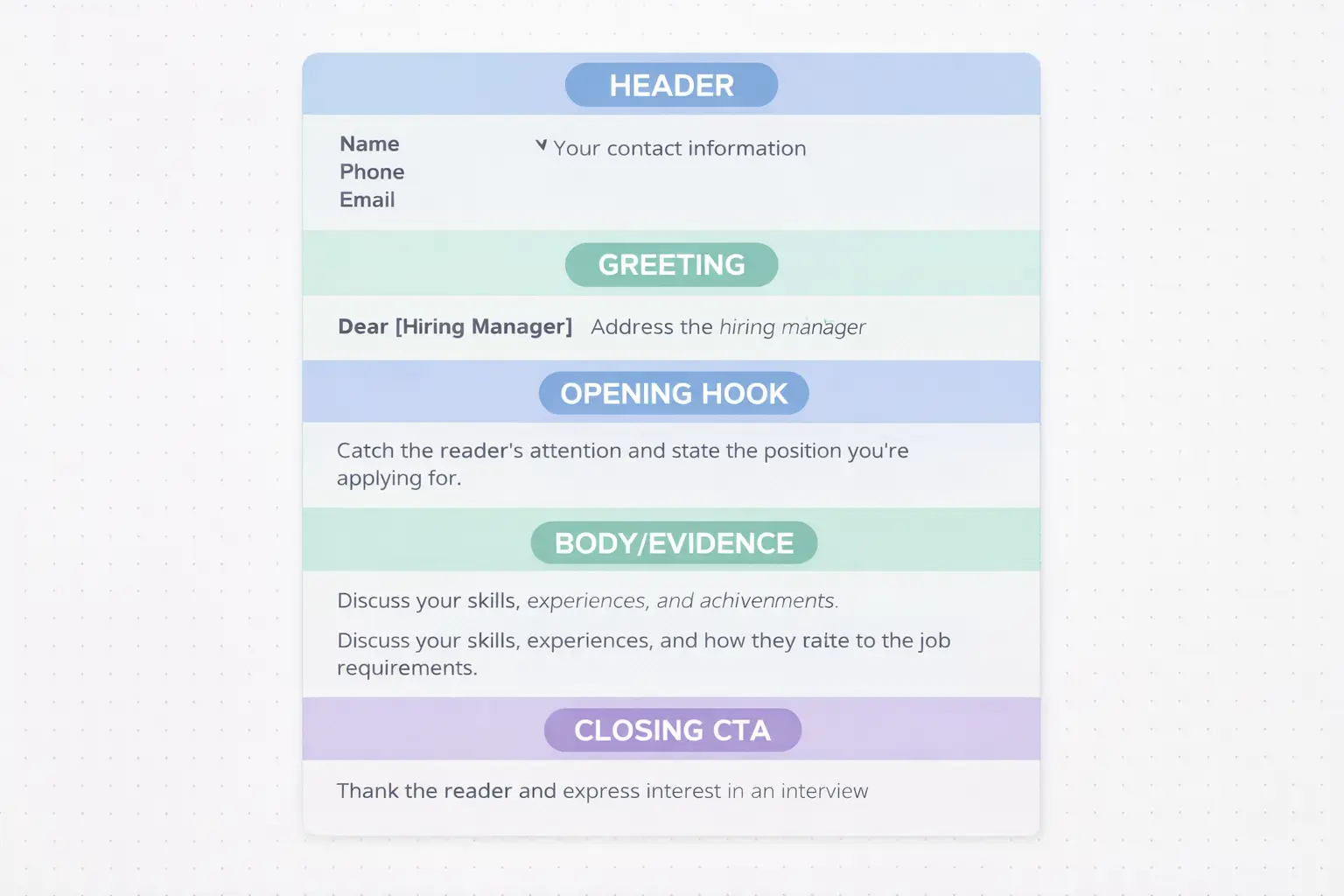
Every strong internship cover letter follows a four-part structure. Keep the entire letter to one page — three to four paragraphs is the sweet spot.
Header and Greeting
Start with your contact information, the date, and the company's details. Then address the letter to a specific person whenever possible. Check LinkedIn, the company's team page, or even call the front desk to find the hiring manager's name.
If you absolutely cannot find a name, "Dear [Department] Hiring Team" works better than "To Whom It May Concern," which reads like a letter from 1995.
Opening Paragraph: Hook Them Immediately
Your first paragraph needs to answer three questions in about two to three sentences: What position are you applying for? Why are you excited about this specific company? What makes you a strong candidate?
Skip generic openings. Instead, lead with something specific — a company project you admire, a product you use, or a value that resonates with you.
Weak opening: "I am writing to apply for the marketing internship at your company. I am a junior at State University majoring in marketing."
Strong opening: "When Greenhouse Capital's summer campaign turned sustainability data into shareable infographics that reached 2 million people, I bookmarked every single one. As a marketing junior at State University who's built analytics dashboards for three campus organizations, I'd love to bring that same data-meets-creativity energy to your team as a summer marketing intern."
See the difference? The strong version shows you know the company's work, connects your skills to their needs, and has energy.
Middle Paragraph(s): Prove Your Value
This is where you make your case. Since you likely don't have extensive professional experience, draw from coursework and academic projects, campus leadership and extracurricular activities, volunteer work or community involvement, part-time jobs (even unrelated ones), and personal projects or freelance work.
The key is connecting each example to the internship's requirements. Don't just list what you did — explain what you accomplished and why it matters for this role.
Use specific numbers whenever possible. "Managed social media" is forgettable. "Grew our club's Instagram following from 200 to 1,400 in one semester by creating a weekly content calendar" tells a story.
If the job description mentions specific skills or tools, address them directly. Hiring managers often scan for keyword alignment between the posting and your letter.
Closing Paragraph: End With Confidence
Your final paragraph should restate your enthusiasm, mention your availability, and include a clear call to action. Don't be passive — express that you'd welcome the chance to discuss how you can contribute.
Example: "I'd love the opportunity to discuss how my experience with data visualization and campaign analytics could support Greenhouse Capital's content team this summer. I'm available to start May 15 and can be reached at [email] or [phone]. Thank you for considering my application — I look forward to hearing from you."
Internship Cover Letter Examples
Example 1: Marketing Internship
> Dear Ms. Rodriguez,
>
> Your team's "Small Business Spotlight" series on LinkedIn caught my attention because it does exactly what I've been studying — turning customer stories into content that drives engagement. As a communications major at Westfield University with hands-on experience managing a 5,000-follower campus media account, I'm excited to apply for the Summer Marketing Intern role at BrightPath Media.
>
> Last semester, I led a four-person team that redesigned our university newspaper's social strategy. We A/B tested headlines, introduced Reels content, and tracked engagement weekly. The result: a 73% increase in Instagram reach and a 40% jump in website traffic from social channels. I also completed a digital marketing certification through HubSpot Academy, where I built a mock campaign with full funnel tracking.
>
> These experiences taught me how to balance creative thinking with data analysis — a combination your job description emphasizes. I'm proficient in Canva, Google Analytics, and Hootsuite, and I'm a fast learner with new tools.
>
> I'd welcome the chance to bring my content creation and analytics skills to BrightPath's team this summer. I'm available full-time starting May 20 and would love to discuss how I can contribute. Thank you for your time and consideration.
>
> Sincerely,
> Jamie Chen
Why this works: It opens with a specific reference to the company's content, provides quantified results from a relevant project, mentions tools from the job description, and closes with clear availability.
Example 2: Software Engineering Internship
> Dear Engineering Hiring Team,
>
> Building the open-source budget tracker that 300 students now use at my university taught me something your engineering blog echoes: the best code solves real problems for real people. I'm a computer science junior at Oakdale Tech applying for the Summer Software Engineering Internship at DataFlow.
>
> Over the past year, I've built three full-stack applications using React, Node.js, and PostgreSQL. My budget tracker project — which I developed, deployed, and maintain on AWS — handles 1,200+ monthly active sessions. I've also contributed to two open-source projects on GitHub, fixing UI bugs and writing documentation that reduced new contributor onboarding time.
>
> In my algorithms course, I implemented a scheduling optimization system that reduced simulated processing time by 35%. I'm comfortable with agile workflows (I've used Jira and GitHub Projects in team settings) and enjoy code reviews as much as writing code.
>
> DataFlow's mission to make data infrastructure accessible aligns with my own interest in tools that simplify complexity. I'd love to discuss how my full-stack and open-source experience could contribute to your team this summer.
>
> Best regards,
> Priya Nair
Why this works: It leads with a relatable project, provides technical depth without being overwhelming, mentions the company's values, and demonstrates both individual and collaborative work.
Example 3: Finance Internship
> Dear Mr. Thompson,
>
> Managing a $50,000 simulated portfolio in my university's investment club — and outperforming the S&P 500 by 4.2% over two semesters — confirmed what I've known since my first economics class: I want to build a career in financial analysis. I'm writing to apply for the Summer Financial Analyst Intern position at Meridian Partners.
>
> As treasurer of the Economics Society, I manage a $12,000 annual budget, prepare quarterly financial reports for our faculty advisor, and introduced a new expense tracking system that cut budget reconciliation time in half. In my financial modeling course, I built a three-statement model for a real startup that was later used in their Series A pitch materials.
>
> I'm proficient in Excel (including VLOOKUP, pivot tables, and macros), have working knowledge of Bloomberg Terminal from my university's trading room, and recently completed a financial analysis specialization on Coursera.
>
> Meridian's focus on mid-market companies is particularly exciting to me — I believe that's where analytical rigor can have the most visible impact. I'd appreciate the opportunity to bring my modeling and analysis skills to your team.
>
> Sincerely,
> Alex Moreno
Why this works: It opens with a quantified achievement, connects academic and extracurricular finance experience, lists relevant technical skills, and shows genuine interest in the firm's focus area.
Common Mistakes to Avoid
Recycling the same letter for every application. Hiring managers can spot a generic cover letter instantly. If you could swap in any company's name without changing anything else, it's not tailored enough. Customize at least the opening paragraph and one body example for each application.
Summarizing your resume. Your cover letter should complement your resume, not repeat it. Use the letter to add context, tell stories, and show personality that bullet points can't capture.
Being too humble. Students often undersell themselves with phrases like "I'm just a student" or "I don't have much experience." You have more to offer than you think — frame your coursework, projects, and activities as the legitimate experience they are.
Writing a wall of text. Keep paragraphs short (two to four sentences). Use white space. Hiring managers scanning dozens of applications will skip dense blocks of text.
Forgetting to proofread. A single typo in a cover letter raises questions about your attention to detail. Read it out loud, use spell check, and ask a friend to review it before submitting.
How to Tailor Your Cover Letter for Each Internship
Tailoring doesn't mean rewriting from scratch every time. Build a base template, then customize three elements for each application.
The company-specific hook. Research something specific — a recent project, a company value, a product feature — and reference it in your opening. This takes five minutes of browsing their website or LinkedIn and makes a big difference.
The skill alignment. Read the job description carefully and identify the top two to three skills or qualifications. Make sure your body paragraphs address those specifically, even if you need to swap out which project or example you highlight.
The closing connection. Tie your closing to something unique about the company or team, not just "I'd love to work for a great company." Show you understand what makes this specific opportunity exciting.
Tools like Seekario's AI Cover Letter Generator can speed up this process significantly. It pulls relevant achievements from your resume and maps them to the job description's requirements, producing a personalized draft in seconds that you can refine with your own voice and details.
Formatting Tips That Make Your Letter Easy to Read
Keep your internship cover letter to one page — hiring managers spend an average of 30 seconds on an initial scan. Use a professional font like Calibri, Arial, or Garamond at 10 to 12 point size. Set margins between 0.75 and 1 inch on all sides.
Match your cover letter's header design to your resume for a cohesive look. If your resume uses a specific font or color accent, carry that through to your letter.
Save and submit as a PDF unless the application specifically requests .docx. PDFs preserve your formatting across different devices and operating systems.
Name the file professionally: "FirstName-LastName-Cover-Letter-CompanyName.pdf" makes it easy for recruiters to find your letter later.
Using AI to Write Your Internship Cover Letter (The Right Way)
AI tools can be a huge time-saver for cover letter drafts, but there's a right way and a wrong way to use them. The wrong way is pasting a job description into ChatGPT and submitting whatever comes out. Those letters sound robotic, lack personal details, and hiring managers are getting better at spotting them.
The right approach is using AI as a starting point and editor, not a ghostwriter. Seekario's AI Cover Letter Generator works differently from generic AI tools because it already has your resume data. It pulls your actual achievements, skills, and experience — then maps them to specific job requirements. The result is a personalized draft that sounds like you, not a template.
After generating a draft, always add your own voice. Include a personal anecdote, adjust the tone to match the company's culture, and make sure every claim is accurate. The goal is a letter that's 80% AI-assisted and 100% authentically you.
Cover Letter Checklist Before You Submit
Before hitting send, run through this quick quality check:
- Does your opening mention the specific company and role by name?
- Have you included at least one quantified achievement or specific result?
- Do your examples align with the top skills listed in the job description?
- Is the letter one page or less?
- Have you addressed the letter to a specific person (or at least the right department)?
- Does the closing include your availability and a clear call to action?
- Have you proofread for spelling, grammar, and formatting?
- Is the file saved as a PDF with a professional file name?
If you can check all of these boxes, your cover letter is ready.
FAQ
Do internships actually require cover letters?
Many internship postings list cover letters as "optional," but submitting one is almost always worth it. It differentiates you from candidates who only send a resume, and it gives you space to show enthusiasm and communication skills. The only exception is if the application system literally has no place to upload one.
How long should an internship cover letter be?
Aim for 250 to 400 words — roughly three to four paragraphs that fit on a single page. Hiring managers reviewing intern applications are often scanning quickly, so brevity and clarity beat length. Every sentence should earn its place.
What if I have no relevant experience for the internship?
You likely have more relevant experience than you realize. Class projects, group assignments, volunteer work, part-time jobs, and personal projects all count. Focus on transferable skills like communication, problem-solving, teamwork, and time management. Use specific examples even if they come from non-professional settings.
Should I use AI to write my internship cover letter?
AI tools like Seekario's AI Cover Letter Generator are great for creating a solid first draft quickly, especially when you're applying to multiple internships. The key is to personalize the output — add your own stories, adjust the tone, and make sure every detail is accurate. Use AI as a starting tool, not a finished product.
How do I address a cover letter when I don't know the hiring manager's name?
Try LinkedIn, the company's website, or even calling the office to ask who manages internship hiring. If you still can't find a name, use "Dear [Department Name] Hiring Team" or "Dear Internship Selection Committee." Avoid "To Whom It May Concern" — it signals you didn't try to find out.
Start Writing Your Internship Cover Letter Today
Your internship cover letter doesn't need to be perfect — it needs to be specific, genuine, and well-structured. Show the hiring manager you've done your research, connect your experience (academic or otherwise) to their needs, and let your enthusiasm come through without sounding desperate.
If you want to save time while still producing personalized, high-quality cover letters, Seekario's AI Cover Letter Generator can create a tailored draft from your resume and the job description in seconds. You can also use the AI Resume Builder to make sure your resume is polished and ATS-ready before you start writing your letter.
The internship you want is competitive. A strong cover letter is one of the few things completely within your control — make it count.