Resume Summary vs Resume Objective: Which One Gets You Hired?

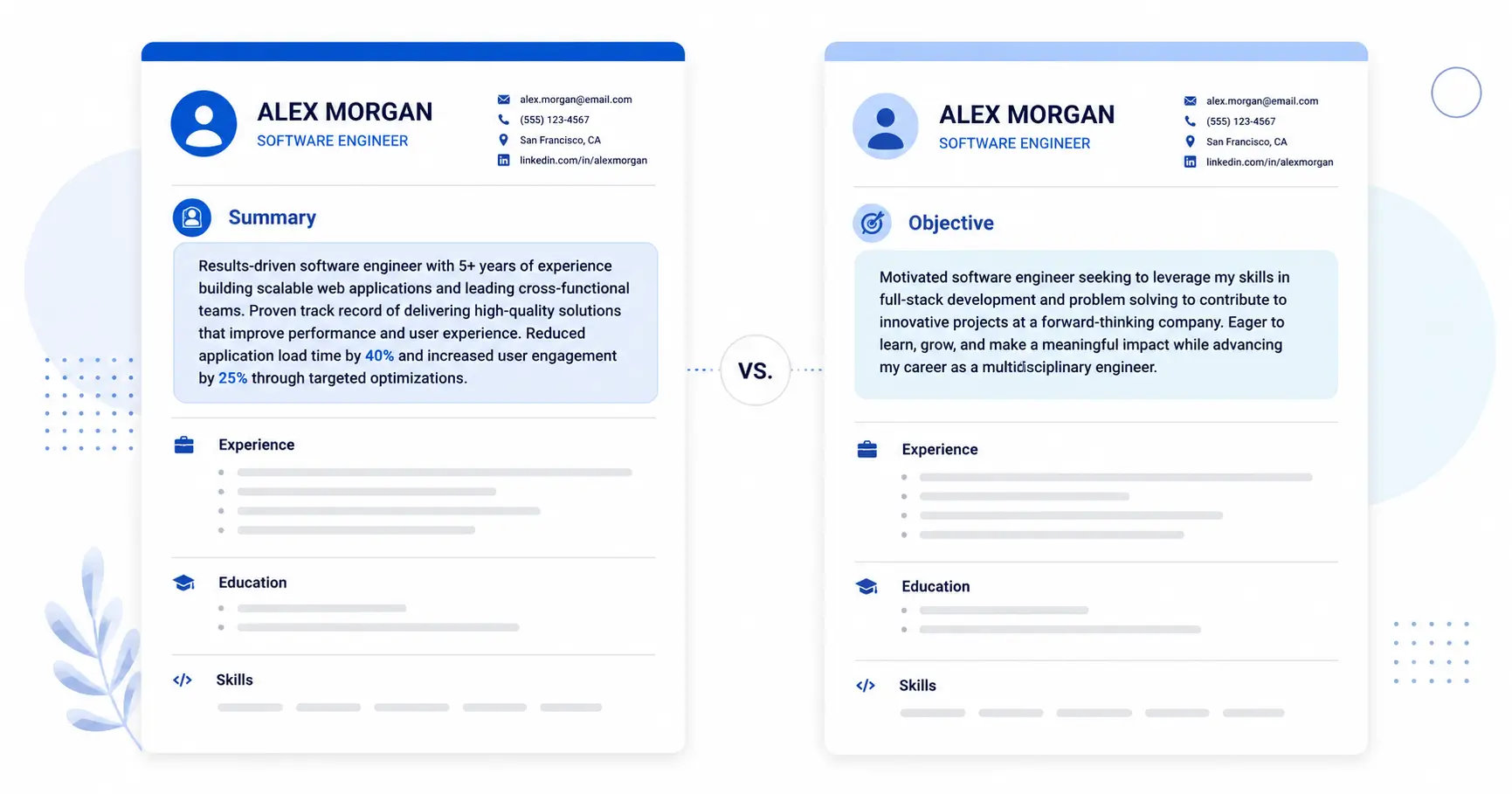
That two-to-three line section at the top of your resume carries outsized weight. Recruiters spend roughly six seconds scanning before making a keep-or-toss decision, and the opening statement is the first thing they read. So should you write a professional summary or a career objective?
The short answer: it depends on where you are in your career. But data strongly favors one option for most job seekers. This guide breaks down exactly what each section does, when each works best, and gives you a simple decision framework so you never second-guess your choice again.
What Is a Resume Summary?
A resume summary (also called a professional summary or qualifications summary) is a 2–4 sentence paragraph that highlights your most relevant experience, key skills, and measurable accomplishments. It answers the recruiter's unspoken question: "What can this person do for us?"
Example:
> Results-driven marketing manager with 7+ years leading B2B campaigns that generated $4.2M in pipeline revenue. Expert in paid media, marketing automation (HubSpot, Marketo), and cross-functional team leadership. Reduced cost-per-lead by 38% while scaling output 2x at a Series B SaaS company.
Notice how every sentence delivers proof. Numbers, tools, outcomes — a summary sells your track record.
What Is a Resume Objective?
A resume objective is a 1–2 sentence statement that communicates your career goal and what you hope to accomplish in the role you're applying for. It answers: "Why am I here, and what do I want?"
Example:
> Recent computer science graduate seeking an entry-level software engineering role where I can apply my Python and React skills to build user-facing products while growing under experienced mentors.
Objectives focus forward. They explain intent rather than showcasing a history of results.
Key Differences at a Glance
The data is clear: resumes with professional summaries receive significantly more interview callbacks than those with traditional objectives. Why? Summaries demonstrate value immediately, while objectives consume prime real estate talking about what *you* want rather than what you *offer*.
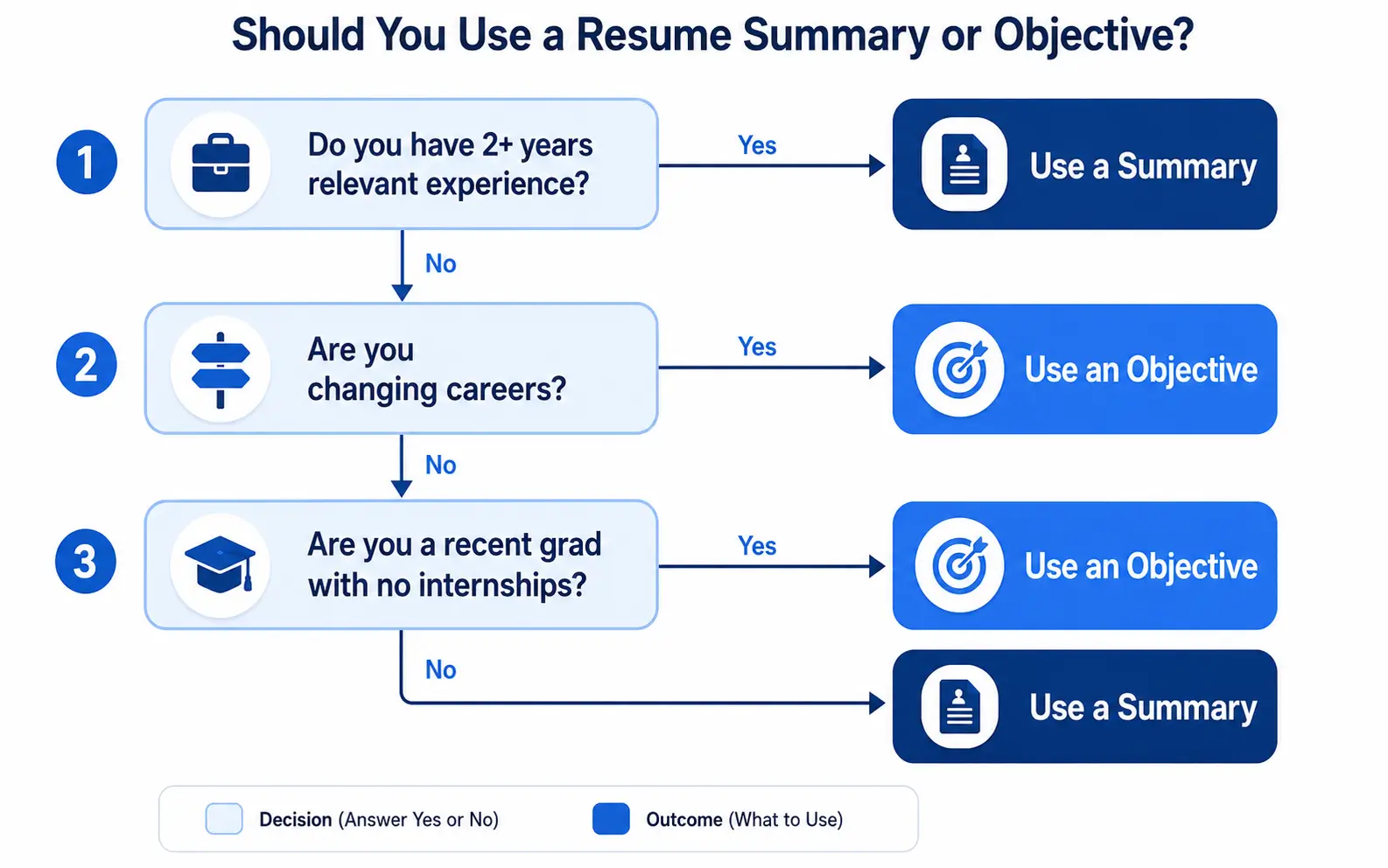
When to Use Each: The Decision Framework
Use a Summary When:
- You have 2+ years of relevant work experience
- You're staying in the same industry or a closely related one
- You can point to measurable accomplishments
- You want to rank higher in ATS keyword scans
This covers roughly 85% of job seekers. If you have a track record — even a short one — a summary outperforms an objective every time.
Use an Objective When:
- You're entry-level with zero professional experience. No internships, no relevant jobs, nothing to summarize. An objective explains your direction and connects your coursework or projects to the role.
- You're making a radical career change. If your entire work history is in hospitality and you're applying for a junior data analyst role, a summary of restaurant management achievements will confuse the reader. An objective bridges that gap by stating your pivot clearly.
- You're re-entering the workforce after a long gap. An objective can acknowledge the transition without drawing extra attention to the gap itself.
Outside these three scenarios, default to a summary.
The Hybrid Approach: Best of Both Worlds
Some candidates benefit from combining elements of both — a "hybrid statement" that opens with a brief objective clause, then immediately pivots to proof.
Example (career changer):
> Transitioning from 5 years in financial analysis to product management, bringing deep expertise in data-driven decision making, stakeholder communication, and cross-functional collaboration. Led a pricing optimization project that increased subscription revenue by 22%, demonstrating product thinking within a finance role.
This works because it quickly states intent (the objective part), then backs it up with relevant evidence (the summary part). You get clarity *and* credibility in one section.
When to use the hybrid:
- Mid-career pivots where your experience is relevant but not obvious
- Industry-adjacent moves (e.g., engineering to engineering management)
- When a job description specifically asks about your goals
How to Write a Winning Summary or Objective
Regardless of which format you choose, follow these principles:
1. Tailor to every application. Mirror 2–3 key requirements from the job description. An AI Resume Tailor can match your experience to specific job postings in seconds.
2. Lead with your strongest qualifier. Years of experience, a notable company name, a certification, or a headline achievement — put the most impressive element first.
3. Include keywords naturally. ATS systems scan this section heavily. Work in the exact phrases from the job posting without stuffing.
4. Keep it concise. Two to four sentences maximum. If it reads like a full paragraph, you've written too much.
5. Avoid generic filler. Phrases like "hard-working professional seeking growth opportunities" tell recruiters nothing. Every word should earn its place.
Need help crafting a summary that hits all these marks? The AI Resume Builder generates tailored professional summaries based on your experience and target role.
Common Mistakes to Avoid
Using an objective when you have experience. If you've held relevant roles, an objective undersells you. Summaries convert better because they prove competence rather than state ambition.
Writing a generic statement for every application. A one-size-fits-all opening section signals laziness to recruiters who read hundreds of resumes daily.
Making it too long. More than four sentences and recruiters skip the section entirely. Brevity wins.
Focusing entirely on yourself. Even objectives should hint at the value you'll bring. Reframe "I want to learn" as "eager to contribute X while developing Y."
FAQ
Is a resume objective outdated?
For most professionals, yes. Objectives were standard in the 1990s and early 2000s, but modern recruiting strongly favors summaries that demonstrate immediate value. The exception: entry-level candidates and career changers who genuinely have nothing relevant to summarize.
Can I use both a summary and an objective on the same resume?
Don't include both as separate sections — it wastes space and confuses the reader. Instead, use the hybrid approach described above if you need elements of both.
What if I'm a recent graduate with internship experience?
If you completed relevant internships, you have enough material for a summary. Treat internships as professional experience and highlight your accomplishments there.
How long should a resume summary or objective be?
Two to four sentences, or roughly 40–60 words. Recruiters spend seconds on this section — make every word count.
Do ATS systems treat summaries and objectives differently?
ATS software scans for keywords regardless of the section label. However, summaries naturally contain more role-relevant terminology (tools, skills, metrics) than objectives, giving them a practical advantage in keyword matching.
Make Your Opening Statement Work Harder
Whether you choose a summary or objective, this section sets the tone for your entire application. Get it right, and you hook the recruiter in those crucial first seconds.
If you're unsure which format fits your situation — or you want a professionally written statement in seconds — try the AI Resume Builder. It analyzes your background and target role to generate a tailored opening section that follows recruiter-backed best practices.