The STAR Method: How to Answer Any Interview Question

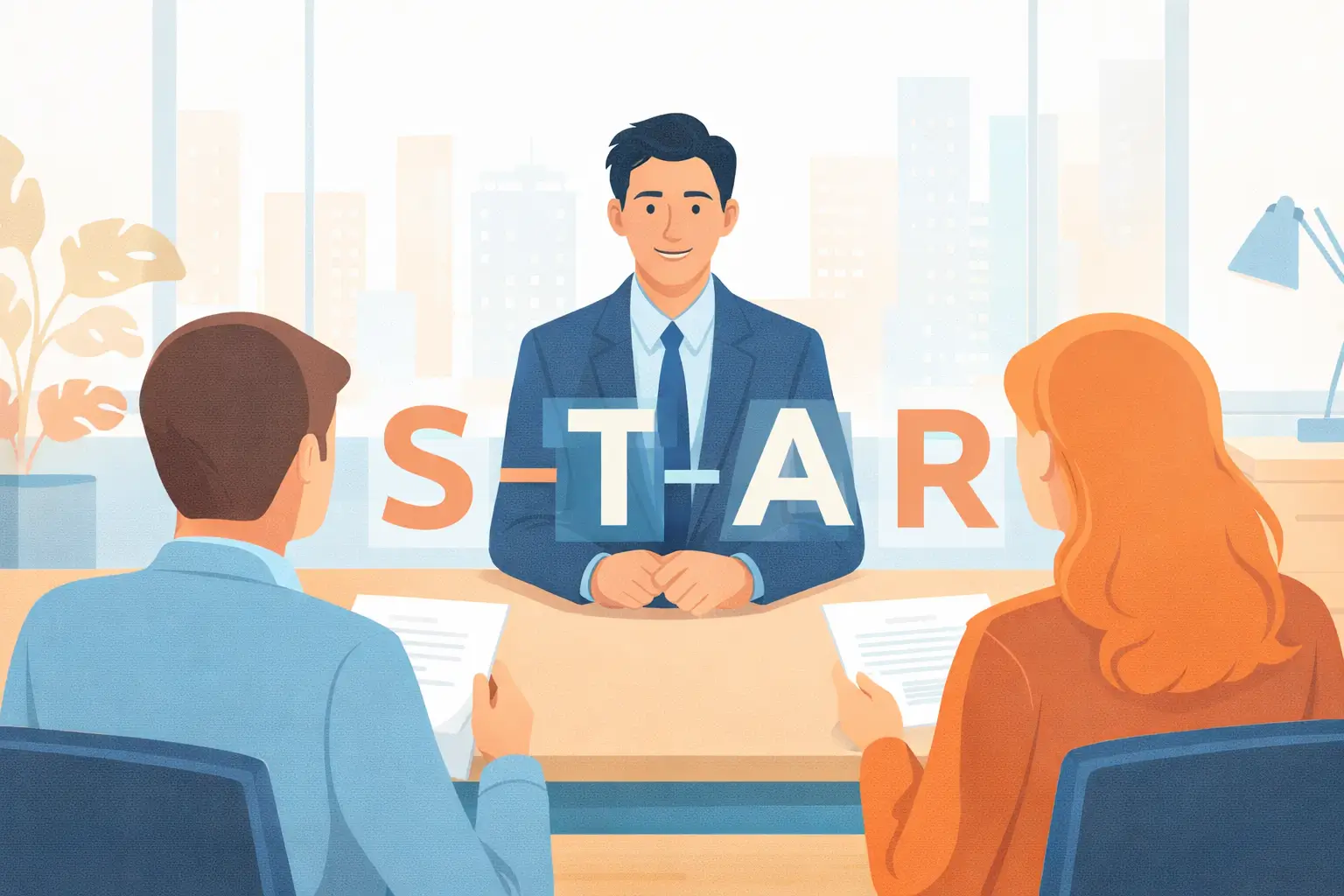
You walk into an interview feeling confident. Then the hiring manager says, "Tell me about a time you handled a difficult situation at work." Your mind goes blank. You ramble for two minutes. You leave thinking, *I could have said that so much better.*
Sound familiar? That's exactly the problem the STAR method solves. It gives you a repeatable framework for turning your real experiences into clear, compelling interview answers — every single time.
Whether you're interviewing for your first job or your fifth promotion, the STAR method is the single most effective way to handle behavioral interview questions. And since roughly 73% of employers now use behavioral interviews, you can't afford to skip this.
What Is the STAR Method?
STAR stands for Situation, Task, Action, Result. It's a structured way to answer behavioral interview questions — those "Tell me about a time when…" prompts that hiring managers love.
Instead of giving a vague or rambling response, STAR forces you to organize your answer into a mini-story with a clear beginning, middle, and end. Each letter represents one part of that story:
- Situation — Set the scene. Where were you? What was happening?
- Task — What was your responsibility or goal?
- Action — What did you specifically do?
- Result — What happened because of your actions?
The beauty of STAR is its simplicity. Once you internalize this four-part structure, you can answer virtually any behavioral question without freezing up or going off on tangents.
Why Interviewers Use Behavioral Questions
Before diving deeper into the technique, it helps to understand why you're being asked these questions in the first place.
Behavioral interviewing is built on one core principle: past behavior is the best predictor of future behavior. When a hiring manager asks you to describe a real situation, they're evaluating how you actually handled something — not how you think you'd handle a hypothetical.
Here's what they're really assessing:
- Problem-solving skills — Can you think on your feet?
- Communication — Can you explain a complex situation clearly?
- Self-awareness — Do you understand your role in team outcomes?
- Cultural fit — Do your values align with the company's?
According to LinkedIn's research, 91% of talent professionals believe soft skills are equally or more important than hard skills. Behavioral questions are the primary way companies evaluate those soft skills.
Breaking Down Each STAR Component
Let's look at each part of the framework in detail, including how much time to spend on each section.
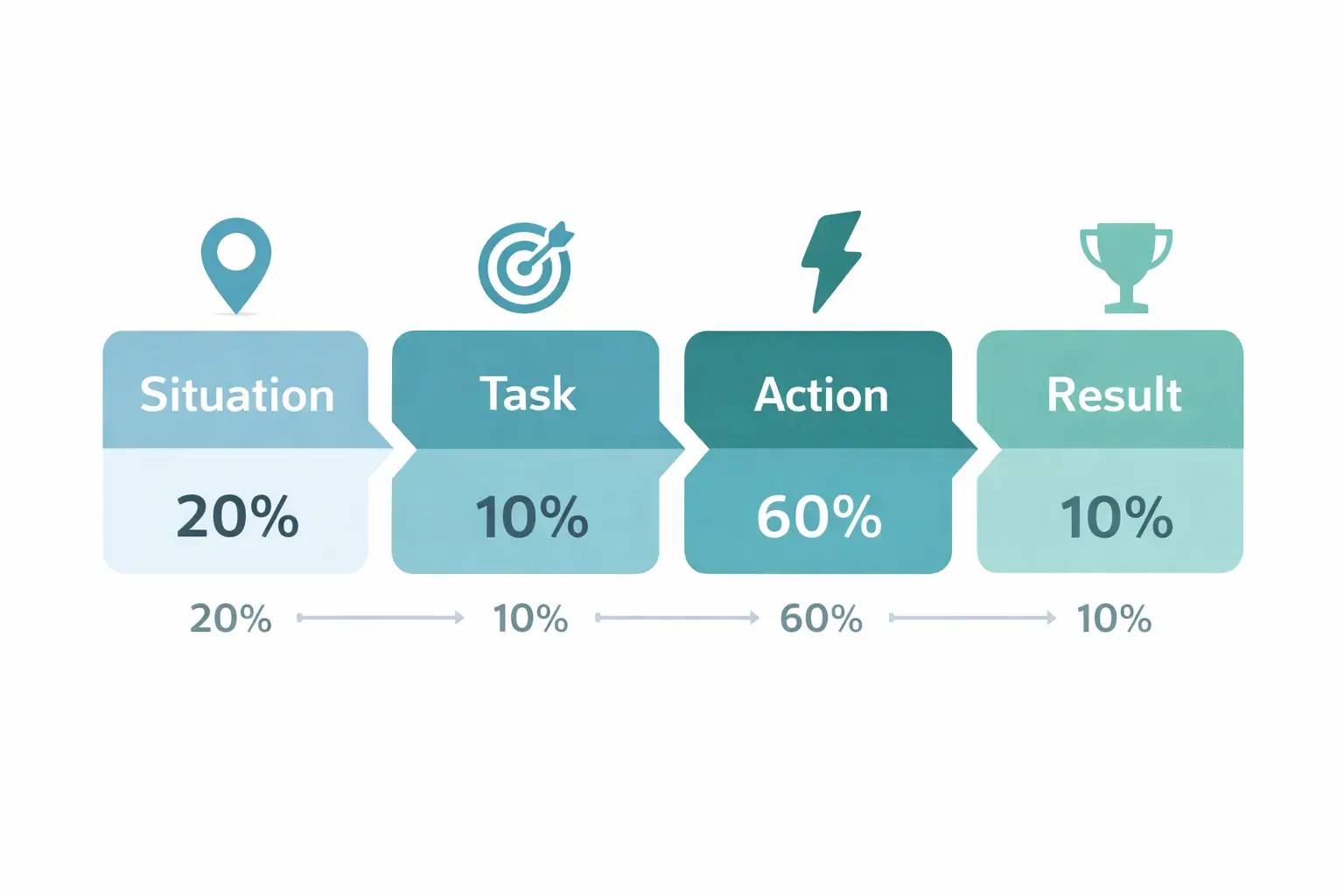
Situation (About 20% of Your Answer)
Start by describing the context. Give just enough background so the interviewer understands the setting. Think of it like the opening scene of a movie — brief but vivid.
Keep it to 2–3 sentences. If you're spending more than 30 seconds on the situation, you're giving too much detail.
Good situation setups include:
- "I was working as a project coordinator at a mid-size marketing agency. We had just landed a new client with a tight six-week turnaround."
- "During my second year as a sales rep, our team was tasked with expanding into a new regional market that had zero brand recognition."
Common mistake: Spending too long setting up the backstory. Interviewers don't need the full history — they need context.
Task (About 10% of Your Answer)
This is the shortest section. Explain what was expected of you specifically. What was your role? What goal were you working toward?
The task is different from the situation. The situation is the environment; the task is your assignment within it.
Example: "My job was to create a project timeline that kept us on schedule while managing the client's expectations for weekly deliverables."
Action (About 60% of Your Answer)
This is the heart of your answer. Describe exactly what *you* did — not what your team did, not what your manager suggested. You.
Use "I" statements throughout this section. Interviewers are evaluating your skills and decision-making, so they need to hear about your personal contributions.
Be specific. Instead of saying "I improved the process," say "I created a shared tracking spreadsheet, set up daily 15-minute standups, and personally reviewed each deliverable before it went to the client."
Pro tip: This is where you demonstrate the skills the job posting calls for. If the role requires leadership, show leadership. If it requires attention to detail, show attention to detail.
Result (About 10% of Your Answer)
End with what happened. Ideally, share a quantifiable outcome: revenue generated, time saved, percentage improvement, customer satisfaction score, or team performance metric.
Strong result statements sound like:
- "We delivered the project two weeks early, and the client renewed for a 12-month contract worth $180K."
- "Customer complaints dropped by 35% within the first quarter after I implemented the new system."
- "I was promoted to team lead within six months based on my performance during that project."
If the outcome wasn't entirely positive, that's okay. End with what you learned and how you applied it going forward. Hiring managers appreciate self-awareness.
STAR Method Examples for Common Questions
Let's walk through three real examples so you can see the framework in action.
Example 1: "Tell me about a time you handled a tight deadline."
Situation: "Last year, I was a content manager at a B2B software company. Two weeks before a major product launch, our lead copywriter resigned unexpectedly."
Task: "I needed to produce all launch materials — landing pages, email sequences, and social posts — on the original timeline with no additional headcount."
Action: "I audited all pending deliverables and prioritized based on launch-day impact. I drafted the landing page and email sequence myself, outsourced social media copy to a vetted freelancer I'd worked with before, and set up a shared review calendar so the product team could approve everything in one pass instead of piecemeal."
Result: "We launched on time with all materials live. The landing page converted at 4.2%, which was 15% above our benchmark. My director cited it as one of the smoothest launches that quarter."
Example 2: "Describe a time you disagreed with a coworker."
Situation: "I was on a cross-functional team developing a new onboarding flow for our mobile app. The UX designer and I disagreed about whether to use a multi-step wizard or a single-page form."
Task: "I needed to advocate for the approach I believed was best for users while maintaining a productive working relationship."
Action: "Instead of debating opinions, I suggested we run a quick A/B test with 200 users from our beta group. I set up both prototypes in Figma, coordinated the test with our research team, and compiled the results into a one-page summary for the team."
Result: "The data showed the multi-step wizard had a 28% higher completion rate. The designer appreciated the data-driven approach, and we shipped the wizard version on schedule. Our onboarding completion rate improved by 22% in the first month."
Example 3: "Tell me about a time you failed."
Situation: "During my first year as a project manager, I was leading a website redesign for an internal client."
Task: "I was responsible for keeping the project within scope and on budget."
Action: "I underestimated the time needed for the QA phase because I relied on estimates from a previous, simpler project. When bugs piled up in the final week, I had to request a two-week extension and additional QA resources. I also created a post-mortem document analyzing where my estimation went wrong and built a new estimation template that accounted for project complexity scoring."
Result: "The project launched two weeks late, but with zero critical bugs. More importantly, my new estimation template was adopted by the PM team and reduced timeline overruns by 40% over the next two quarters."
How to Prepare Your STAR Stories
You don't need a unique story for every possible question. Career coaches recommend preparing 6 to 8 versatile stories that you can adapt to different themes.
Step 1: Identify Your Best Stories
Think about experiences that showcase:
- Overcoming a challenge
- Leading a team or initiative
- Solving a problem creatively
- Handling conflict or disagreement
- Delivering results under pressure
- Learning from a mistake
Step 2: Map Stories to Common Themes
One strong story can often answer multiple questions. For example, a story about managing a difficult client could work for questions about communication, conflict resolution, working under pressure, or customer service.
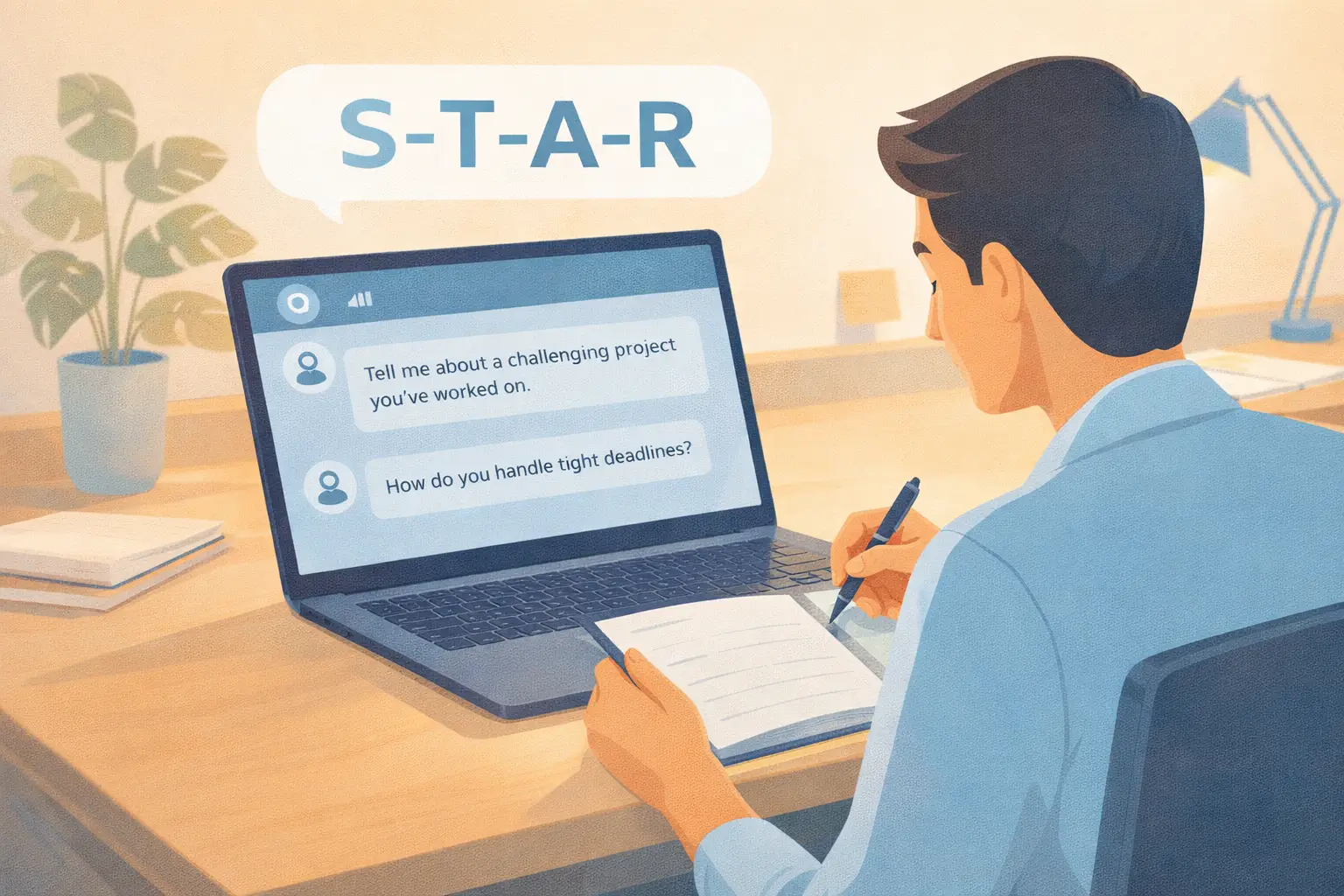
Step 3: Practice Out Loud
Write out your STAR responses, then practice delivering them verbally. Aim for 60 to 90 seconds per answer. Use a timer. If you're going over two minutes, trim the situation and expand the action.
Step 4: Use AI to Practice
Tools like Seekario's AI Interview Prep can simulate real behavioral interviews, give you feedback on your answers, and help you refine your STAR stories before the real thing. Practicing with an AI interviewer helps you get comfortable with the format without the pressure of a live audience.
15 Behavioral Questions to Practice With the STAR Method
Here are questions you're likely to encounter, organized by skill area:
Leadership:
- Tell me about a time you led a team through a difficult project.
- Describe a situation where you had to make an unpopular decision.
- Give an example of when you mentored or coached someone.
Problem-Solving:
- Tell me about a time you solved a problem with limited resources.
- Describe a situation where you had to think on your feet.
- Give an example of when you identified a problem before it became critical.
Communication:
- Tell me about a time you had to explain something complex to a non-technical audience.
- Describe a situation where miscommunication caused an issue and how you resolved it.
Teamwork:
- Give an example of a successful collaboration with someone from a different department.
- Tell me about a time you had to work with someone whose style was very different from yours.
Adaptability:
- Describe a time when priorities changed suddenly. How did you handle it?
- Tell me about a time you had to learn a new skill quickly to complete a task.
Failure and Growth:
- Tell me about your biggest professional failure and what you learned.
- Describe a time when you received tough feedback. What did you do with it?
- Give an example of a project that didn't go as planned and how you adapted.
Preparing STAR answers for even half of these questions puts you ahead of most candidates. If you want targeted practice, Seekario's AI Interview Prep tool generates role-specific behavioral questions based on the job you're applying for.
Common STAR Method Mistakes (and How to Avoid Them)
Even people who know about STAR make these errors:
Mistake 1: Being Too Vague
"I improved the process and things got better" tells the interviewer nothing. Replace vague language with specifics: names of tools, exact actions, measurable outcomes.
Mistake 2: Focusing on the Team Instead of Yourself
"We decided to restructure the workflow" should become "I proposed restructuring the workflow and led the implementation." Interviewers want to know what *you* contributed.
Mistake 3: Skipping the Result
Some candidates tell a great story but forget to land the ending. Always close with what happened — even if it's a learning moment rather than a win.
Mistake 4: Memorizing Scripts Word for Word
Rehearsed answers sound robotic. Know the key beats of your story, but let the exact words come naturally in conversation.
Mistake 5: Choosing Weak Examples
Pick stories with real stakes and clear outcomes. "I organized a team lunch" doesn't carry the same weight as "I reorganized our QA process and cut defect rates by 30%."
How to Adapt STAR for Different Interview Formats
Video Interviews
Keep your answers slightly shorter (60–75 seconds). Make eye contact with the camera during your action and result sections. Virtual interviews can feel less personal, so make your stories extra vivid with concrete details.
Panel Interviews
Direct your situation setup to the whole panel, but focus your action and result sections toward the person who asked the question. Brief eye contact with other panelists keeps everyone engaged.
Phone Screens
Without visual cues, clarity matters even more. Signal your structure out loud: "Let me give you some context on the situation first, then walk through what I did."
Using the STAR Method Beyond Interviews
The STAR framework isn't just for interviews. It's useful any time you need to communicate a professional accomplishment clearly:
- Resume bullet points — Structure your achievements as mini-STAR statements. Seekario's AI Resume Builder can help you turn work experiences into STAR-formatted accomplishments.
- Performance reviews — Use STAR to present your contributions with context and measurable results.
- Cover letters — A short STAR example in a cover letter makes your qualifications concrete. Try Seekario's AI Cover Letter Generator to see how AI can weave STAR stories into compelling cover letters.
- LinkedIn summaries — STAR-style achievements make your profile stand out to recruiters.
FAQ
What does STAR stand for in an interview?
STAR stands for Situation, Task, Action, and Result. It's a structured method for answering behavioral interview questions by describing a specific experience in four clear parts. The framework helps you give organized, compelling answers instead of rambling or giving vague responses.
How long should a STAR method answer be?
Aim for 60 to 90 seconds. Spend about 20% on the situation, 10% on the task, 60% on the action, and 10% on the result. If your answer exceeds two minutes, trim the situation section and focus more on your specific actions and outcomes.
Can I use the same STAR story for multiple questions?
Yes. Career coaches recommend preparing 6 to 8 strong stories that can flex across different themes. One story about a challenging project could answer questions about leadership, problem-solving, communication, or working under pressure — you just emphasize different parts of the action section depending on the question.
What if I don't have a positive result to share?
That's perfectly fine. Many interviewers specifically ask about failures or setbacks. If the result wasn't ideal, focus on what you learned and what you did differently going forward. Showing self-awareness and growth is often more impressive than a perfect outcome.
How do I practice the STAR method effectively?
Write out your stories using the four-part framework, then practice saying them out loud. Time yourself to stay under 90 seconds. Record yourself or practice with a friend. You can also use AI-powered tools like Seekario's AI Interview Prep to simulate behavioral interviews and get instant feedback on your answers.
Conclusion
The STAR method isn't complicated, but it is powerful. It transforms scattered thoughts into structured, persuasive answers that show hiring managers exactly what you bring to the table.
Start by picking your 6–8 best professional stories. Structure each one using Situation, Task, Action, and Result. Practice them out loud until they feel natural — not memorized, just comfortable.
If you want to take your preparation further, Seekario's AI Interview Prep generates tailored behavioral questions for any role and gives you real-time feedback on your STAR responses. It's like having a career coach available 24/7, right before your next big interview.