How to Tailor Your Resume to a Job Description (Step-by-Step)


Sending the same resume to every job opening is one of the fastest ways to get ignored. Recruiters spend an average of six to ten seconds scanning a resume, and if yours doesn't immediately signal that you're a fit for the role, it goes straight to the rejection pile. Worse, most companies now use Applicant Tracking Systems (ATS) that filter out resumes before a human ever sees them. The fix? Learning how to tailor your resume to a job description — every single time you apply. This guide walks you through the exact process, step by step, so you can stop wasting applications and start landing interviews.
Why Tailoring Your Resume Actually Matters
You might think a well-written resume should work for any job. But here's the reality: hiring managers aren't looking for generalists. They're looking for someone who solves their specific problem.
Data from over 3 million job seekers shows that tailored resumes are up to six times more likely to result in an interview compared to generic ones. That's not a marginal improvement — it's the difference between getting callbacks and hearing nothing for months.
There are two audiences you need to satisfy. First, the ATS software that scans your resume for keywords. If your language doesn't match the job description, the system deletes you before anyone reads a word. Second, the hiring manager who skims your resume looking for proof you can do the job. Tailoring addresses both problems at once.
Step 1: Build a Master Resume First
Before you tailor anything, you need source material. A master resume is a comprehensive document that includes every role you've held, every measurable achievement, all your technical skills, certifications, and notable projects.
Think of it as your career database. It should be too long to ever submit — three, four, even five pages is fine. Organize it by skill category or job function rather than strict chronology. When a new opportunity comes up, you'll pull the most relevant sections instead of trying to remember what you did three years ago.
Here's what to include:
- Every position with detailed bullet points covering your full scope of work
- Metrics and outcomes for as many accomplishments as possible
- Technical tools, software, and platforms you've used
- Certifications, training programs, and relevant coursework
- Projects, volunteer work, and leadership roles
This master resume saves hours over time. Instead of rewriting from scratch, you're curating and customizing.
Step 2: Analyze the Job Description Like a Recruiter
Most people skim job descriptions. That's a mistake. The job posting is literally a cheat sheet telling you what to put on your resume.
Start by reading the entire description carefully. Then go through it again and highlight or underline three things:
- Required skills and qualifications — these are non-negotiable. If you have them, they must appear on your resume.
- Preferred qualifications — these give you an edge. Include them if you can back them up.
- Repeated words and phrases — if a term appears multiple times, the employer considers it a priority.
Pay attention to the order of responsibilities listed. The first few bullet points usually signal the employer's top priorities. A job that leads with "manage cross-functional teams" values leadership. One that leads with "analyze data and generate reports" values technical execution.
Also look at the tone. A startup using casual language signals a different culture than a financial institution with formal phrasing. You can reflect this subtly in how you write your resume summary.

Step 3: Match Your Experience to Their Requirements
Now place your master resume next to the job description. Go through each requirement and find your best examples.
This is where most people go wrong. They list responsibilities instead of results. "Managed social media accounts" tells a hiring manager nothing. "Grew Instagram engagement by 47% in six months through a data-driven content strategy" tells them exactly what you can do.
For each key requirement in the job description, write or pull a bullet point that demonstrates:
- What you did (the action)
- How you did it (the method or tool)
- What happened (the measurable result)
If the job asks for project management experience and you led a product launch that came in under budget, that's your bullet point. If they want someone proficient in Salesforce and you used it daily for pipeline tracking, say so — and mention the results.
Don't stretch the truth. Tailoring means presenting your real experience in the most relevant light. It doesn't mean inventing skills you don't have.
Step 4: Mirror the Job Description's Language
Resume tailoring is, at its core, translation work. You're taking legitimate experience and presenting it using the employer's vocabulary.
If the job description says "collaborate cross-functionally," use that phrase instead of "worked with other teams." If they say "stakeholder management," don't say "talked to clients." The meaning is the same, but the language match matters — both for ATS scanning and for the recruiter's quick read.
Here are a few common swaps:
- "Helped with" → "Contributed to" or "Supported"
- "Was responsible for" → "Led" or "Managed"
- "Worked on" → "Developed" or "Executed"
- "Talked to customers" → "Engaged with clients" or "Managed client relationships"
Mirror their language, but keep it natural. Keyword stuffing is obvious and counterproductive. Use each important keyword one to three times across your resume — in your summary, skills section, and experience bullets.
Step 5: Restructure Your Resume Sections
Tailoring isn't just about words. It's about structure. The most relevant information should appear in the top third of your resume, because that's what gets read first.
Resume summary: Rewrite this for every application. In two to three sentences, connect your strongest qualifications directly to the role. Mention the job title, your years of relevant experience, and one or two key skills from the description.
Skills section: This should reflect the exact tools and abilities listed in the job posting — as long as you actually have them. Put the most critical skills first. If the job asks for Python, SQL, and Tableau, and you know all three, list them in that order.
Experience section: You may need to reorder your bullet points. Lead with the accomplishments most relevant to this specific role, even if they weren't the biggest part of your previous job. You can also reorder entire job entries if an older role is more relevant than your current one.
Education and certifications: If the job requires a specific degree or certification, move this section higher on the page.
Tools like Seekario's AI Resume Tailor can speed up this process significantly. Instead of manually comparing your resume to each job description, the AI identifies gaps and suggests targeted edits — saving you time while keeping the quality high.
Step 6: Optimize for ATS Without Over-Optimizing
Applicant Tracking Systems are gatekeepers. About 75% of resumes are rejected by ATS before a human ever sees them. But beating the system isn't about gaming it — it's about clear, honest alignment.
Do this:
- Use standard section headings like "Work Experience," "Education," and "Skills"
- Include exact keywords from the job description
- Stick to simple formatting — no tables, columns, graphics, or headers/footers
- Save as a .docx or .pdf (check the application instructions)
- Use standard fonts like Arial, Calibri, or Times New Roman
Don't do this:
- Don't hide white keywords on a white background (ATS systems catch this, and if they don't, recruiters will)
- Don't stuff keywords unnaturally into every sentence
- Don't use creative resume templates with complex layouts
- Don't use abbreviations without also spelling out the full term (write "Search Engine Optimization (SEO)" the first time)
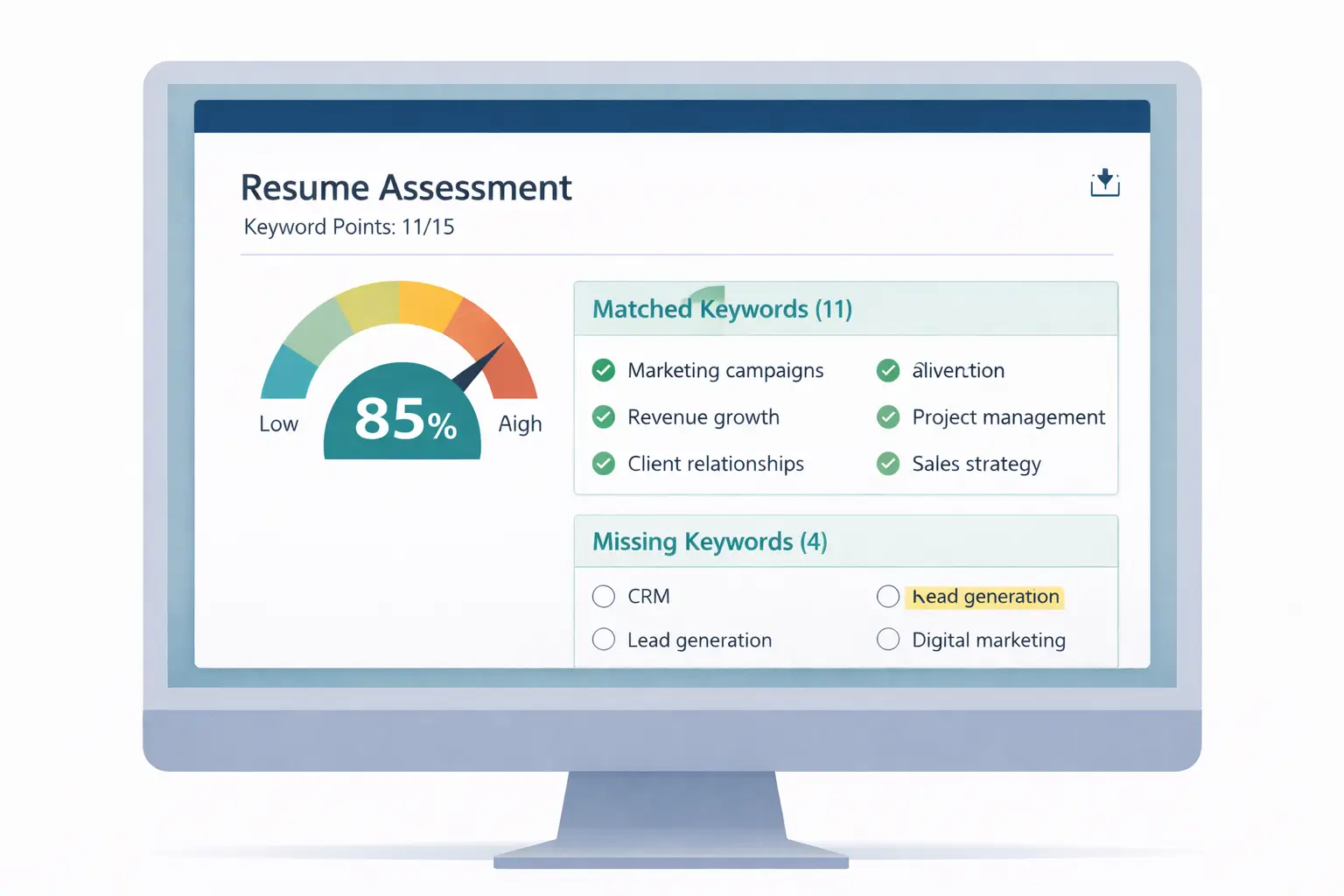
If you want to check how well your resume matches a specific job description, Seekario's AI Resume Scanner scans your resume against the posting and gives you an actionable match score with specific suggestions for improvement.
Step 7: Customize Your Cover Letter Too
A tailored resume paired with a generic cover letter sends mixed signals. Your cover letter should reinforce the same story: you understand what this role needs and you're the person who delivers it.
Reference specific requirements from the job description and explain how your experience addresses them. Keep it concise — three to four paragraphs maximum. The cover letter fills in context that bullet points can't capture, like why you're drawn to this company or how a particular project prepared you for this exact role.
Need help writing a targeted cover letter fast? Seekario's AI Cover Letter Generator creates role-specific cover letters that align with your tailored resume, so both documents tell a consistent story.
Common Resume Tailoring Mistakes to Avoid
Even people who understand the concept make avoidable errors. Watch out for these:
Copying the job description verbatim. Mirroring language doesn't mean copy-pasting. If your resume reads like a rewritten version of the posting, it looks lazy — and dishonest.
Over-tailoring to the point of misrepresentation. Emphasizing relevant experience is smart. Claiming expertise you don't have will surface during the interview and cost you the offer.
Only tailoring the skills section. Keywords in your skills list help with ATS, but hiring managers read your experience bullets. The tailoring needs to show up there too.
Forgetting to proofread. When you're editing quickly between applications, typos and formatting inconsistencies creep in. Always do a final review before submitting.
Tailoring for every job individually when you could batch similar roles. If you're applying to five similar marketing manager roles, create one tailored version for that job type and make minor adjustments for each company. You don't need to start from zero every time.
How Long Should Resume Tailoring Take?
With a solid master resume, tailoring should take 15 to 30 minutes per application. If it's taking longer, your master resume probably needs more detail, or you're applying to roles that are too far outside your experience.
Here's a quick checklist to run through for each application:
- Resume summary references this specific role
- Top skills from the job description appear in your skills section
- At least three to five experience bullets directly address key requirements
- Language mirrors the job posting's terminology
- Formatting is ATS-compatible
- File is saved with a professional name (e.g., "Jane-Smith-Marketing-Manager-Resume.pdf")
FAQ
How many times should I tailor my resume?
Every application deserves a tailored resume. At minimum, adjust your summary, skills section, and top bullet points. For roles you're very excited about, do a deeper customization of your entire experience section.
Is it okay to use AI to tailor my resume?
Yes, as long as you review the output carefully. AI tools like Seekario's AI Resume Tailor can identify keyword gaps and suggest stronger phrasing, but you should always verify that the final resume accurately represents your experience.
What if I don't have all the qualifications listed?
Apply anyway if you meet 60% to 70% of the requirements. Focus your tailoring on the qualifications you do have, and address gaps honestly in your cover letter by highlighting transferable skills or your willingness to learn.
Should I create a different resume for every job?
Not from scratch. Maintain a master resume and create tailored versions by adjusting your summary, reordering bullets, and updating your skills section. Batch similar roles together to save time.
How do I know if my tailored resume is working?
Track your application-to-interview rate. If you're getting callbacks on more than 10% of applications, your tailoring is effective. If not, revisit how closely you're matching the job description's language and requirements.
Start Tailoring Smarter, Not Harder
Tailoring your resume to each job description is the single most impactful thing you can do to improve your job search results. It gets you past the ATS, catches the recruiter's eye, and proves you're not just looking for any job — you're looking for this job.
The process doesn't have to be painful. Build a strong master resume, learn to read job descriptions strategically, and use tools that accelerate the work without sacrificing quality. Seekario's AI Resume Tailor analyzes job descriptions and suggests targeted edits to your resume in seconds — so you spend less time formatting and more time preparing for interviews.


