How to Write a Resume for Remote Jobs in 2026


Remote work isn't a perk anymore — it's a career path. With roughly 27% of full-time employees worldwide working remotely and another 52% in hybrid roles, the competition for work-from-home positions has never been fiercer. And that means your resume needs to do more than list your experience. It needs to prove you can thrive without an office, a manager looking over your shoulder, or a commute to keep you accountable.
The problem? Most resume advice still assumes you're applying for an on-site role. A remote job resume plays by different rules. Hiring managers are scanning for specific skills, tools, and proof that you can deliver results independently. This guide walks you through exactly how to build a resume that lands remote interviews.
Why a Remote Job Resume Is Different
When a company hires someone to sit in their office five days a week, they have built-in accountability structures. They can see you working. They can walk over and ask a question. Remote roles strip all of that away.
That's why hiring managers evaluating remote candidates look for a specific set of qualities that regular resumes don't always address:
- Self-direction: Can you manage your own time, set priorities, and hit deadlines without daily check-ins?
- Communication skills: Can you write clearly, run virtual meetings, and keep stakeholders informed asynchronously?
- Tech fluency: Are you comfortable with the collaboration tools that keep distributed teams running?
- Results orientation: Can you point to measurable outcomes rather than just listing responsibilities?
Your resume needs to answer all four questions within a few seconds of scanning. Here's how.
How to Format Your Remote Job Resume
Stick with a reverse-chronological format. It's the most ATS-friendly layout, and it lets hiring managers quickly see your career progression and recent remote experience.
Header and Contact Information
Skip the street address — it's irrelevant for remote roles and takes up space. Instead, use this format:
```
Jane Doe
Remote — Based in Austin, TX
jane.doe@email.com | (555) 123-4567 | linkedin.com/in/janedoe
```
Writing "Remote — Based in [City, State]" immediately signals that you're set up for remote work while giving recruiters your time zone context. Many remote companies care about time zone overlap, so including your location is still useful.
Professional Summary
Your summary is prime real estate. Use it to establish three things: your experience level, your remote work track record, and the value you bring.
Strong example:
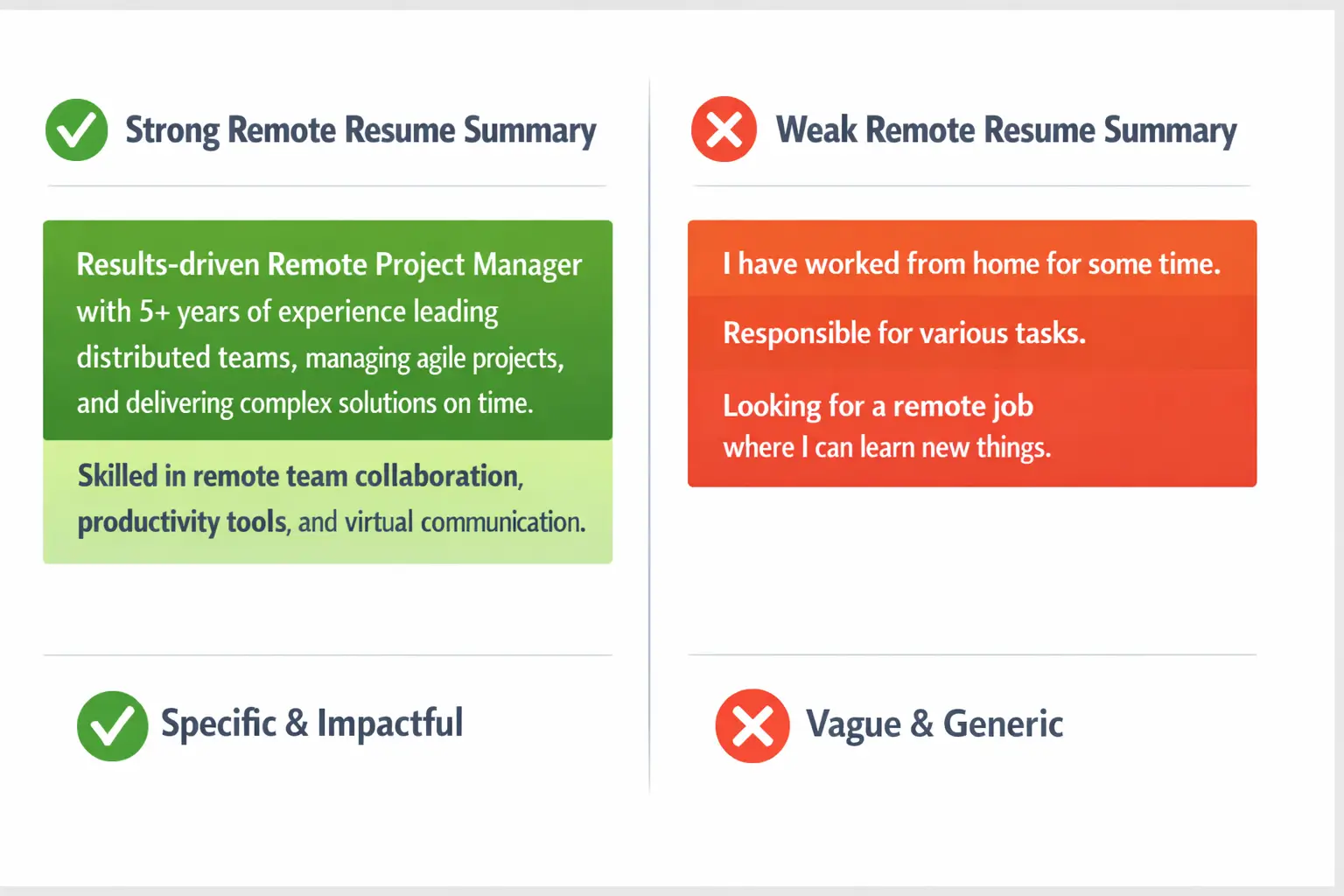
"Marketing manager with 6 years of experience leading fully remote teams across three time zones. Drove a 34% increase in qualified leads through content strategy and marketing automation. Skilled in asynchronous communication, project management with Asana, and cross-functional collaboration using Slack, Loom, and Notion."
Weak example:
"Experienced marketing professional looking for a remote position. Strong communicator and team player with a passion for digital marketing."
The first version is specific, measurable, and packed with remote-relevant keywords. The second could describe anyone.
Essential Skills for a Remote Work Resume
Hiring managers scanning remote job resumes look for a blend of soft skills and technical tools. Generic terms like "communication" and "organization" won't cut it. Be specific.
Remote-Specific Soft Skills
- Asynchronous communication
- Self-directed time management
- Virtual team collaboration
- Cross-cultural communication (for global teams)
- Written communication and documentation
- Proactive problem-solving
- Remote meeting facilitation
Collaboration and Productivity Tools
List the actual tools you use, not just categories. Here are the most in-demand ones for 2026:
- Communication: Slack, Microsoft Teams, Zoom, Google Meet, Loom
- Project management: Asana, Jira, Trello, ClickUp, Monday.com, Notion
- Documentation: Confluence, Google Docs, Notion
- Design and development: Figma, GitHub, VS Code, Miro
- CRM and sales: Salesforce, HubSpot, Zendesk
- Cloud storage: Google Drive, Dropbox, OneDrive
If a job description mentions specific tools, make sure those exact names appear on your resume. ATS software in 2026 relies heavily on keyword matching, and paraphrasing (writing "video calls" instead of "Zoom") can cost you.
Need help identifying the right keywords for a specific job posting? Seekario's AI Resume Tailor analyzes job descriptions and highlights the exact skills and tools you should include.
How to List Remote Work Experience
There's no single "correct" way to show remote work on a resume, but you need to make it obvious. Here are three proven approaches:
Option 1: Add "Remote" to the Job Title Line
```
Senior Product Designer (Remote)
Acme Corp | Jan 2023 – Present
```
Option 2: Replace the Location with "Remote"
```
Senior Product Designer
Acme Corp | Remote | Jan 2023 – Present
```
Option 3: Mention It in the First Bullet Point
```
Senior Product Designer
Acme Corp | Jan 2023 – Present
- Led product design for a fully distributed team of 12 across 4 time zones
```
Any of these works. The key is consistency — pick one style and use it throughout your resume.
Writing Achievement-Focused Bullet Points
Remote employers care about output, not activity. Every bullet point should follow the "accomplished X by doing Y, resulting in Z" framework.
Before (task-based):
- Managed social media accounts
- Attended weekly team meetings
- Created reports for leadership
After (achievement-based):
- Grew Instagram engagement by 47% over 6 months by implementing a data-driven content calendar and A/B testing post formats
- Led weekly cross-functional standups with 8 team members across 3 time zones using Zoom and async Loom updates
- Built automated reporting dashboards in Google Data Studio, reducing manual reporting time by 5 hours per week
The second set proves you can deliver results in a remote setting. It also naturally includes remote-relevant keywords that ATS systems pick up.
Optimizing Your Remote Resume for ATS
By late 2025, 83% of companies were using AI-powered resume screening. If your resume doesn't pass the ATS, a human never sees it. Here's how to optimize:
Formatting Rules
- Use a single-column layout with no tables, text boxes, or graphics
- Stick to standard fonts: Arial, Calibri, or Garamond (10–12pt)
- Use conventional section headings: "Work Experience," "Skills," "Education"
- Submit as .docx or a simple PDF (avoid designed PDFs with columns)
Keyword Strategy
- Read the job description carefully and mirror its exact language
- Include both the spelled-out term and the acronym (e.g., "Applicant Tracking System (ATS)")
- Place your highest-priority keywords in your summary and skills section
- Don't keyword-stuff — use each term naturally and in context
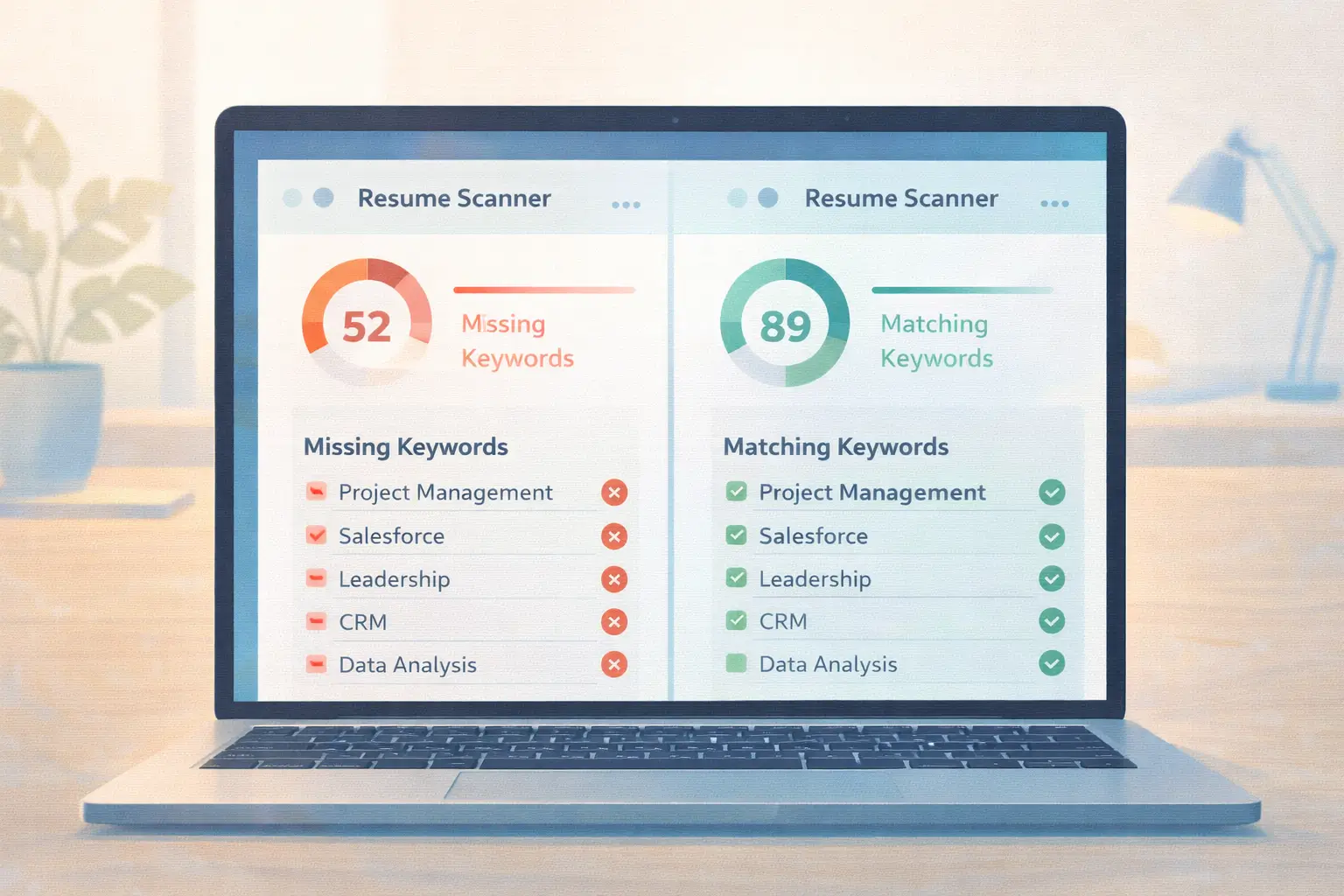
Want to check how well your resume matches a specific job posting? Seekario's AI Resume Scanner gives you a match score and tells you exactly which keywords you're missing.
Tailoring Your Resume for Each Remote Job
Sending the same resume to every job posting is the fastest way to get ignored. Each remote role has different expectations, tools, and priorities. Tailoring takes effort, but it's what separates candidates who get interviews from those who don't.
Here's a quick tailoring checklist:
- Read the full job description — highlight required skills, tools, and qualifications
- Match your summary — adjust your opening to reflect the specific role
- Reorder your skills — put the most relevant skills first
- Update your bullet points — emphasize experiences that align with the role's requirements
- Check for tool matches — if they mention Jira and you've used it, make sure it's on your resume
Doing this manually for every application is exhausting. Seekario's AI Resume Tailor automates the process — paste in a job description, and it adjusts your resume's keywords, skills, and phrasing to match.
Common Mistakes on Remote Job Resumes
Even experienced professionals make these errors when applying for remote roles:
Forgetting to mention remote experience at all. If you've worked remotely before, say so explicitly. Don't assume the hiring manager will figure it out from context.
Using vague skill descriptions. "Good communicator" means nothing. "Led daily async standups for a 10-person distributed team using Slack and Notion" tells a story.
Ignoring time zone context. If you've worked with teams across multiple time zones, highlight it. This is a major selling point for global companies.
Overdesigning the resume. Fancy templates with columns, icons, and graphics often break ATS parsing. Keep the design clean and simple.
Skipping the tools section. For remote roles, your tech stack matters almost as much as your experience. Dedicate a clear section to listing the collaboration tools you know.
Remote Resume Example: Before and After
Before:
*Summary:* Experienced project manager seeking a remote opportunity. Strong leadership and organizational skills.
*Skills:* Management, communication, Microsoft Office, leadership
After:
*Summary:* Project manager with 5 years of experience leading fully remote engineering teams (8–15 members) across US and European time zones. Delivered 12 product launches on schedule using Agile methodology. Expert in Jira, Confluence, Slack, and Zoom for distributed team coordination.
*Skills:* Agile/Scrum project management, Jira, Confluence, Slack, Zoom, asynchronous communication, stakeholder reporting, cross-functional team leadership, OKR tracking, risk management
The "after" version is specific, keyword-rich, and immediately communicates remote readiness.
FAQ
How do I list remote work on my resume if the company wasn't fully remote?
Add "(Hybrid-Remote)" or "(Remote — 3 days/week)" next to the job title or location. Be transparent about the arrangement, and use your bullet points to highlight the remote aspects of your work.
Should I include my home address on a remote job resume?
No. Replace your street address with "Remote — Based in [City, State]" to signal remote readiness while providing time zone context. Full home addresses are unnecessary and take up valuable space.
What if I have no remote work experience?
Focus on transferable skills that translate to remote work: self-directed project completion, written communication, experience with collaboration tools, and any freelance or independent work. Even managing a side project from home counts.
Do I need a different resume for remote vs. on-site jobs?
Yes. A remote job resume should emphasize different skills (communication tools, self-management, async collaboration) and format remote experience explicitly. Having a separate version tailored for remote applications will improve your results.
How do I pass ATS screening for remote jobs?
Use the exact keywords from the job description, stick to a simple single-column format, and include remote-specific terms like "distributed team," "async communication," and the names of specific tools mentioned in the posting.
Start Building Your Remote Resume Today
Landing a remote job in 2026 takes more than adding "Remote" to your header. You need a resume that proves you can communicate, collaborate, and deliver results without a physical office. Focus on specific tools, measurable achievements, and explicit remote experience — and tailor every application to the job you want.
If you want to move faster, Seekario's AI Resume Tailor can match your resume to any remote job description in seconds, making sure you hit the right keywords and skills every time. Try it free and see how your resume scores against real remote job postings.