Top 10 Behavioral Interview Questions and How to Answer Them


You've polished your resume, written a strong cover letter, and landed an interview. Then the hiring manager leans forward and says, "Tell me about a time when..." — and your mind goes blank. Sound familiar? Behavioral interview questions trip up even experienced professionals because they demand specific stories, not rehearsed talking points. The good news: once you understand the pattern behind these questions and prepare a handful of strong examples, you can walk into any interview feeling confident. This guide breaks down the ten behavioral interview questions you're most likely to face, explains exactly how to structure your answers, and gives you frameworks you can adapt to your own experience.
What Are Behavioral Interview Questions?
Behavioral interview questions ask you to describe how you handled real situations in previous jobs. Instead of hypothetical scenarios like "What would you do if...," they focus on what you actually did. The logic is simple: past behavior is the best predictor of future performance.
About 85% of companies now use behavioral questions as a core part of their interview process. You'll hear them in first-round phone screens, panel interviews, and final-round conversations alike. They show up across every industry and seniority level.
These questions typically start with phrases like:
- "Tell me about a time when..."
- "Describe a situation where..."
- "Give me an example of..."
- "Walk me through how you handled..."
The interviewer isn't looking for a perfect story. They want to understand your thought process, how you handle pressure, and whether you learn from your experiences.
The STAR Method: Your Answer Framework
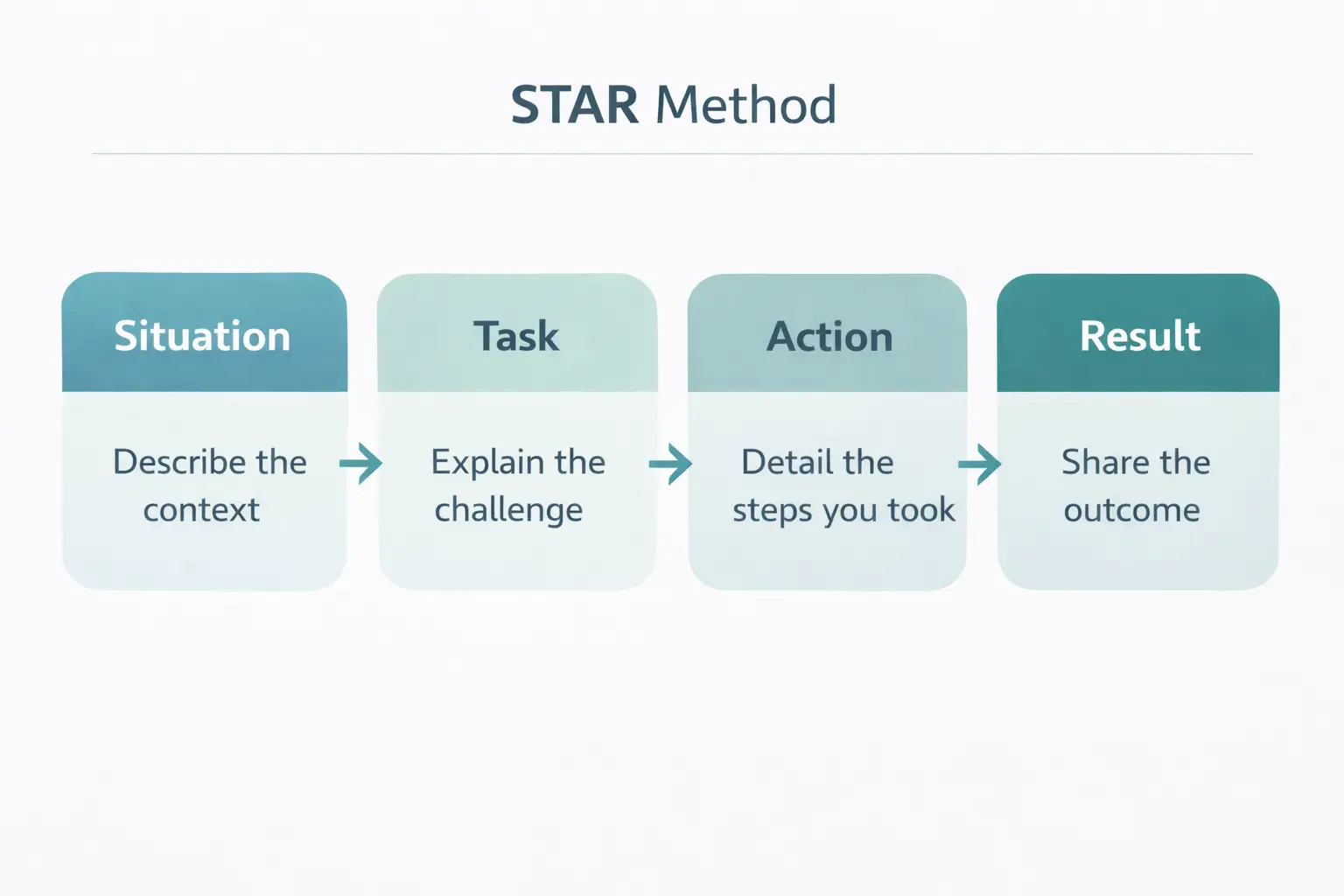
Before diving into specific questions, you need a reliable structure for your answers. The STAR method gives you one.
Situation: Set the scene. Where were you working? What was the context? Keep this brief — two to three sentences maximum. The interviewer needs just enough background to understand what follows.
Task: What was your specific responsibility or challenge? This is where you clarify your role in the situation. One clear sentence is usually enough.
Action: This is the heart of your answer. What did you actually do? Be specific about your decisions, steps, and reasoning. Spend the most time here — roughly 60 to 75 seconds in a spoken answer.
Result: What happened because of your actions? Quantify the outcome whenever possible. Even if the result wasn't perfect, explain what you learned and how it changed your approach.
Here's how the timing breaks down in practice:
- Situation: 15-20 seconds
- Task: 10-15 seconds
- Action: 60-75 seconds
- Result: 15-20 seconds
Total answer length: about two minutes. That's the sweet spot. Shorter feels thin. Longer loses the interviewer's attention.
One important rule: always talk about what *you* did, not what the team did. Interviewers are evaluating you specifically. Saying "we decided" or "the team implemented" gives them nothing to assess.
Question 1: "Tell Me About a Time You Faced a Difficult Challenge at Work"
What they're really asking: Can you problem-solve under pressure? Do you stay calm or do you panic?
This is the most common behavioral interview question across industries. The interviewer wants to see how you identify problems, think through options, and take decisive action.
How to answer it well:
Pick a challenge that was genuinely difficult — not something trivial. A tight deadline on a major deliverable, a project that went off the rails, or a resource constraint that forced creative thinking. Walk through your specific actions and emphasize the reasoning behind your decisions.
Framework:
- Situation: Brief context about the challenge
- Task: Your specific role in resolving it
- Action: The steps you took and why
- Result: The outcome, ideally with a metric (saved $X, reduced timeline by Y days, retained Z client)
Avoid blaming others. Even if the challenge was caused by someone else's mistake, focus on how you responded rather than who created the problem.
Question 2: "Describe a Time You Worked on a Team to Complete a Project"
What they're really asking: Are you collaborative? Can you work with people who have different working styles or opinions?
Nearly every role involves teamwork. This question gauges whether you contribute productively, handle disagreements constructively, and support shared goals.
How to answer it well:
Choose a project with a clear outcome. Describe your specific contribution — not just that you were on the team. Highlight how you communicated, divided responsibilities, or helped resolve a conflict within the group.
Framework:
- Situation: The project and team setup
- Task: Your specific role or responsibility
- Action: How you collaborated, contributed, and handled any friction
- Result: The project outcome and what the team achieved together
The strongest answers show both individual contribution and team awareness. Mention how you adapted to others' styles or supported a teammate who was struggling.
Question 3: "Tell Me About a Time You Had to Make an Unpopular Decision"
What they're really asking: Do you have the backbone to lead, even when it's uncomfortable?
This question tests leadership, conviction, and communication skills. The interviewer wants to know if you can make tough calls and bring people along — or at least handle the pushback professionally.
How to answer it well:
Pick a decision that had real stakes. Explain your reasoning, how you communicated the decision, and how you managed the fallout. The best answers show empathy alongside decisiveness — you understood why people disagreed, but you moved forward because it was the right call.
Framework:
- Situation: The context requiring the decision
- Task: Why the decision fell to you
- Action: How you made the call and communicated it
- Result: What happened, including how relationships were affected
Question 4: "Give Me an Example of When You Had Multiple Deadlines at Once"
What they're really asking: Can you prioritize, manage your time, and deliver quality work when everything feels urgent?
Time management and prioritization are consistently among the top skills employers screen for. This question reveals whether you have a system or whether you just react to whatever feels most pressing.
How to answer it well:
Describe a specific period when you genuinely juggled competing priorities. Explain how you decided what to tackle first, whether you delegated anything, and how you communicated timelines to stakeholders.
Framework:
- Situation: The competing deadlines and their stakes
- Task: What you were personally responsible for
- Action: How you prioritized, organized, and communicated
- Result: Whether you met the deadlines and what you learned about managing workload
Bonus points if you mention a specific system you use — whether that's time-blocking, the Eisenhower Matrix, or a project management tool.
Question 5: "Tell Me About a Time You Failed"
What they're really asking: Are you self-aware? Do you learn from mistakes or repeat them?
This question scares people, but it's actually an opportunity. Nobody expects perfection. Interviewers want to see that you can own a mistake, extract a lesson, and change your behavior going forward.
How to answer it well:
Choose a real failure — not a humble brag disguised as a weakness. But also choose one where the aftermath shows growth. The failure itself matters less than what you did about it.
Framework:
- Situation: What was happening
- Task: What you were trying to accomplish
- Action: What went wrong and what role you played in it
- Result: What you learned and how you've applied that lesson since
Never blame external factors entirely. The strongest answers show personal accountability and a concrete change in approach.
Question 6: "Describe a Time You Led a Team Through a Significant Change"
What they're really asking: Can you manage uncertainty, communicate clearly, and keep people motivated during transitions?
Change management is a critical skill, especially as organizations continue to evolve rapidly. This question shows up frequently for mid-level and senior roles.
How to answer it well:
Pick a change that had real impact — a new process, a restructuring, a technology migration, or a strategic pivot. Focus on how you communicated the change, addressed concerns, and kept the team moving forward.
Framework:
- Situation: The change and why it was happening
- Task: Your role in leading or implementing the change
- Action: How you communicated, managed resistance, and supported the team
- Result: The outcome of the change and the team's performance
Question 7: "Tell Me About a Time You Had to Explain Something Complex to a Non-Expert"
What they're really asking: Can you communicate clearly across different audiences? Do you simplify without condescending?
This question is especially common in technical roles, consulting, and client-facing positions. It tests your ability to bridge knowledge gaps.
How to answer it well:
Choose a scenario where the stakes of clear communication were real — maybe a client needed to understand technical findings to make a business decision, or a non-technical executive needed to approve a technical project.
Framework:
- Situation: The complex topic and the audience
- Task: Why clear communication was critical
- Action: How you simplified the information (analogies, visuals, step-by-step breakdowns)
- Result: Whether the audience understood and what decision they made
The best answers demonstrate empathy — you thought about what the listener already knew and met them where they were.
Question 8: "Tell Me About a Time You Disagreed With Your Manager"
What they're really asking: Can you push back respectfully? Do you default to compliance or do you advocate for better outcomes?
This is a nuanced question. The interviewer doesn't want a pushover, but they also don't want someone who's combative. They're looking for professional courage paired with emotional intelligence.
How to answer it well:
Choose a disagreement where you advocated for a better approach — and ideally one where the outcome validated your perspective. But even if you ultimately deferred to your manager's decision, show that you expressed your view thoughtfully and supported the final call.
Framework:
- Situation: The decision or direction you disagreed with
- Task: Why it mattered enough to speak up
- Action: How you raised your concern and what evidence you presented
- Result: What happened — whether the approach changed or how you supported the final decision
Question 9: "Describe a Situation Where You Went Above and Beyond"
What they're really asking: Are you someone who does the minimum, or do you take ownership and initiative?
This question reveals your work ethic and whether you see yourself as an owner of outcomes or just a task-completer. It's particularly common for customer-facing and leadership roles.
How to answer it well:
Pick an example where you identified an opportunity or problem that wasn't in your job description and took action anyway. The "above and beyond" shouldn't feel forced — it should demonstrate genuine engagement with your work.
Framework:
- Situation: The context where you saw an opportunity others missed
- Task: What your actual responsibility was (to contrast with what you chose to do)
- Action: The extra steps you took
- Result: The impact of your initiative

Question 10: "Tell Me About a Time You Received Constructive Criticism"
What they're really asking: Can you handle feedback without getting defensive? Do you grow from it?
Feedback is central to professional growth, and employers want people who take it seriously. This question tests your maturity and coachability.
How to answer it well:
Choose feedback that was meaningful and that you genuinely implemented. Avoid picking something trivial. The best answers show that you listened, reflected, and made a tangible change.
Framework:
- Situation: When and from whom you received the feedback
- Task: What behavior or output was being addressed
- Action: How you processed the feedback and what you changed
- Result: The improvement that followed
Don't frame the feedback as unfair or exaggerated, even if it was. The point is to show you can extract value from criticism.
How to Prepare Your STAR Stories
You don't need a unique story for every possible question. Most candidates can cover the majority of behavioral interview questions with five to seven well-prepared stories. Here's how to build your library:
Step 1: Identify your strongest experiences. Think about projects you led, problems you solved, conflicts you navigated, failures you recovered from, and achievements you're proud of.
Step 2: Map each story to multiple questions. A story about leading a team through a tight deadline can answer questions about leadership, time management, teamwork, and working under pressure.
Step 3: Write bullet-point outlines, not scripts. Memorized answers sound robotic. Outline the Situation, Task, Action, and Result for each story so you can deliver it naturally in conversation.
Step 4: Practice out loud. Time yourself. Each answer should land between 90 seconds and two minutes. If you're going over three minutes, trim the Situation section — that's usually where people over-explain.
Step 5: Get feedback. Practice with a friend, mentor, or AI tool. Seekario's AI Interview Prep lets you rehearse behavioral questions with realistic follow-ups, so you can refine your delivery before the real thing.
Mistakes That Cost People Job Offers
Knowing the right answers isn't enough if you're making structural mistakes. Here are the most common ones:
Being too vague. "I'm a team player" means nothing without a specific example. Every claim needs a story to back it up.
Talking about the team instead of yourself. "We launched the campaign" doesn't tell the interviewer what *you* contributed. Use "I" more than "we."
Rambling. If your answer is longer than two and a half minutes, you've lost them. Practice trimming.
Picking the wrong examples. Don't choose a story where you look bad without a clear redemption arc. And don't pick something so minor that it doesn't demonstrate real skill.
Not preparing enough stories. Five stories isn't a lot. If you walk in with only one or two prepared examples, you'll run out of material fast and start improvising poorly.
Forgetting the result. Many candidates describe the Situation and Action well but then trail off without a clear outcome. The Result is what makes the story stick.
What Interviewers Are Scoring
Most companies use a structured scoring rubric for behavioral interviews. Understanding what they evaluate helps you give better answers:
- Relevance: Did the example actually address the question?
- Specificity: Were the details concrete, or was the answer generic?
- Impact: Did the result demonstrate meaningful contribution?
- Self-awareness: Did the candidate show they understood their own role and limitations?
- Communication: Was the answer organized, clear, and appropriately concise?
When you structure answers using the STAR method and keep them under two minutes, you're naturally hitting most of these criteria.
FAQ
How many behavioral questions will I get in an interview?
Most interviews include three to six behavioral questions, depending on the length and format. Panel interviews and final rounds tend to have more. Phone screens usually have one or two.
Can I use the same story for different questions?
Yes, but adapt the emphasis. A story about leading a project under a tight deadline can be framed around leadership for one question and time management for another. Just shift which part of the STAR structure you emphasize.
What if I don't have work experience to draw from?
Use examples from school, internships, volunteer work, or personal projects. The STAR framework works regardless of the setting. What matters is that you demonstrate the skill being evaluated.
How do I handle follow-up questions?
Interviewers often dig deeper with questions like "What would you do differently?" or "How did that affect your team?" Prepare for these by thinking through alternative approaches and broader impacts for each of your stories.
Should I practice with AI tools?
Practicing with AI can be very effective for building confidence and refining your delivery. Seekario's AI Interview Prep simulates realistic behavioral interview sessions, asks follow-up questions, and provides feedback on your answers — so you can practice as many times as you need before the real interview.
Walk In Ready
Behavioral interview questions aren't designed to trick you. They're designed to reveal how you actually work, solve problems, and interact with others. The candidates who perform best aren't necessarily the ones with the most impressive resumes — they're the ones who prepared specific, well-structured stories and practiced delivering them clearly.
Build your library of five to seven STAR stories. Practice them until they feel natural, not memorized. And if you want to sharpen your skills with realistic practice sessions, Seekario's AI Interview Prep gives you a low-pressure environment to rehearse and improve before the interview that matters.


