50+ Action Verbs That Make Your Resume Stand Out


Your resume has roughly seven seconds to make an impression. That's not a lot of time — and every word counts. The verbs you choose to open each bullet point can mean the difference between "meh" and "tell me more." Swap out tired phrases like "responsible for" and "assisted with" for sharp, specific action verbs, and you'll instantly sound more capable and confident. This guide gives you 50+ resume action verbs organized by category, plus tips on how to use them so your resume actually gets read.
Why Action Verbs Matter More Than You Think
Recruiters scan resumes fast. A 2025 hiring study found that recruiters spend an average of 6–8 seconds on an initial scan, and they tend to focus on bullet points under each role. If those bullet points start with "Was tasked with" or "Helped to," you've already lost momentum.
Strong resume action verbs do three things:
- Show ownership. "Led a product launch" sounds very different from "was involved in a product launch."
- Communicate results. Verbs like "accelerated," "boosted," and "generated" prime the reader to expect measurable outcomes.
- Pass ATS filters. Applicant tracking systems scan for keywords — and many job descriptions use action-oriented language. Matching that language improves your chances of getting through the first automated screen.
Using the right power words for resume bullet points is one of the fastest, lowest-effort upgrades you can make to your application. And if you're tailoring your resume for a specific role, tools like Seekario's AI Resume Tailor can match your verbs and keywords to the job description automatically.
50+ Strong Resume Verbs, Organized by Category
Below you'll find action words grouped by the skill they communicate. Pick the ones that best reflect what you actually did — specificity always wins.
Leadership and Management
These verbs signal that you drove outcomes, managed people, or took charge of a project.
- Spearheaded — Initiated and led a major effort. *Example: Spearheaded a cross-functional rebrand that increased brand recognition by 40%.*
- Directed — Guided a team or process toward a goal.
- Oversaw — Managed the execution of a program or department.
- Orchestrated — Coordinated multiple moving parts into a successful outcome.
- Championed — Advocated for and drove adoption of an initiative.
- Mentored — Developed talent through coaching and guidance.
- Mobilized — Rallied a team or resources around a shared objective.
- Delegated — Strategically distributed tasks to maximize team output.
- Helmed — Steered a project, team, or organization.
Achievement and Results
Use these when you delivered something measurable.
- Accelerated — Sped up a process or timeline. *Example: Accelerated product development cycle by 30%, launching two months ahead of schedule.*
- Boosted — Increased a metric significantly.
- Generated — Created revenue, leads, or other tangible outcomes.
- Exceeded — Surpassed a goal or benchmark.
- Delivered — Brought a project or result to completion.
- Transformed — Fundamentally changed a process or outcome for the better.
- Maximized — Extracted the highest possible value from a resource.
- Outperformed — Beat a standard, competitor, or previous benchmark.
Problem-Solving and Analysis
These verbs show you can diagnose issues and find solutions.
- Diagnosed — Identified the root cause of a problem. *Example: Diagnosed a recurring system failure that had cost $200K annually and implemented a fix within 30 days.*
- Resolved — Fixed a problem or conflict.
- Streamlined — Simplified or made a process more efficient.
- Optimized — Improved performance of a system, process, or campaign.
- Redesigned — Overhauled an existing system for better results.
- Troubleshot — Identified and repaired technical or operational issues.
- Mitigated — Reduced the impact or likelihood of a risk.
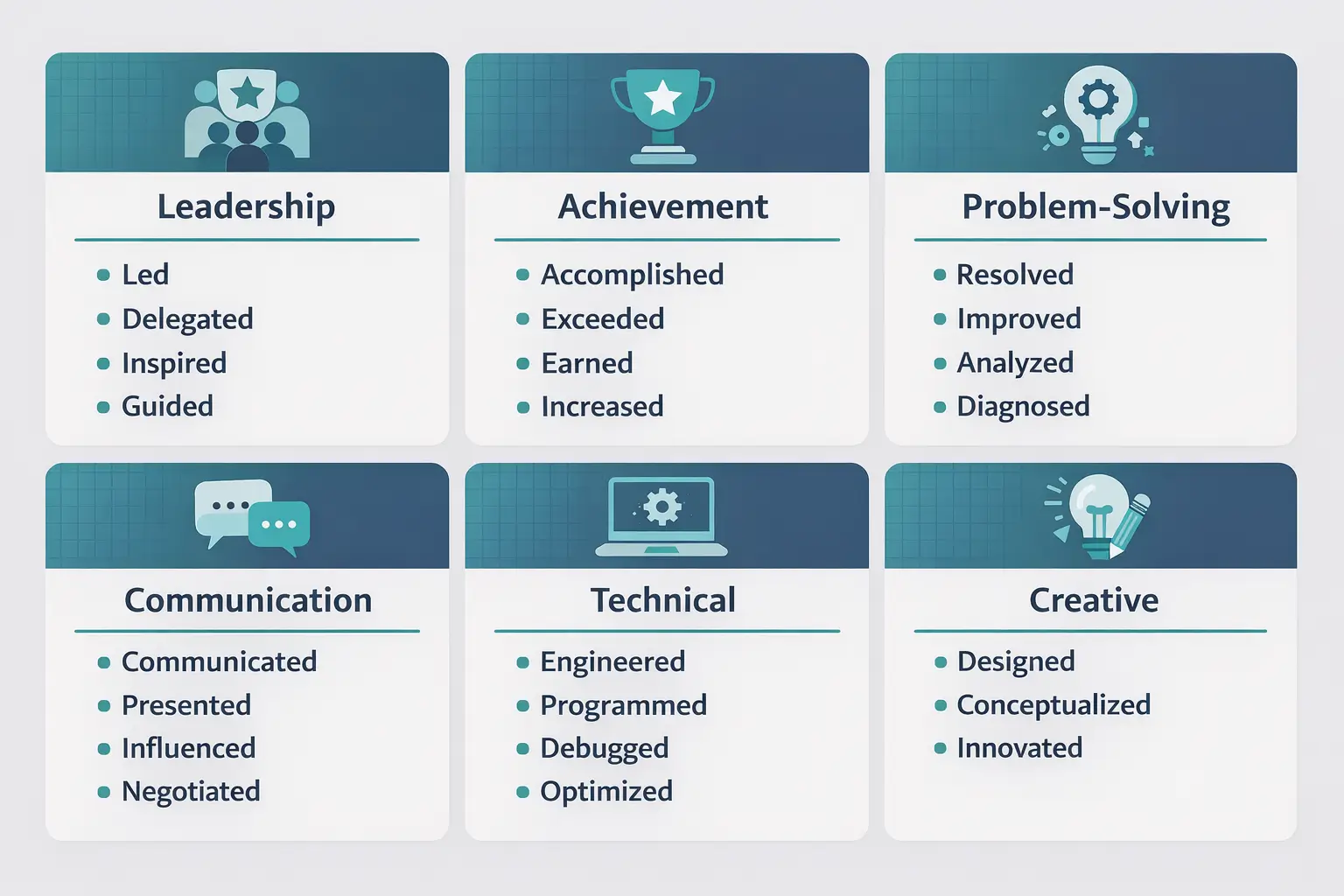
Communication and Collaboration
Ideal for roles that require teamwork, presentations, or stakeholder management.
- Negotiated — Reached favorable terms through discussion. *Example: Negotiated vendor contracts worth $1.2M, saving 18% over previous agreements.*
- Presented — Communicated ideas or findings to an audience.
- Persuaded — Convinced stakeholders to adopt a course of action.
- Facilitated — Guided group discussions or workshops toward outcomes.
- Authored — Wrote original content, proposals, or documentation.
- Influenced — Shaped decisions or direction without direct authority.
- Briefed — Provided concise, relevant updates to leadership.
- Advocated — Publicly supported a cause, policy, or approach.
Technical and Analytical
Strong choices for engineering, data, IT, and finance roles.
- Engineered — Designed and built a system or solution. *Example: Engineered a data pipeline that processed 10M records daily with 99.9% uptime.*
- Automated — Replaced manual processes with technology.
- Deployed — Launched a system, tool, or product into production.
- Architected — Designed the high-level structure of a system.
- Integrated — Combined separate systems or components into a unified whole.
- Programmed — Wrote code to build or improve software.
- Modeled — Created analytical or financial models for decision-making.
- Audited — Reviewed data, systems, or processes for accuracy and compliance.
Creative and Innovation
For marketing, design, content, and product roles.
- Launched — Brought something new to market or to an audience. *Example: Launched a content strategy that grew organic traffic by 250% in six months.*
- Pioneered — Introduced something entirely new.
- Conceptualized — Developed original ideas from scratch.
- Crafted — Created something with skill and intentionality.
- Revitalized — Breathed new life into a struggling project or brand.
- Produced — Created deliverables from concept to completion.
- Curated — Selected and organized content or resources thoughtfully.
Financial and Operational
Good for business, operations, and finance professionals.
- Reduced — Cut costs, time, or waste. *Example: Reduced operational expenses by $350K annually through vendor consolidation and process automation.*
- Budgeted — Planned and managed financial resources.
- Forecasted — Predicted future trends or outcomes using data.
- Consolidated — Combined resources or operations for greater efficiency.
- Allocated — Distributed resources strategically.
- Secured — Obtained funding, contracts, or partnerships.
How to Use Action Verbs Effectively
Having a big list is only useful if you know how to apply it. Here are the rules that separate a good resume from a great one.
Start Every Bullet Point With a Verb
This isn't optional. Every line under your work experience should begin with an action verb in past tense (for previous roles) or present tense (for your current role). Never start with "I" or a noun.
- Weak: "Was responsible for managing a team of 12 engineers."
- Strong: "Managed a team of 12 engineers, delivering three product releases ahead of schedule."
Pair Verbs With Quantifiable Results
A verb on its own is just decoration. Attach it to a number, percentage, dollar amount, or timeframe to make it real.
Formula: Action Verb + What You Did + Measurable Result
- Increased quarterly sales by 28% through targeted outreach to enterprise clients.
- Reduced customer churn by 15% by redesigning the onboarding workflow.
- Trained 45 new employees across three departments in the first quarter.
Don't Repeat the Same Verb
If "managed" appears five times on your resume, it stops meaning anything. Vary your choices across bullet points. Use "directed" for one entry, "oversaw" for another, "coordinated" for a third. This keeps the reader engaged and paints a fuller picture of your skill set.
Match Verbs to the Job Description
This is where tailoring becomes critical. If the job posting says "drive cross-functional collaboration," use verbs like "orchestrated" or "facilitated" instead of "helped." Mirror the language of the role, and your resume will feel like a natural fit — both to human readers and to ATS software.
Not sure which verbs match the role you're applying for? Seekario's AI Resume Scanner scans your resume against the job description and flags where your language doesn't align.
Avoid These Overused Words
Some verbs have been drained of all meaning through overuse. Swap them out:
Industry-Specific Action Verbs
Different fields have their own vocabulary. Using industry-specific strong resume verbs signals that you understand the role.
Technology and Engineering
Deployed, Debugged, Refactored, Migrated, Containerized, Provisioned, Benchmarked
Healthcare
Assessed, Administered, Triaged, Rehabilitated, Monitored, Prescribed, Educated
Marketing and Sales
Converted, Segmented, Branded, Prospected, Closed, Upsold, Retained
Education
Instructed, Differentiated, Assessed, Scaffolded, Adapted, Evaluated, Tutored
Finance
Reconciled, Forecasted, Underwritten, Appraised, Audited, Diversified, Liquidated
Project Management
Scoped, Prioritized, Milestoned, Tracked, Escalated, Risk-assessed, Iterated
Quick-Reference Cheat Sheet
Save this when you sit down to write or update your resume:
For showing leadership: Spearheaded, Directed, Championed, Mobilized, Helmed
For showing results: Accelerated, Generated, Exceeded, Outperformed, Delivered
For showing problem-solving: Diagnosed, Streamlined, Optimized, Resolved, Mitigated
For showing collaboration: Negotiated, Facilitated, Influenced, Advocated, Persuaded
For showing technical skill: Engineered, Automated, Deployed, Architected, Integrated
For showing creativity: Launched, Pioneered, Conceptualized, Crafted, Revitalized
FAQ
What are action verbs on a resume?
Action verbs are strong, descriptive words that begin your resume bullet points and describe what you accomplished in each role. Instead of passive phrases like "was responsible for," action verbs like "directed," "launched," or "optimized" communicate your contributions clearly and confidently. They help recruiters quickly understand your impact.
How many action verbs should I use on my resume?
A typical one-page resume will use 20–30 different action verbs across all bullet points. The key rule: don't use the same verb more than twice on the entire document, and never use two action verbs in the same bullet point. Variety keeps the reader's attention and demonstrates range.
What are the best action verbs for a resume with no experience?
If you're writing your first resume, focus on verbs that highlight transferable skills from school, volunteering, or personal projects. Strong choices include: Organized, Coordinated, Researched, Created, Presented, Collaborated, and Initiated. These work well for academic projects, student organizations, and internship experiences.
Do action verbs help with ATS systems?
Yes. Many job descriptions are written using action-oriented language, and ATS software scans for keyword matches. When your resume uses the same types of verbs found in the job posting, you increase your chances of passing the automated screen. Tools like Seekario's AI Resume Builder help you identify and include the right action words based on each job description.
Should I use past tense or present tense for action verbs?
Use present tense for your current role ("Manage a team of eight engineers") and past tense for all previous positions ("Managed a team of eight engineers"). This keeps your resume grammatically consistent and easy to follow.
Make Every Word on Your Resume Count
Choosing the right resume action verbs is one of the simplest upgrades you can make — and one of the most effective. Strong verbs show hiring managers that you took ownership, delivered results, and communicated clearly. Weak verbs do the opposite.
If you want to take the guesswork out of optimizing your resume language, Seekario's AI Resume Builder analyzes your bullet points and suggests stronger, more targeted action words based on the role you're applying for. It's the fastest way to turn a decent resume into one that actually gets callbacks.