AI Resume Builder vs Traditional Resume Builders: Which Is Better?

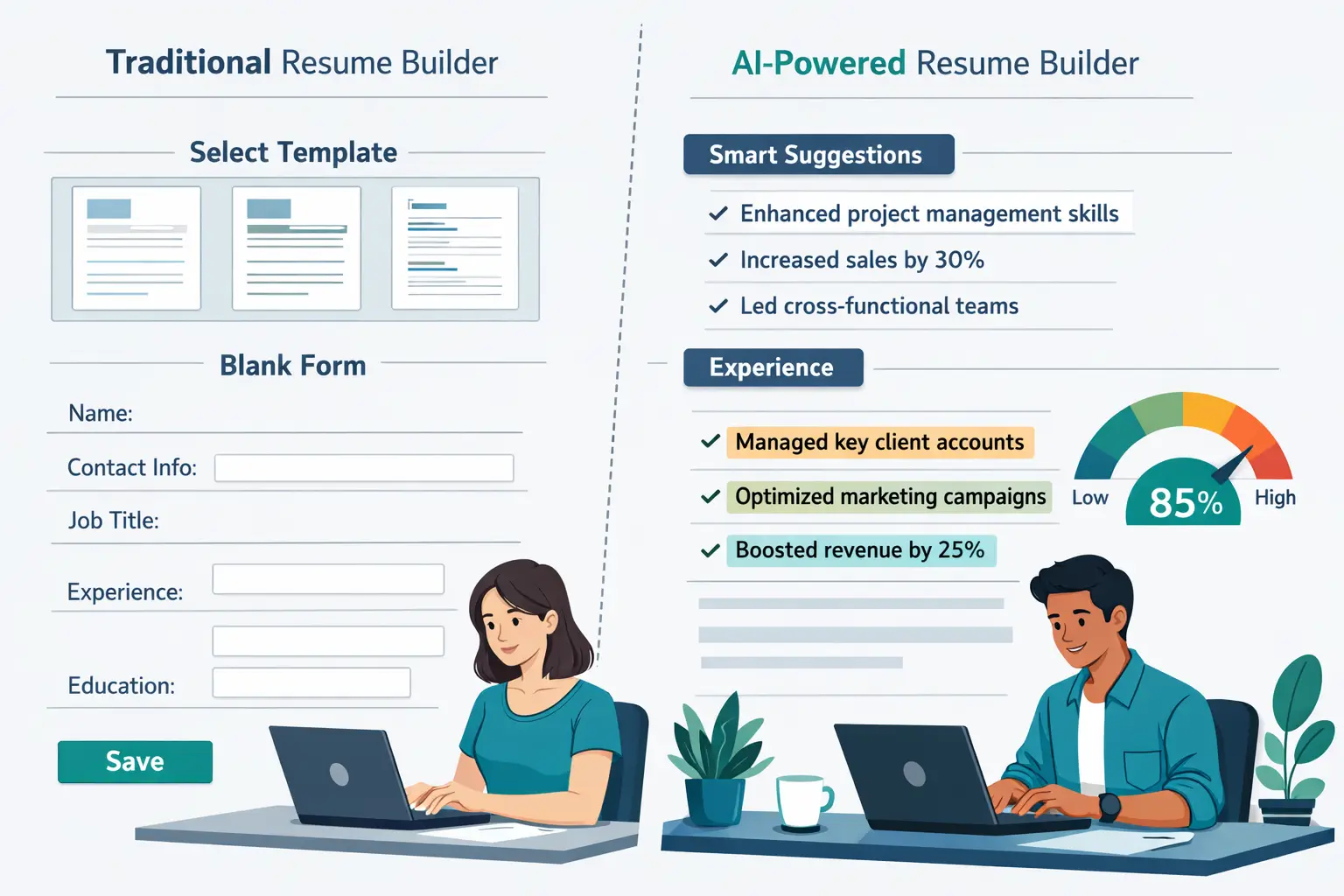
Resume builders have been around for over a decade. Upload your info, pick a template, download a PDF. Simple enough. But starting around 2024, a new category emerged: AI-powered resume builders that don't just format your resume — they actually help you write it, tailor it, and optimize it for specific jobs. So which approach is actually better for landing interviews? Let's break it down.
What Traditional Resume Builders Actually Do
Traditional resume builders are template-based tools. You fill in your contact information, work history, education, and skills. The tool arranges that information into a pre-designed layout, and you export it as a PDF or Word document.
Popular traditional builders include platforms like Canva's resume templates, Microsoft Word's built-in templates, and older tools like VisualCV or Resume.com. They've served job seekers well for years, and they still have some advantages:
- Full creative control. You decide every word that goes on the page.
- Design variety. Many offer dozens or even hundreds of visual templates.
- Simplicity. There's no learning curve. Type your info, pick a design, download.
- Low cost. Many basic templates are completely free.
The limitation? A traditional builder doesn't know anything about the job you're applying for. It can't tell you if your bullet points are weak, if you're missing keywords the ATS will look for, or if your resume is structured in a way that recruiters actually prefer. It's a formatting tool — not a writing tool.
What an AI Resume Builder Does Differently
An AI resume builder uses natural language processing and machine learning to go beyond formatting. It reads your experience, understands the role you're targeting, and actively helps you improve your content.
Here's what that looks like in practice:
Smart Content Generation
Instead of staring at a blank bullet point wondering what to write, an AI resume maker analyzes your job title and generates professionally written bullet points based on your role. You can then edit, accept, or regenerate until each line accurately reflects what you did.
This is especially useful for people who struggle with self-promotion or who haven't updated their resume in years. The AI gives you a starting point that's already polished and action-oriented.
Job-Specific Tailoring
This is the biggest difference. A traditional builder produces one static resume. An AI builder like Seekario's AI Resume Tailor reads the job description you paste in and adjusts your resume to match it — rearranging sections, suggesting different skills to highlight, and rewriting bullet points to mirror the language of the posting.
Why does this matter? Because 83% of recruiters say they're more likely to interview candidates whose resume is clearly tailored to the role. And with most companies using ATS software to filter applications before a human sees them, tailoring isn't optional anymore — it's the baseline.
ATS Keyword Optimization
Applicant tracking systems scan for specific keywords pulled from the job description. If your resume doesn't include enough matching terms, it may never reach a recruiter's desk. Up to 75% of applications get filtered out by ATS before a human reviewer sees them.
Traditional builders don't analyze keywords at all. AI resume builders compare your resume to the job posting and identify gaps. Seekario's AI Resume Scanner, for example, gives you an ATS compatibility score and tells you exactly which keywords you're missing and where to add them.
Real-Time Feedback
Traditional tools let you export and hope for the best. AI tools give you feedback as you build — flagging weak verbs, suggesting stronger phrasing, identifying missing sections, and scoring your resume against industry standards. It's like having a career coach looking over your shoulder while you write.

Head-to-Head: AI vs Traditional Resume Builders
Let's compare the two approaches across the factors that actually matter when you're job hunting.
Speed
Traditional: Building a resume from scratch with a template takes most people 2–4 hours, depending on how much editing and formatting they do.
AI: An automated resume builder can produce a complete, job-tailored draft in under 10 minutes. You'll still want to review and personalize it, but the heavy lifting is done. For people applying to multiple roles, this time savings compounds fast.
Winner: AI, by a wide margin.
Quality of Content
Traditional: The quality depends entirely on your own writing ability. If you're good at describing your accomplishments in concise, results-oriented language, a traditional builder works fine. But most people aren't trained resume writers, and it shows.
AI: AI tools generate professional-grade bullet points and suggest improvements to your existing content. The best AI resume builders draw from patterns across millions of successful resumes to suggest language that resonates with recruiters. The risk here is sounding generic — but the best tools (like Seekario's AI Resume Builder) let you customize the output so it still sounds like you.
Winner: AI for most people. Experienced writers may prefer traditional for full control.
ATS Compatibility
Traditional: Most templates aren't optimized for ATS at all. Fancy designs with columns, graphics, headers in text boxes, and non-standard fonts frequently confuse ATS parsers. Your beautifully designed resume might look like gibberish to the software that screens it first.
AI: ATS optimization is a core feature. AI builders use clean, parseable layouts and ensure your keywords, section headers, and formatting meet ATS requirements. This alone can be the difference between getting screened out and getting an interview.
Winner: AI, definitively.
Personalization and Authenticity
Traditional: You write every word, so it naturally reflects your voice and personality.
AI: Earlier AI tools had a reputation for producing cookie-cutter content. That's changed significantly in 2026. Modern AI resume builders let you adjust tone, customize suggestions, and maintain your personal voice while benefiting from AI optimization. Still, you need to actively edit the output. Sending an unedited AI resume is a risk — 74% of hiring managers say they can spot AI-generated content, and 62% say they reject resumes that feel generic or clearly unedited.
Winner: Tie. Traditional gives you more natural voice by default; AI requires editing but delivers better optimization.
Cost
Traditional: Many basic template builders are free. Premium templates typically cost $5–$20 one-time.
AI: AI resume builders generally run $10–$30 per month, with some offering free tiers. The investment pays off quickly if you're actively job hunting and applying to multiple positions, since you'd otherwise spend hours manually tailoring each resume.
Winner: Traditional for one-time use. AI for active job searches.
Scalability
Traditional: Every new job application means manually rewriting and reformatting your resume. If you're applying to 20 roles, that's 20 rounds of edits.
AI: Paste in a new job description, and the AI adjusts your resume in minutes. This makes it realistic to send a tailored resume for every application — which is exactly what recruiters want to see.
Winner: AI, significantly.
The Numbers Tell the Story
Here's what the data says about AI's impact on job searching in 2026:
- 54% of job seekers now use AI to help write their resumes.
- Companies using AI recruitment tools report a 30% reduction in cost-per-hire, which means they're investing more in AI screening — and you need to keep up.
- 99% of Fortune 500 companies use some form of ATS, making keyword optimization non-negotiable.
- AI-powered resume screening reduces initial review time by up to 71%, meaning your resume gets even less human attention at the first stage.
- 83% of recruiters prefer candidates who tailor their resume to the specific role.
The takeaway: both sides of the hiring equation are using AI. Job seekers who stick with traditional tools alone are bringing a knife to a gunfight.
When a Traditional Builder Still Makes Sense
Traditional builders aren't dead. They work well in specific situations:
- Creative fields where visual design is part of the job (graphic design, UX, art direction). Here, a unique layout communicates skill.
- One-time updates where you just need to refresh an existing resume for a single opportunity.
- Highly experienced writers who know exactly how to position their experience and just need a clean format.
- Portfolio-based roles where the resume is secondary to your work samples.
For everyone else — especially if you're actively job hunting, applying to multiple roles, or re-entering the workforce — an AI resume builder gives you a significant edge.
How to Get the Best of Both Worlds
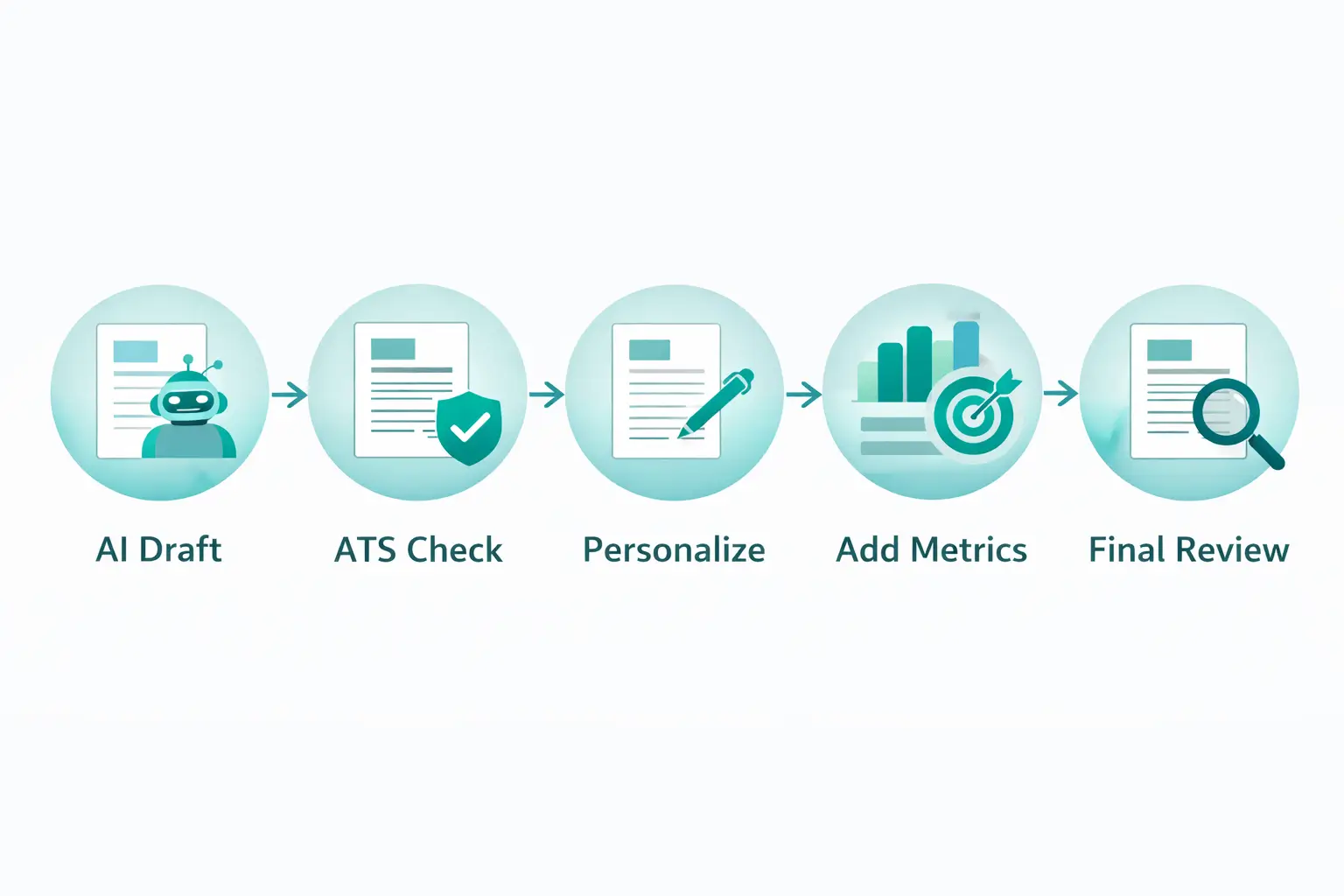
The smartest approach in 2026 isn't picking one or the other. It's using AI as your starting point and then applying your own judgment. Here's a workflow that works:
- Start with AI. Use a tool like Seekario's AI Resume Builder to generate a tailored draft based on the job description.
- Review the ATS score. Check your keyword match rate and fill any gaps the AI identifies.
- Personalize the language. Edit bullet points so they reflect your actual voice and include specific details only you would know.
- Add measurable results. AI can suggest structure, but only you know the exact numbers — revenue generated, percentage improvements, team sizes managed.
- Check the formatting. Make sure the final design is clean, readable, and ATS-friendly.
This hybrid approach gives you the speed and optimization of AI with the authenticity and specificity that recruiters value.
FAQ
Are AI resume builders worth the money?
For active job seekers applying to multiple roles, yes. The time savings alone justify the cost — manually tailoring a resume for each application takes hours, while an AI tool does it in minutes. Add in ATS optimization and content suggestions, and the ROI becomes clear quickly. Most platforms cost between $10–$30 per month, which is a fraction of what a professional resume writer charges (typically $200–$500 per resume).
Can employers tell if I used an AI resume builder?
They can tell if you didn't edit the output. Generic phrasing, overused buzzwords, and lack of specific details are red flags. However, if you use AI as a starting point and then personalize with your own accomplishments, numbers, and voice, there's no way to distinguish it from a manually written resume. The goal is a polished, tailored document — not an obvious AI-generated one.
Will an AI resume builder work for my industry?
Modern AI resume builders are trained on data across virtually every industry — tech, healthcare, finance, education, marketing, engineering, and more. The best tools let you specify your target role and industry so the suggestions are relevant. For highly specialized fields, you may need to do more manual editing, but the AI still handles formatting, ATS optimization, and structure effectively.
What's the best AI resume builder in 2026?
The best tool depends on your needs. Seekario stands out for its combination of AI resume building, job-specific tailoring, ATS scoring, and integrated cover letter generation — all in one platform. It's designed for job seekers who want to apply smarter, not just faster.
Do I still need a human resume writer if I use AI?
For most job seekers, no. AI tools in 2026 produce content that rivals professional resume writers in terms of structure, keyword optimization, and formatting. Where human writers still add value is in high-level career strategy — positioning a complex career narrative, handling unusual backgrounds, or preparing for executive-level roles. For everyone else, an AI builder combined with your own careful editing delivers excellent results.
The Bottom Line
Traditional resume builders are fine for formatting. But formatting isn't what gets you interviews — content, keywords, and tailoring do. AI resume builders handle all three, faster and more consistently than manual methods.
If you're serious about your job search in 2026, an AI resume builder isn't a luxury. It's the standard. Try Seekario's AI Resume Builder to see how AI-optimized, job-tailored resumes can transform your application results.