ATS Resume Score: What It Is and How to Improve Yours


You spent hours polishing your resume, hit "apply," and heard nothing back. Sound familiar? There's a good chance an applicant tracking system scored your resume lower than other candidates — and a recruiter never saw it. With over 98% of Fortune 500 companies using ATS software, understanding your ATS resume score is no longer optional. It's the first hurdle between you and a job interview.
This article breaks down exactly what an ATS resume score is, what factors influence it, and the specific steps you can take to push yours higher — starting today.
What Does "ATS Resume Score" Actually Mean?
An ATS resume score is a compatibility rating that measures how well your resume matches a specific job posting. When you submit an application, the ATS parses your resume — pulling out your skills, job titles, education, and keywords — then compares that information against the job description's requirements.
The result is a ranking score. Resumes that closely match the job listing's language, qualifications, and structure land near the top of the pile. Resumes that don't get buried.
Here's the key thing to understand: most ATS platforms don't "reject" resumes outright. A 2025 study by Enhancv interviewing 25 US recruiters across 10+ ATS platforms found that 92% confirmed their ATS does not auto-reject based on resume content. Instead, the system ranks applicants. But when a single job posting attracts 250+ applications and a recruiter only reviews the top 20, being ranked at #150 might as well be a rejection.
How ATS Scoring Works Behind the Scenes
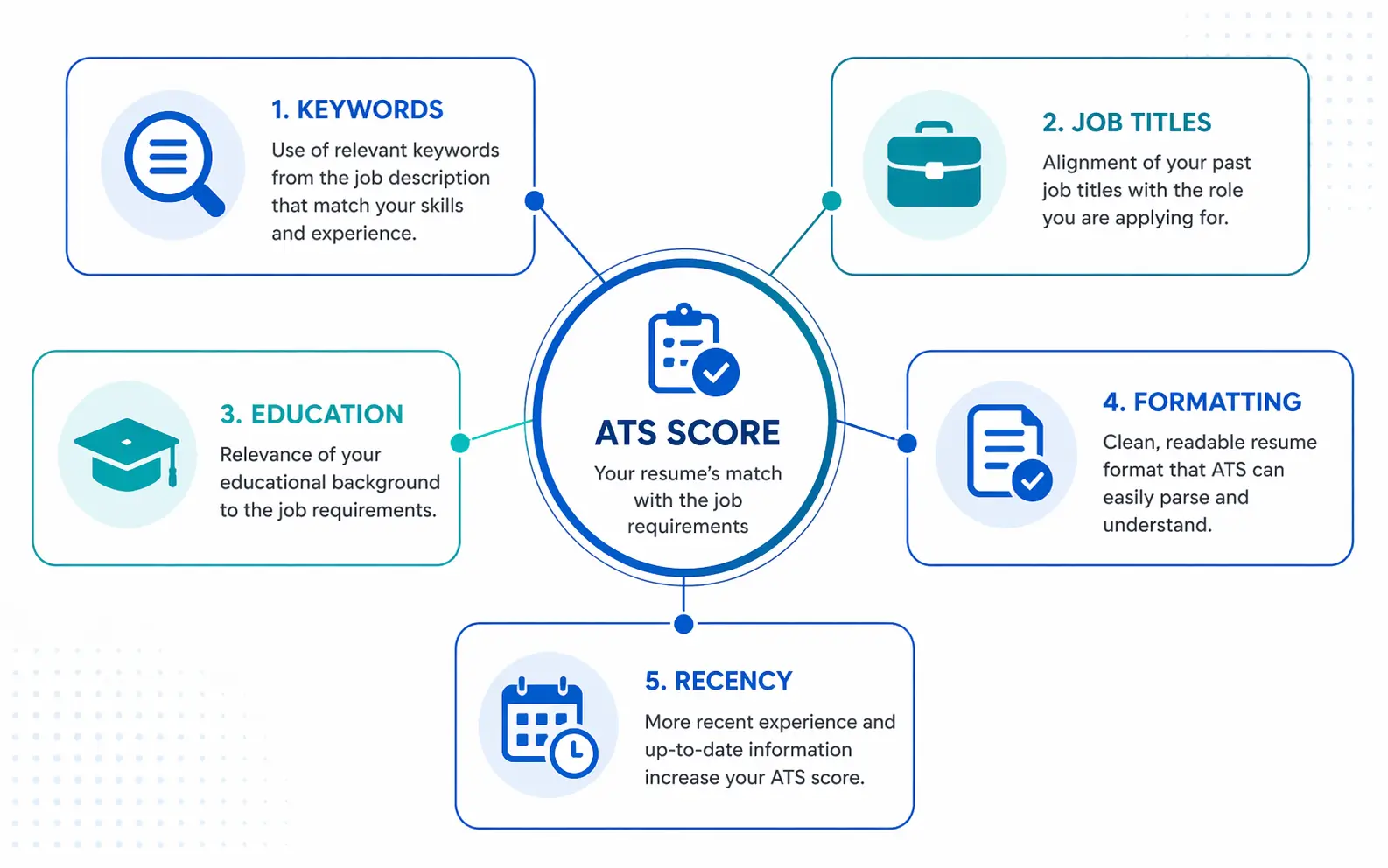
ATS platforms don't all use the same algorithm, but most follow a similar logic. Understanding how these systems think gives you a real advantage.
Keyword Matching
This is the biggest factor. The ATS scans your resume for specific terms that appear in the job description — hard skills, software tools, certifications, and industry terminology. If the job asks for "project management" and "Agile methodology," your resume needs those exact phrases.
Job Title Alignment
Systems compare your previous job titles against the target role. A direct match (e.g., "Marketing Manager" applying for "Marketing Manager") scores higher than a tangential one. That doesn't mean you can't apply for stretch roles — but you may need to work harder on keyword alignment.
Education and Certifications
When a posting lists specific degree requirements or certifications, the ATS checks for those. Roles requiring a PMP certification or a specific degree level will factor these into the ranking.
Section Structure and Formatting
ATS platforms expect standard resume sections: Contact Information, Work Experience, Education, and Skills. Creative section headers like "My Journey" or "Superpowers" confuse the parser and can cause your content to be miscategorized — or missed entirely.
Recency and Relevance
Some ATS platforms weigh recent experience more heavily. A skill you used in your current role carries more weight than one buried in a job from eight years ago.
What Is a Good ATS Resume Score?
There's no universal standard, but here's a practical breakdown based on data from multiple resume optimization tools:
Below 50% — Your resume has significant gaps. It's likely missing critical keywords, has formatting issues, or doesn't align well with the target role. At this level, your application will almost certainly be buried.
50–69% — You're in a competitive but risky range. Some keywords match, but there are noticeable gaps. You might get lucky with a less competitive posting, but stronger candidates will outrank you.
70–79% — This is the minimum target for most job seekers. Your resume demonstrates solid alignment with the role. Recruiters scanning the top candidates are likely to see your application.
80–89% — Strong territory. Your resume closely mirrors the job description and should rank near the top.
90%+ — Excellent. Your resume is highly optimized for this specific role. Research from ResumeAdapter suggests that resumes scoring 85% or higher are roughly three times more likely to result in an interview callback compared to those below 50%.
One important caveat: the average first-submission ATS compatibility score is below 40%. That means most applicants are applying with resumes that barely register. Even modest optimization puts you ahead of the majority.
8 Proven Ways to Improve Your ATS Resume Score
1. Mirror the Job Description's Language
Read the job posting carefully and identify the specific terms it uses. If the listing says "data analysis," don't write "data analytics" and assume it's close enough. ATS systems often match exact phrases. Pull the top 10–15 keywords from the posting and weave them naturally into your experience bullets and skills section.
Tools like Seekario's AI Resume Assessment can compare your resume against a job description and highlight exactly which keywords you're missing — saving you the guesswork.
2. Use a Clean, Standard Format
Stick with a single-column layout. Use standard section headers: "Work Experience," "Education," "Skills," and "Certifications." Avoid tables, text boxes, columns, headers/footers for critical information, and graphics. These elements look great to human eyes but confuse most ATS parsers.
Save your file as .docx unless the application specifically requests PDF. Some older ATS platforms still struggle with PDF parsing.
3. Include Both Acronyms and Full Terms
Write "Search Engine Optimization (SEO)" the first time, then use "SEO" afterward. Some ATS platforms search for the acronym; others search for the full phrase. Covering both ensures you don't miss a match.
4. Add a Dedicated Skills Section
A skills section gives the ATS a concentrated block of keywords to parse. List 8–15 relevant hard skills that appear in the job description. Place this section near the top of your resume, right after your summary.
5. Tailor Your Resume for Every Application
This is the single most impactful thing you can do. A generic resume will score well for some roles and poorly for others. Each job description emphasizes different skills and qualifications, and your resume needs to reflect that.
If tailoring every resume sounds exhausting, Seekario's AI Resume Tailor automates the process — adjusting your keywords, skills section, and bullet points to match each specific job description.
6. Quantify Your Achievements
Numbers catch both ATS algorithms and human recruiters' attention. Instead of "Managed social media accounts," write "Managed 4 social media platforms, growing combined following by 35% in 6 months." Specific metrics make your experience more parseable and more impressive.
7. Match Your Job Titles When Possible
If your actual title was "Client Happiness Specialist" but the role you're targeting calls it "Customer Success Manager," consider listing both: "Client Happiness Specialist (Customer Success Manager)." This preserves honesty while improving keyword alignment.
8. Test Your Score Before You Apply
Don't submit blind. Run your resume through an ATS scoring tool to see where you stand. Make adjustments, re-test, and keep iterating until you're consistently hitting 75% or above. Seekario's AI Resume Assessment gives you a detailed compatibility breakdown with specific suggestions for improvement.
Common ATS Score Killers to Avoid
Even well-qualified candidates tank their ATS scores with avoidable mistakes. Watch out for these:
Fancy templates with graphics and icons. They look polished in a PDF viewer but get garbled by ATS parsers. Stick with clean, text-based designs.
Missing keywords from the job description. If the listing mentions "stakeholder management" five times and your resume never uses that phrase, you're leaving points on the table.
Non-standard file formats. Submitting a .pages, .odt, or image-based PDF can cause parsing failures. Default to .docx.
Stuffing keywords unnaturally. Some applicants paste invisible white text or cram keywords into their resume. Modern ATS platforms detect this, and recruiters who do see your resume will notice. It's a fast track to the reject pile.
Using headers and footers for contact info. Many ATS systems can't read content in headers or footers. Put your name, email, phone number, and LinkedIn URL in the main body of the document.
How Often Should You Check Your ATS Score?
Check your score every time you apply for a role that matters to you. Since each job description is different, a resume that scores 85% for one posting might score 55% for another. The 10 minutes it takes to test and adjust your resume can be the difference between landing an interview and getting ghosted.
For active job seekers applying to multiple roles per week, building a "base resume" and tailoring it per application is the most efficient workflow. Start with a strong foundation, then tweak for each posting.
FAQ
Does every company use an ATS?
Nearly all large employers do — over 98% of Fortune 500 companies use ATS software. Smaller companies and startups are less likely to use one, but adoption is growing every year. It's safest to assume your resume will pass through an ATS unless you're submitting directly to a hiring manager.
Can I check my ATS score for free?
Yes. Several free tools offer basic ATS scoring, though they vary in accuracy and detail. For a more thorough analysis that includes specific keyword recommendations and formatting checks, Seekario's AI Resume Assessment provides a detailed breakdown tailored to your target job.
Is a 100% ATS score possible or necessary?
A perfect score is theoretically possible but rarely necessary. Aiming for 80%+ puts you in a strong competitive position. Chasing 100% can lead to over-optimization — keyword stuffing or awkward phrasing that hurts your chances with the human recruiter who reviews your resume after the ATS.
Does the ATS score guarantee I'll get an interview?
No. A high ATS score gets your resume in front of a recruiter, but the recruiter still evaluates your qualifications, experience, and fit. Think of your ATS score as the entry ticket — you still need a compelling resume to close the deal.
Should I use a different resume for every job application?
Ideally, yes. Each job description uses different language and prioritizes different skills. Tailoring your resume to each posting — even if the adjustments are small — significantly improves your ATS score and your chances of getting noticed.
Improve Your ATS Score and Start Getting Interviews
Your ATS resume score is the gatekeeper between your application and a real human conversation. The good news is that improving it doesn't require rewriting your entire career history. Small, targeted changes — matching keywords, cleaning up formatting, tailoring per application — can dramatically shift your ranking.
If you want to take the guesswork out of the process, Seekario's AI Resume Assessment analyzes your resume against any job description, identifies exactly where you're falling short, and gives you actionable steps to improve. Stop wondering why you're not hearing back — find out your score and fix it.