Career Change Resume: How to Pivot Successfully in 2026


You've decided it's time for something different. Maybe you're burned out, underpaid, or just ready to use your skills in a new way. You're not alone — over half of American workers are considering a career change this year, and the average person holds 12 different jobs across their lifetime.
But here's the challenge: your resume was built for your *old* career. And a hiring manager in your new field won't automatically see why your background matters. That's where a well-crafted career change resume comes in. It reframes your experience, leads with transferable skills, and tells a story that makes your pivot feel intentional — not random.
This guide walks you through every step of building a career change resume that actually gets callbacks.
Why a Career Change Resume Is Different From a Standard Resume
A traditional resume lists your experience in reverse chronological order and lets your job titles do the talking. That works fine when you're applying for the same type of role. But when you're switching fields, your job titles can actually work against you.
A career change resume flips the script. Instead of leading with "where you worked," it leads with "what you can do." The goal is to help a recruiter connect the dots between your past experience and the role they're trying to fill — before they dismiss you as unqualified.
The biggest differences include a stronger emphasis on your professional summary, a skills-first layout, achievement descriptions reframed for relevance, and strategic keyword placement for ATS systems.
Step 1: Pick the Right Resume Format
Your resume format sets the tone for everything. For career changers, the combination (hybrid) format works best. It places a skills section near the top, followed by a streamlined work history.
Why not a functional resume? While functional resumes focus entirely on skills and hide your timeline, most recruiters and ATS systems don't like them. They raise red flags because they obscure your work history. The hybrid format gives you the skills-first advantage without triggering suspicion.
Why not a chronological resume? A purely chronological resume puts your most recent (and least relevant) job titles front and center. If you spent the last five years as a restaurant manager and you're applying for a marketing coordinator role, leading with "Restaurant Manager" won't help your case.
The hybrid format lets you lead with a summary and skills section, then list your work experience with reframed bullet points underneath.
Step 2: Write a Summary That Explains Your Pivot
Your professional summary is the single most important section on a career change resume. It's your chance to control the narrative before the reader forms their own conclusions.
A strong career change summary should accomplish three things: name your target role or industry, highlight your most relevant transferable skills, and briefly explain why you're making the switch.
Here's an example:
> Marketing professional with 6+ years of experience in brand storytelling, audience engagement, and data-driven campaign optimization. Background in hospitality management, where I grew social media followings by 300% and led customer experience initiatives that increased retention by 22%. Seeking to bring my analytical and creative skills to a dedicated marketing role in the tech industry.
Notice what this does. It doesn't apologize for the career change. It doesn't say "seeking new opportunities." It connects the dots for the reader and makes the pivot feel like a natural progression.
If writing a summary that bridges two industries feels challenging, Seekario's AI Resume Tailor can generate targeted summaries based on the specific job description you're applying to.
Step 3: Identify and Showcase Transferable Skills
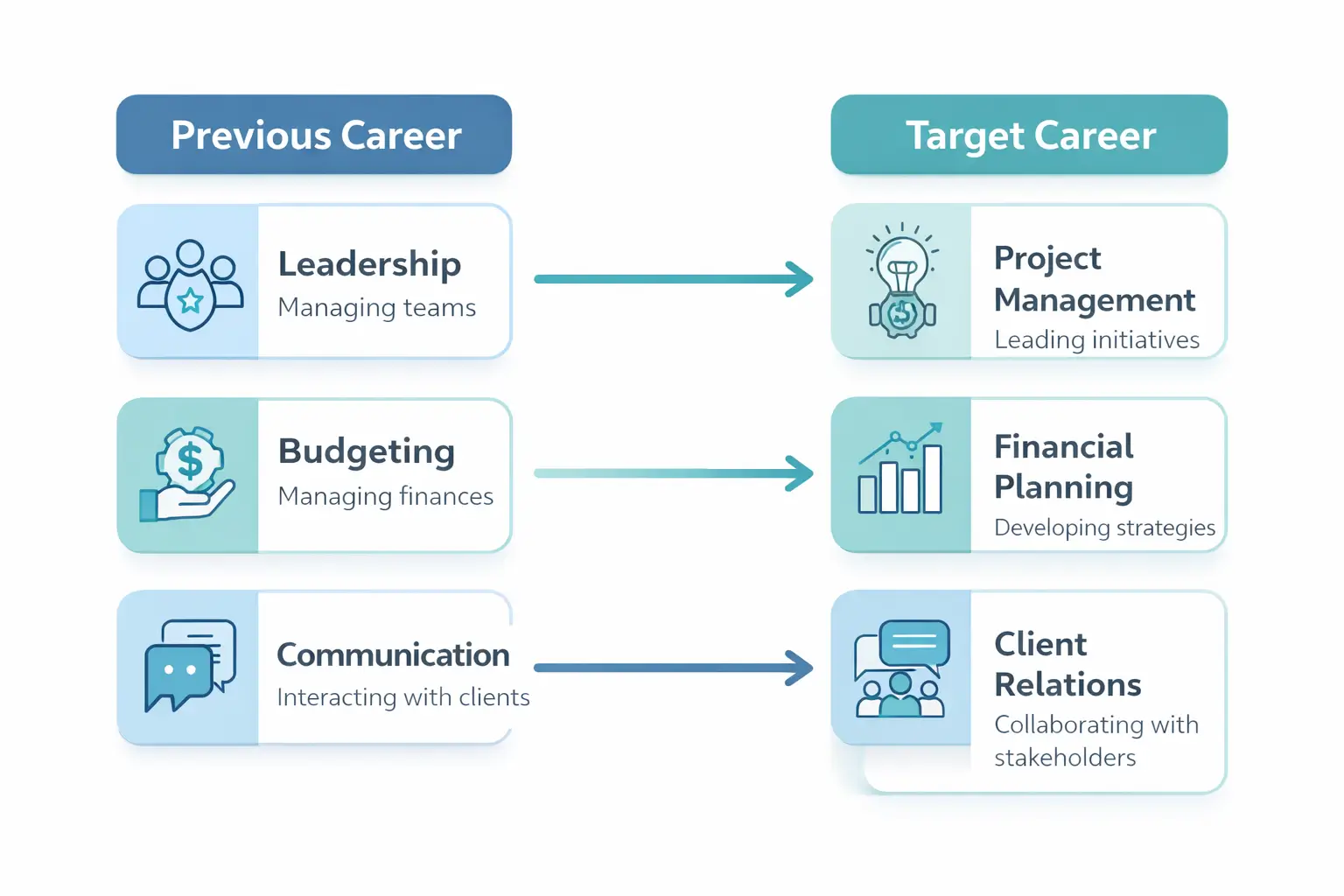
Transferable skills are the backbone of any career change resume. These are abilities you've developed in one context that apply directly to another.
Hard Transferable Skills
These are measurable, technical abilities that cross industries:
- Project management — coordinating timelines, budgets, and teams applies everywhere from construction to software
- Data analysis — reading spreadsheets, interpreting trends, and making data-driven decisions
- Budgeting and financial planning — whether it's a restaurant's P&L or a marketing budget
- Technical writing — creating documentation, SOPs, or training materials
- CRM and software proficiency — Salesforce, HubSpot, Asana, and similar platforms
Soft Transferable Skills
These are harder to quantify but equally important:
- Leadership and team management — motivating, delegating, and developing people
- Communication — written and verbal skills including presentations, negotiations, and client relations
- Problem-solving — identifying issues and implementing solutions under pressure
- Adaptability — thriving in changing environments (which is exactly what a career change requires)
How to Find Your Transferable Skills
Pull up 3-5 job descriptions for your target role. Highlight every skill and qualification mentioned. Then go through your own experience and match each requirement to something you've done — even if it was in a completely different context.
Step 4: Reframe Your Work Experience
You don't need to lie about your past. You need to describe it differently. Every bullet point on your career change resume should answer one question: "How does this prove I can do the new job?"
Before (Generic)
- Managed a team of 15 servers and kitchen staff
- Handled weekly inventory and vendor orders
- Resolved customer complaints
After (Reframed for Marketing Role)
- Led a cross-functional team of 15, coordinating scheduling, training, and performance reviews
- Managed a $4,200 weekly supply budget, reducing waste by 18% through data-driven ordering
- Developed customer retention strategies that improved repeat visit rates by 25%
See the difference? Same experience, completely different framing. You're translating industry-specific tasks into universal business language.
Tips for Reframing
- Remove jargon specific to your old industry and replace it with language from job descriptions in your target field
- Quantify everything — numbers are universal and catch a recruiter's eye regardless of industry
- Focus on outcomes over tasks — what changed because of your work?
- Use action verbs that match your target role — "analyzed," "optimized," "developed," "implemented"
Step 5: Add Relevant Education, Certifications, and Side Projects
Career changers often underestimate the power of supplementary sections. If you've taken courses, earned certifications, or completed projects related to your new field, give them prominent placement on your resume.
What to Include
- Online certifications — Google Analytics, HubSpot Inbound Marketing, AWS Cloud Practitioner, PMP, or any credential relevant to your target field
- Coursework — completed courses from Coursera, edX, LinkedIn Learning, or a community college
- Freelance or volunteer work — any projects in your new field, even if unpaid
- Personal projects — a blog, portfolio website, open-source contributions, or side business
Place these in a dedicated "Relevant Education & Certifications" section right after your skills section. For career changers, this section can carry as much weight as your work experience.
Step 6: Optimize Your Career Change Resume for ATS
Roughly 75% of resumes are rejected by ATS software before a human ever sees them. When you're changing careers, ATS optimization becomes even more critical because your old job titles won't naturally match the new role's keywords.
ATS Optimization Checklist
- Extract keywords directly from the target job description — job titles, tools, skills, and industry terms
- Mirror the exact phrasing used in the posting (if they say "project coordination," don't write "project oversight")
- Use standard section headers like "Work Experience," "Skills," and "Education" — creative headers confuse ATS parsers
- Avoid tables, columns, and graphics — many ATS systems can't read them
- Save as .docx or PDF depending on what the application specifies
Running your resume through an AI-powered resume scanner tool can show you exactly which keywords you're missing and how well your resume aligns with the target job.
Step 7: Write a Cover Letter That Supports Your Pivot
Your career change resume tells the "what." Your cover letter tells the "why." Hiring managers reviewing a career changer's application almost always read the cover letter to understand motivation. Don't skip it.
Your cover letter should address three points: why you're leaving your current field (keep it positive), why you're drawn to this new field specifically, and what unique perspective your background brings.
A strong cover letter can turn a skeptical recruiter into an advocate. If you need help drafting one that complements your career change resume, Seekario's AI Cover Letter Generator creates role-specific cover letters that align with your resume.
Real Career Change Resume Examples
Example 1: Teacher to UX Designer
Summary: Detail-oriented educator with 8 years of experience designing curriculum, analyzing student performance data, and creating engaging learning materials. Transitioning to UX design with a Google UX Design Certificate and a portfolio of 5 case studies. Skilled in user research, wireframing, and iterative design thinking.
Key reframes:
- "Designed curriculum for 120+ students" → "Created structured learning experiences for diverse user groups"
- "Analyzed test score data to adjust teaching methods" → "Used quantitative data analysis to iterate on content design"
Example 2: Sales Rep to Project Manager
Summary: Results-driven sales professional with 5 years managing client accounts worth $2M+ annually. Experienced in cross-functional coordination, timeline management, and stakeholder communication. PMP-certified and seeking to apply client management and organizational skills in a dedicated project management role.
Key reframes:
- "Managed a pipeline of 50+ accounts" → "Coordinated concurrent projects across 50+ stakeholder relationships"
- "Hit 115% of quarterly quota" → "Consistently exceeded performance targets through strategic planning and prioritization"
Common Mistakes Career Changers Make on Resumes
Avoid these pitfalls that derail otherwise strong career change resumes:
- Using a generic objective statement — "Seeking a challenging position" tells the reader nothing. Be specific about the role and what you bring.
- Keeping old industry jargon — If your resume reads like it was written for your last field, recruiters in the new field will tune out. Translate your language.
- Ignoring the skills section — Many career changers bury their transferable skills in bullet points. Pull them up into a dedicated section near the top.
- Submitting one resume for every application — Each job description is different. Tailoring your resume to match specific keywords and requirements is essential — and Seekario's AI Resume Tailor makes this fast.
- Apologizing for the change — Phrases like "despite my lack of experience" undermine your credibility. Frame the pivot as a deliberate, strategic move.

FAQ
How do I write a resume for a career change with no experience in the new field?
Focus on transferable skills, relevant certifications or coursework, volunteer work, and personal projects. Use the hybrid resume format so your skills appear before your work history. Reframe your past experience using language from job descriptions in your target field.
What is the best resume format for a career change?
The combination (hybrid) format is the strongest choice. It lets you lead with a skills section that highlights your transferable abilities, followed by a work experience section that provides context and credibility.
Should I explain my career change on my resume?
Yes — in your professional summary. Keep it brief and positive. Focus on what you're moving toward, not what you're running from. Your cover letter is where you can go into more detail about your motivation.
How many transferable skills should I list on a career change resume?
Aim for 8-12 skills that directly match the requirements in the job description. Mix hard and soft skills, and only include skills you can back up with examples from your experience.
Can AI tools help with a career change resume?
Absolutely. AI resume tools can analyze job descriptions, identify keyword gaps, suggest reframed bullet points, and generate tailored summaries — saving hours of manual work. Tools like Seekario's AI Resume Builder are specifically designed to help with this process.
Make Your Career Pivot With Confidence
Switching careers takes courage. Your resume shouldn't hold you back. By choosing the right format, leading with transferable skills, reframing your experience, and optimizing for ATS, you can build a career change resume that opens doors in your new field.
If you want to speed up the process, Seekario's AI-powered tools can help you tailor your resume to specific job descriptions, assess your ATS compatibility, and generate cover letters that support your pivot — all in minutes. Try Seekario free today and take the next step toward your new career.