Best AI Job Search Tools in 2026: A Complete Comparison

Job hunting has changed. Resumes pass through ATS filters before a human ever sees them. Recruiters spend seconds on each application. And the sheer volume of postings across LinkedIn, Indeed, and dozens of niche boards makes it nearly impossible to stay organized without help.
That's where AI job search tools come in. These platforms use artificial intelligence to help you write better resumes, match with the right roles, track your applications, and even prepare for interviews. But with so many tools launching every month, figuring out which ones are actually worth your time — and money — isn't easy.
We tested and compared the leading AI career tools available in 2026 so you don't have to. Here's what each one does best, what it costs, and how to build a job search stack that actually moves the needle.
What AI Job Search Tools Actually Do
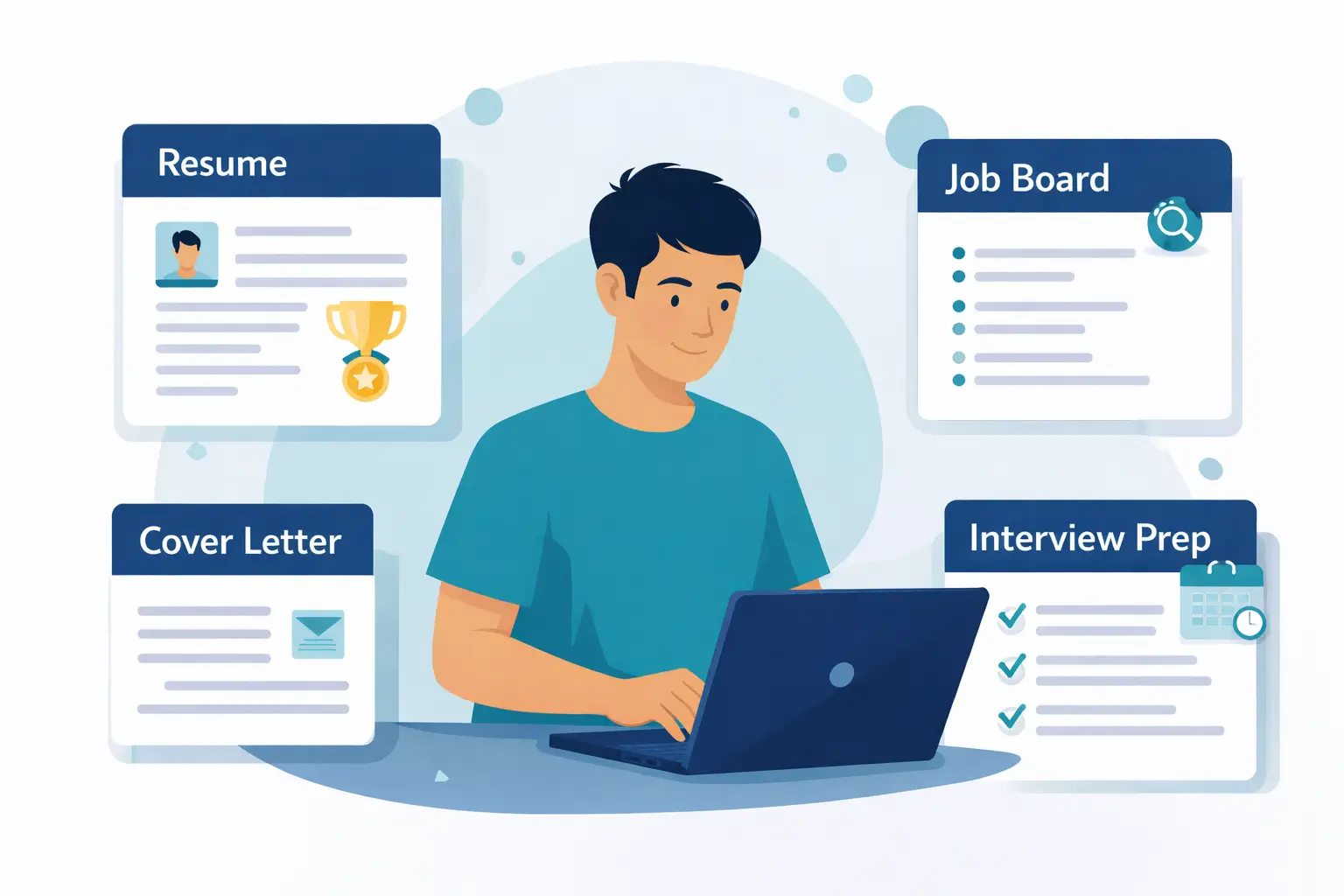
Before diving into specific platforms, it helps to understand the categories these tools fall into:
- Resume builders and optimizers help you create, format, and tailor your resume for specific roles and ATS systems.
- Cover letter generators draft personalized cover letters based on your resume and the job description.
- Job matching and discovery tools scan job boards and recommend roles that fit your profile.
- Application trackers keep your entire job search organized with dashboards, pipelines, and reminders.
- Interview prep tools simulate interviews, generate likely questions, and coach you on answers.
- Auto-apply tools submit applications on your behalf across multiple job boards.
The best AI job search strategy uses a combination of these tools at different stages. No single platform does everything perfectly — yet.
The Best AI Job Search Tools Compared
1. Seekario — Best All-in-One AI Job Search Platform
Seekario stands apart by covering the entire job search workflow in a single platform. Instead of stitching together five different tools, you get resume building, resume tailoring, ATS assessment, cover letter generation, interview prep, LinkedIn optimization, and job tracking all under one roof.
Key features:
- AI Resume Builder Creates professional, ATS-optimized resumes from scratch using your experience and target role.
- AI Resume Tailor Analyzes a job description and adjusts your resume's keywords, skills, and summary to match what the employer is looking for.
- AI Resume Scanner Scores your resume against a job posting and gives you a detailed breakdown of what's working and what's missing.
- AI Cover Letter Generator Writes targeted cover letters that reference the specific role and company — not generic fill-in-the-blank templates.
- AI Interview Prep Generates likely interview questions based on the job description and coaches you on strong answers using the STAR method.
- AI LinkedIn Profile Builder Helps you rewrite your LinkedIn headline, summary, and experience sections for recruiter visibility.
- Job Tracker A Kanban-style board to track every application from "interested" to "offer received."
Why it stands out: Most platforms specialize in one or two features. Seekario is designed for job seekers who want to stop juggling tabs and subscriptions. You tailor your resume, generate a cover letter, track the application, and prep for the interview — all from the same dashboard.
Best for: Job seekers who want a unified workflow without paying for multiple subscriptions.
2. Jobscan — Best for ATS Resume Optimization
Jobscan built its reputation on one thing: helping you beat ATS filters. You paste your resume and a job description, and the tool gives you a match score along with specific keyword and formatting recommendations.
Key features:
- Resume-to-job-description match scoring
- Keyword gap analysis
- ATS formatting checks
- LinkedIn profile optimization
- Cover letter optimization
Pricing: 5 free scans per month. Premium starts at $49.95/month.
Best for: Candidates applying to large companies that heavily rely on ATS screening (especially tech, finance, and healthcare).
Limitations: Jobscan focuses almost entirely on ATS optimization. It doesn't build resumes from scratch, track applications, or prep you for interviews. You'll need additional tools for those steps.
3. Teal — Best for Job Search Organization
Teal has evolved from a simple job tracker into a more complete platform. Its browser extension lets you save jobs from any board with one click, and its dashboard keeps everything organized with status tracking, notes, and contact management.
Key features:
- Chrome extension for one-click job saving
- AI-assisted resume customization
- Job application tracker with pipeline view
- Cover letter generation
- Company and contact management
Pricing: Free tier available. Premium plans unlock AI features.
Best for: Highly organized job seekers who apply to many roles and need a central command center.
Limitations: Resume and cover letter AI features are functional but less specialized than dedicated tools. The strength is in organization, not content creation.
4. Jobright — Best for AI-Powered Job Matching
Jobright uses AI to analyze your profile and recommend roles that match your skills, experience, and preferences. Instead of manually searching boards and filtering by keyword, the platform surfaces opportunities you might otherwise miss.
Key features:
- AI job matching based on your full profile
- Resume tailoring suggestions
- Application tracking
- Networking recommendations
- Company insider connections
Best for: Job seekers who feel overwhelmed by the volume of postings and want curated recommendations.
Limitations: Matching quality depends heavily on how complete your profile is. The tool is strongest when you invest time in setting up detailed preferences.
5. Sonara — Best for Automated Applications
Sonara takes a more hands-off approach. After reviewing your resume and preferences, it identifies relevant roles and handles much of the application process. It's designed for job seekers who want to maximize volume without spending hours on individual submissions.
Key features:
- Automated job discovery based on preferences
- AI-assisted application submission
- Resume customization per role
- Application status tracking
Best for: People who want to cast a wide net quickly, especially during an active job search sprint.
Limitations: Auto-apply tools come with a real risk: mass applications that feel generic can hurt your reputation with recruiters. Hiring managers increasingly notice when applications lack personalization. Use automated submissions as a supplement, not your entire strategy.
6. Huntr — Best for Visual Application Tracking
Huntr's Kanban-style board makes it easy to see where every application stands at a glance. It's lightweight, visual, and integrates with common job boards.
Key features:
- Kanban board for application tracking
- Job saving via browser extension
- Resume and cover letter tools
- Contact and networking tracking
- Interview notes and follow-up reminders
Best for: Visual thinkers who want a simple, clean way to manage their search pipeline.
Limitations: AI features are more basic compared to dedicated AI platforms. Huntr shines as a tracker, not as a content creation tool.
7. LoopCV — Best for High-Volume Applications
LoopCV automates job discovery and application at scale. Upload your CV, set your preferences, and the platform applies to matching roles across multiple job boards on your behalf.
Key features:
- Automated job discovery and application
- Multi-board scanning
- Email tracking for responses
- Dashboard analytics on application performance
Best for: Job seekers who want to maximize application volume, particularly in competitive markets.
Limitations: As with any auto-apply tool, quality can suffer at high volume. Some employers may flag auto-submitted applications as lower priority.
8. Enhancv — Best for Resume Design
Enhancv pairs strong visual templates with AI-powered content suggestions. If how your resume looks matters as much as what it says — for creative roles, design positions, or startup applications — Enhancv delivers polished results.
Key features:
- Design-forward resume templates
- AI content suggestions and rewriting
- ATS-compatible formatting options
- Cover letter builder
- Resume review and scoring
Pricing: Starts at approximately $16.66/month (billed quarterly).
Best for: Creative professionals, designers, and anyone applying to companies where visual presentation matters.
Limitations: The design focus means less emphasis on ATS optimization compared to tools built specifically for that purpose.
9. ChatGPT — Best Free Versatile AI Assistant
ChatGPT remains one of the most flexible tools for job seekers in 2026. You can use it to draft resumes, write cover letters, generate interview questions, role-play mock interviews, and brainstorm career strategies.
Key features:
- Resume and cover letter drafting from prompts
- Interview question generation based on job descriptions
- Mock interview role-play
- Career strategy brainstorming
- Salary research and negotiation scripting
Pricing: Free tier available. Plus starts at $20/month.
Best for: Budget-conscious job seekers who are comfortable writing their own prompts and don't need a structured workflow.
Limitations: ChatGPT isn't a job search platform — it's a general-purpose AI. There's no ATS scoring, no application tracking, no job matching. You have to bring the structure yourself, and the quality of the output depends entirely on how well you prompt it.
How to Build Your AI Job Search Stack
You don't need every tool on this list. The key is matching the right tools to your specific bottleneck. Here's a framework:
If your resume isn't getting callbacks: Start with ATS optimization. Use Seekario's AI Resume Scanner to identify keyword gaps, then tailor your resume with the AI Resume Tailor.
If you're drowning in applications with no system: Add a tracker. Seekario's Job Tracker, Teal, or Huntr can bring order to the chaos.
If you're getting interviews but not offers: Focus on interview prep. Seekario's AI Interview Prep generates role-specific questions and helps you structure compelling answers.
If you're not finding the right roles: Use a matching tool like Jobright or Seekario's Job Search to surface opportunities that align with your skills and preferences.
If you want to maximize volume quickly: Consider auto-apply tools like Sonara or LoopCV — but only as a supplement to targeted, customized applications.
What to Look for When Choosing an AI Job Search Tool
Not all AI tools are created equal. Here's what separates the useful ones from the overhyped:
- ATS compatibility. Does the tool actually help you pass automated screening? Look for keyword analysis and formatting checks.
- Personalization quality. Generic outputs waste your time. The best tools tailor content to specific job descriptions, not just your general profile.
- Workflow integration. Can you move from resume to cover letter to application tracking without switching platforms?
- Transparency. Does the tool explain its recommendations, or is it a black box?
- Pricing fairness. Monthly subscriptions add up fast. Look for tools that offer meaningful free tiers or reasonable pricing relative to the features you'll actually use.

The Limits of AI Job Search Tools
AI tools are powerful, but they can't do everything. Here's what still requires a human touch:
- Networking. Referrals remain the most effective way to land interviews. AI can help you optimize your LinkedIn profile and draft outreach messages, but building real relationships takes genuine effort.
- Telling your story. A resume gets you in the door. But explaining your career transitions, motivations, and unique perspective during an interview — that's on you.
- Judgment calls. Should you accept that offer? Negotiate harder? Wait for another opportunity? These decisions require context that no algorithm fully understands.
- Company culture fit. AI can match your skills to a job description, but it can't tell you whether you'll enjoy working at that company day-to-day.
Use AI tools to handle the repetitive, time-consuming parts of job hunting. Save your energy for the high-impact activities where being human is the advantage.
FAQ
Are AI job search tools worth paying for?
It depends on where you're stuck. If your resume isn't getting past ATS filters, a paid tool with keyword analysis can pay for itself with one interview callback. If you're already getting interviews but struggling with offers, interview prep tools offer more value. Start with free tiers to test what works, then invest in the area where you need the most help.
Can AI tools automatically apply to jobs for me?
Some tools like Sonara and LoopCV offer auto-apply features. They scan job boards and submit applications on your behalf. While this saves time, there's a trade-off: mass-applied resumes often feel generic. Recruiters can tell when an application wasn't customized for their role. Use auto-apply for volume, but always send tailored applications for your top-choice positions.
Do employers care if I used AI to write my resume?
Most employers don't care how you created your resume — they care whether it clearly demonstrates your qualifications. The goal isn't to hide AI usage; it's to use AI as a starting point and then personalize the output with your actual achievements, specific numbers, and authentic voice.
Which AI job search tool is best for recent graduates?
Recent graduates benefit most from tools that help build a resume from limited experience and prepare for interviews. Seekario's AI Resume Builder can help structure your education, internships, and projects into a compelling resume. The AI Interview Prep feature is also valuable when you don't have years of interview experience to draw from.
How many AI job search tools should I use at once?
Two to three is the sweet spot for most people. You want enough coverage to handle resume optimization, application tracking, and interview prep — but not so many that managing the tools becomes its own full-time job. A unified platform like Seekario reduces the need for multiple subscriptions by combining these features in one place.
Finding the Right Tools for Your Search
The AI job search landscape in 2026 is crowded, but the right combination of tools can genuinely accelerate your search. The key is being strategic: identify your biggest bottleneck, pick the tool that addresses it, and avoid the temptation to automate everything.
AI handles the repetitive work — formatting resumes, generating cover letters, organizing applications, surfacing relevant roles. You handle the parts that matter most — networking, interviewing with authenticity, and making smart career decisions.
Ready to streamline your entire job search in one platform? Try Seekario to build, tailor, and assess your resume, generate cover letters, prep for interviews, and track every application — all from a single dashboard.
.webp)

