How to Answer 'Tell Me About Yourself' in an Interview


It's the first real question in almost every interview, and most candidates blow it. Not because they're unqualified — because they don't know what the question is actually asking.
"Tell me about yourself" isn't an invitation to recite your resume from top to bottom. It's not a request for your life story. And it's definitely not the time to wing it and hope something coherent comes out.
This question is your opening pitch. Hiring managers use it to gauge three things: whether you can communicate clearly, whether you understand the role, and whether your background makes sense for what they need. Nail this answer and you set the tone for the entire conversation. Fumble it and you spend the rest of the interview climbing out of a hole.
Here's how to build an answer that's sharp, relevant, and memorable — with frameworks you can adapt to any role, any industry, and any career stage.
What Interviewers Actually Want to Hear
When someone across the table says "tell me about yourself," they're running a quick mental checklist:
Can this person communicate? Your answer reveals whether you can organize your thoughts and deliver them clearly under mild pressure. If you ramble for four minutes without a point, that tells them something.
Do they understand the role? A strong answer connects your background to what the company needs. A weak answer talks about things that don't matter for the position.
Is there a logical career narrative? Hiring managers want to see that your career makes sense — that each step led somewhere intentional, even if the path wasn't perfectly linear.
Are they genuinely interested? Your enthusiasm (or lack of it) comes through immediately. This question is where you show you didn't just spray-and-pray your application.
The key takeaway: this question is about relevance, not completeness. You're not summarizing your entire career. You're highlighting the parts that matter for *this* job.
The Present-Past-Future Framework
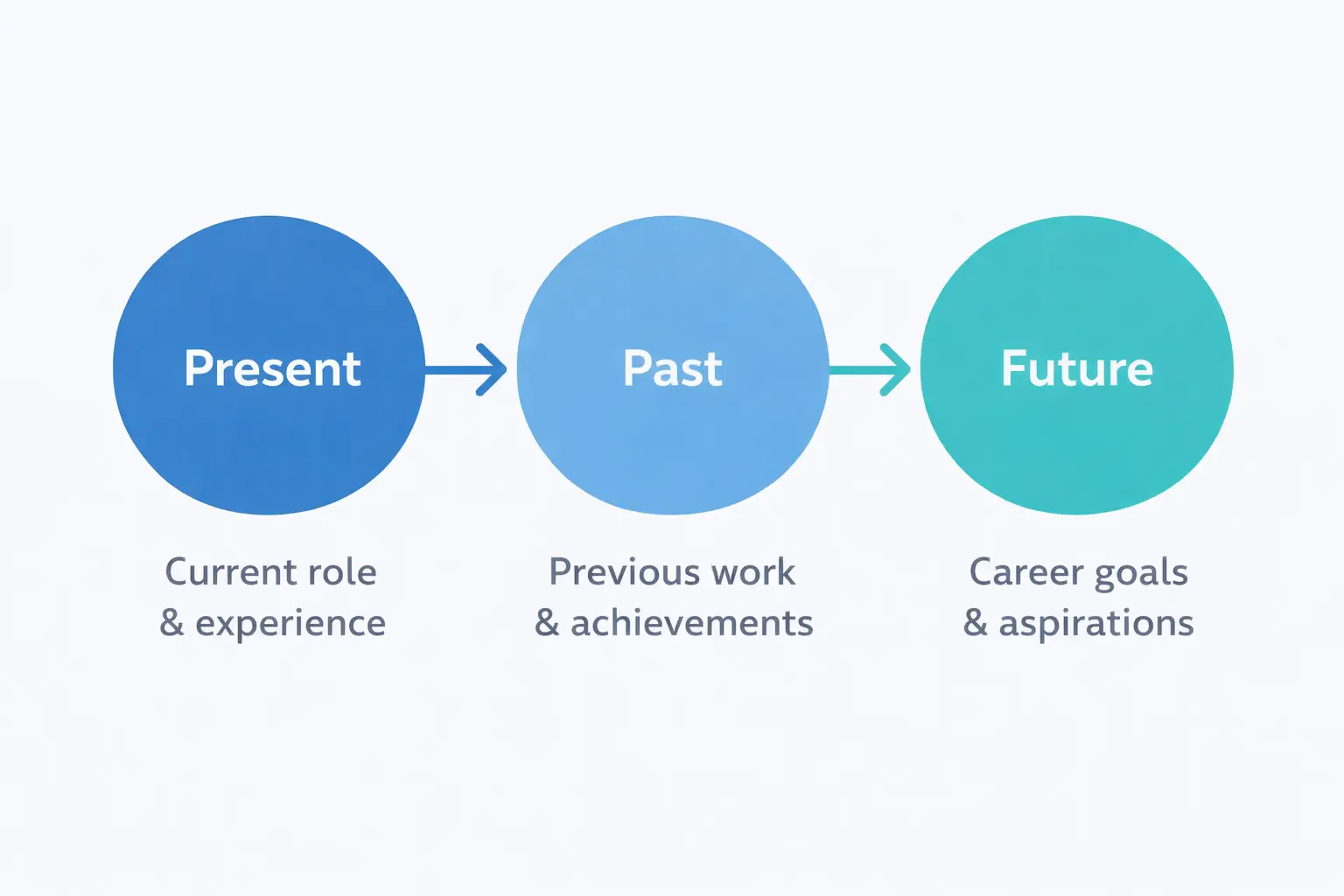
The most reliable structure for answering this question is the Present-Past-Future framework. It works because it follows a natural narrative arc and keeps your answer focused.
Present: Start with who you are right now. Your current role, your primary responsibilities, and one notable achievement or focus area.
Past: Briefly explain how you got here. Touch on the experience, education, or career move that's most relevant to the role you're interviewing for.
Future: Wrap up by connecting to the opportunity in front of you. Explain why you're excited about this specific role and what you'd bring to it.
Here's what this sounds like in practice:
*"I'm currently a product marketing manager at a B2B SaaS company where I lead go-to-market strategy for our enterprise product line. Last quarter, I drove a launch that generated 40% more qualified leads than our previous release. Before this, I spent three years in content marketing, which gave me a strong foundation in audience research and messaging. I'm excited about this role because your team is building a new market category, and that kind of strategic positioning work is exactly where I want to focus my career."*
That's about 80 words — roughly 30 to 40 seconds of speaking. Clean. Relevant. Forward-looking.
The Tailored Approach: Adjust for Your Audience
One underrated skill in interviewing: adjusting your answer based on who's asking.
Recruiter or phone screen: Keep it high-level. Focus on your headline, years of experience, and why you're interested. Recruiters are matching you against a requirements checklist, so hit the key qualifications clearly.
Hiring manager: Get slightly more specific about your relevant skills and recent accomplishments. This person cares about how you'd perform day-to-day, so show that you understand the work.
Senior leadership or executive: Zoom out. Talk about your strategic impact, your understanding of the company's mission, and how your experience aligns with broader business goals.
Panel interview: Find the middle ground. Keep your answer broad enough for everyone to follow, but specific enough to show depth. You'll get a chance to go deeper with individual panelists later.
This doesn't mean preparing four completely different answers. It means having one core narrative that you can adjust — shorter or longer, more tactical or more strategic — depending on the context.
Examples by Career Stage
Entry-Level / New Graduate
*"I just completed my degree in computer science at the University of Michigan, where I focused on machine learning and data systems. During my senior year, I built a recommendation engine as part of a capstone project with a local retail company — that's when I realized I wanted to work on applied ML rather than pure research. I also completed an internship at a fintech startup where I worked on data pipeline automation. This role caught my attention because your team is applying machine learning to real customer problems at scale, and that's exactly the challenge I want to take on."*
Why it works: No apologies for being early-career. Instead, it highlights relevant projects and genuine interest. The answer also shows initiative through the internship and capstone project.
Mid-Career Professional
*"I've spent the past eight years in financial planning and analysis, most recently as a senior FP&A analyst at a healthcare company where I manage a $200M operating budget. My biggest contribution has been building a rolling forecast model that cut our variance from plan by 30%. Before that, I worked in corporate accounting, which gave me a strong technical foundation in GAAP and financial reporting. I'm looking to move into a leadership role, and this FP&A manager position is a great fit because it combines strategic planning with team development — both areas I'm ready to grow into."*
Why it works: Clear progression, quantified results, and a specific reason for pursuing this opportunity. It tells a story of someone who's earned their next step.
Career Changer
*"For the past six years, I've been a high school science teacher — and I've loved it. I've developed curriculum, managed classrooms of 30+ students, and run data-driven interventions to improve student outcomes. Over the past year, I've been transitioning into instructional design. I completed a certificate program in learning experience design and built three e-learning modules for a nonprofit. I'm drawn to this role because your team is reimagining onboarding for a large distributed workforce, and my experience designing learning experiences for diverse audiences translates directly to that challenge."*
Why it works: It doesn't hide the career change — it reframes the previous experience as relevant. The certificate and portfolio projects show commitment to the pivot.
Six Mistakes That Kill Your Answer
1. Starting With "Well, I Was Born In..."
No one needs your autobiography. The interviewer wants professional relevance, not a timeline that starts in elementary school. Begin with your current role or most recent relevant experience.
2. Reciting Your Resume Line by Line
They've already read it (or at least skimmed it). Repeating it word-for-word wastes your chance to add context, personality, and narrative that a resume can't capture.
3. Going Longer Than 90 Seconds
The ideal answer runs 60 to 90 seconds. If you're still talking after two minutes, you've lost them. Practice with a timer until you can hit the right length consistently.
4. Being Too Vague
"I'm a hard worker who's passionate about making a difference" tells the interviewer nothing. Replace abstract qualities with specific skills, accomplishments, and interests. Show, don't tell.
5. Forgetting to Connect to the Role
Every great answer ends by linking your background to the job you're interviewing for. If you stop at describing your history without explaining why you're sitting in that chair, you've missed the point.
6. Badmouthing Your Current Employer
Even if you're leaving a toxic workplace, this answer isn't the place to mention it. Keep the tone forward-looking and positive. "I'm looking for an opportunity to..." works better than "I'm trying to get away from..."
How to Practice Without Sounding Rehearsed
The goal is to sound natural, not scripted. Here's how to get there.
Write it out first. Draft your answer in full sentences. This forces you to organize your thoughts and cut the fluff.
Reduce it to bullet points. Once you have a written version you like, distill it into three to four bullet points. These become your mental guideposts during the interview.
Practice out loud — a lot. Say it aloud at least ten times. Record yourself and listen back. You'll catch filler words, awkward transitions, and sections that drag.
Practice with AI. Seekario's AI Interview Prep lets you run through mock interviews with realistic follow-up questions. It's particularly useful for testing whether your "tell me about yourself" answer naturally leads into deeper conversation about your qualifications.
Vary it slightly each time. You don't want to deliver the exact same words in a robotic tone. Practice hitting the same key points with slightly different phrasing each time, so it sounds conversational rather than memorized.
Adapting Your Answer for Different Interview Formats
Video Interviews
Look directly into the camera (not the screen) when delivering your answer. Speak slightly slower than you would in person — audio compression can make rushed speech harder to follow. Keep a copy of your bullet points just below the camera as a safety net.
Phone Screens
Without visual cues, your voice does all the heavy lifting. Stand up while you talk — it changes your vocal energy. Have your notes in front of you, but don't read them verbatim. Phone screens typically run shorter, so aim for 45 to 60 seconds.
One-Way Video (Recorded)
Some companies use asynchronous video platforms where you record your answer. Treat it like a live interview but take advantage of the ability to re-record. Watch your first take, note what to improve, and record a cleaner version.
FAQ
How long should my "tell me about yourself" answer be?
Aim for 60 to 90 seconds. This gives you enough time to cover your present role, relevant background, and interest in the position without losing the interviewer's attention. If you're in a panel interview or speaking with a senior executive, you can extend to about two minutes — but only if every second adds value.
Should I include personal information in my answer?
Keep it professional. The rare exception is if a personal interest directly connects to the role or company mission — for example, mentioning your passion for accessibility technology when interviewing at a company focused on inclusive design. Otherwise, save personal details for the casual small talk that often happens at the beginning or end of interviews.
What if I'm asked this question multiple times during the interview process?
Adjust your answer for each stage. For a recruiter, emphasize your high-level fit and interest. For the hiring manager, go deeper into relevant skills and recent accomplishments. For a senior leader, focus on strategic impact and alignment with company goals. The core narrative stays the same; the emphasis shifts.
How do I answer this as a career changer?
Lead with your transferable skills and the steps you've taken toward the new field. Don't apologize for your previous career — reframe it as an asset. Mention any relevant courses, certifications, or projects that demonstrate commitment to the transition. Then connect your unique background to the specific value you'd bring to this role.
Can AI help me prepare my answer?
Yes — and it should. Tools like Seekario's AI Interview Prep can generate realistic interview simulations tailored to specific roles and companies. Practicing with AI lets you refine your answer through repetition and get feedback on structure, length, and relevance before you're in the actual interview.
Your Opening Answer Sets the Trajectory
Every interview follows the trajectory set by your first answer. A strong "tell me about yourself" response creates momentum — the interviewer sees you as organized, relevant, and worth their time. The conversation flows naturally from there.
A weak opener does the opposite. You spend the next 30 minutes trying to recover ground you never should have lost.
The fix isn't complicated: know your narrative, practice it until it feels natural, and tailor it for every role you pursue. If you want a structured way to practice, Seekario's AI Interview Prep gives you unlimited mock interviews with role-specific questions and real-time feedback — so you walk into every interview with your answer already dialed in.


