How to Write a Follow-Up Email After an Interview


You walked out of the interview feeling great. The conversation flowed, you nailed the tough questions, and the hiring manager seemed genuinely impressed. Then... silence. Days pass with no word. You start second-guessing everything.
Here's the thing: 91% of employers actually want to receive a follow-up email after an interview. Yet 57% of candidates never send one. That means writing a solid follow-up email after interview puts you ahead of more than half of your competition — before anyone even reviews your qualifications again.
This guide breaks down exactly when to send your follow-up, what to write, and how to handle the dreaded "no response" scenario. You'll also get ready-to-use templates you can customize in minutes.
Why Sending a Follow-Up Email Matters More Than You Think
A follow-up email after an interview isn't just a polite gesture — it's a strategic move. Hiring managers typically interview multiple candidates over several days. By the time they sit down to compare notes, your conversation might blur with everyone else's.
A well-written thank-you email does three things at once. First, it keeps your name at the top of the hiring manager's inbox (and mind). Second, it gives you a chance to reinforce your strongest qualifications. Third, it signals professionalism, attention to detail, and genuine interest in the role.
Recruiters consistently report that candidates who send personalized follow-up emails are viewed more favorably than those who don't. Personalized emails are three times more likely to receive a response than generic ones — so the effort you put into customization directly impacts your chances.
If you're applying to multiple roles simultaneously, tools like Seekario's AI Networking Tool can help you prepare talking points before each interview, making it easier to reference specific details in your follow-up.
When to Send Your Follow-Up Email
Timing can make or break your follow-up. Here's the breakdown:
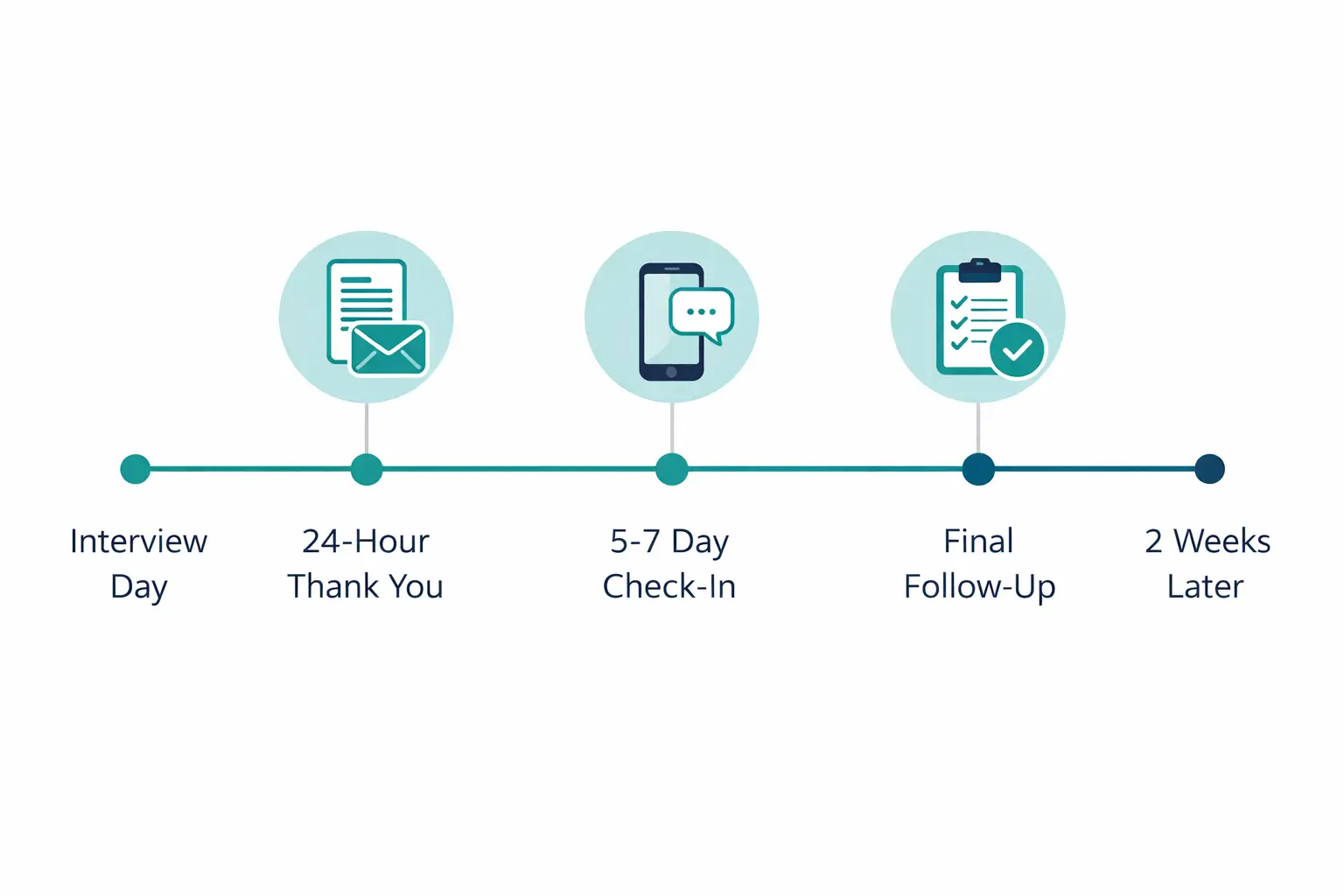
Within 24 hours (the thank-you email): Send your initial thank-you email the same day as your interview or by the next morning at the latest. This is the standard window that hiring managers expect. Waiting longer than 48 hours makes your message feel like an afterthought.
5–7 business days later (the status check): If you haven't heard back and no timeline was given, send a brief status update email. Keep it short — one or two sentences asking about next steps is plenty.
1–2 days after a stated deadline passes: If the interviewer said, "We'll have a decision by Friday," wait until the following Monday or Tuesday before reaching out. This shows patience while keeping your name visible.
The final follow-up: After two unanswered follow-ups, send one last gracious note. Express continued interest, thank them again, and let them know you're available if anything changes. Then redirect your energy to other opportunities.
The sweet spot for sending? Late afternoon, between 4 and 6 PM. Your email lands near the top of their inbox for the next morning.
What to Include in Your Follow-Up Email
Every effective follow-up email after interview contains five elements:
A clear subject line. Keep it simple and direct. Something like "Thank you for the conversation — [Your Name]" or "Following up on our [Day] interview." If you already have an email thread with the interviewer, reply to it rather than starting a new chain.
A genuine thank you. Open by thanking the interviewer for their time and for sharing details about the role. Be specific — mention something they said that stuck with you.
A personal callback. Reference a specific moment from the conversation. Maybe the interviewer described a challenge the team is facing, or you bonded over a shared interest. This detail proves you were actively listening and engaged.
A value reinforcement. In two to three sentences, connect your skills to something discussed during the interview. This isn't the place to rehash your entire resume — pick one relevant strength and tie it directly to a need they mentioned.
A forward-looking close. Express enthusiasm for the role and next steps. End with something like, "I look forward to hearing about the next steps" rather than a passive "Let me know if you need anything."
Follow-Up Email Templates You Can Use Today
Template 1: The Standard Thank-You (Send Within 24 Hours)
Subject: Thank you for the conversation today
Hi [Interviewer's Name],
Thank you for taking the time to speak with me today about the [Job Title] role at [Company]. I enjoyed learning about [specific topic discussed — e.g., "your team's approach to cross-functional product launches"].
Our conversation reinforced my excitement about this opportunity. My experience with [relevant skill or achievement] aligns well with [specific need or project they mentioned], and I'm eager to contribute to [team/company goal].
Please don't hesitate to reach out if you need any additional information from me. I look forward to hearing about next steps.
Best regards,
[Your Name]
Template 2: The Panel Interview Follow-Up
When you interview with multiple people, send a personalized email to each one. Here's how to keep them distinct without starting from scratch:
Subject: Great speaking with you about [specific topic from their portion]
Hi [Interviewer's Name],
Thank you for the insightful conversation during today's interview. I especially appreciated your perspective on [something unique this person discussed].
It was helpful to understand how the [team/department] approaches [challenge or project], and I believe my background in [relevant area] would allow me to make an immediate impact.
I'm excited about the possibility of joining the team. Thank you again for your time.
Warm regards,
[Your Name]
Template 3: The Status Check (5–7 Days Later)
Subject: Following up on [Job Title] interview
Hi [Interviewer's Name],
I hope you're having a good week. I wanted to follow up on our conversation last [day] about the [Job Title] position. I remain very interested in the role and would love to learn about any updates on the timeline.
Please let me know if there's any additional information I can provide. Thank you again for the opportunity.
Best,
[Your Name]
Template 4: The Final Follow-Up (10+ Days, No Response)
Subject: Checking in — [Job Title] position
Hi [Interviewer's Name],
I understand how busy hiring processes can be, so I wanted to send one last note to express my continued interest in the [Job Title] role. The work your team is doing with [project/initiative] is genuinely exciting to me.
If the position has been filled or the timeline has shifted, I completely understand. I'd appreciate any update you're able to share, and I hope we might connect on future opportunities.
Thank you for your time and consideration.
Best regards,
[Your Name]
How to Follow Up After Different Interview Types
The type of interview you had should shape your approach.
After a phone screen: Keep it short — three to four sentences max. Phone screens are early-stage, so a brief note thanking the recruiter and expressing interest in moving forward is sufficient. Mention one thing from the call that excited you about the role.
After a video interview: Treat this the same as an in-person interview. Video calls can feel less personal, so your follow-up is a chance to build the connection you might have missed through a screen. Reference something visual if relevant — a whiteboard in their background, a team photo, anything that shows you paid attention.
After an in-person interview: This is where your follow-up can be most personal. If the interviewer walked you through the office or introduced you to team members, mention it. These details show you're already picturing yourself in the role.
After a technical assessment or case study: Go beyond the standard thank you. Briefly reference your approach to the problem and mention any additional thoughts you've had since the session. This demonstrates you're still engaged with the material.
Mistakes That Kill Your Follow-Up Email
Even a well-intentioned follow-up can backfire. Here are the most common mistakes:
Being too generic. "Thank you for the interview, I'm really interested in the role" tells the hiring manager nothing. If your email could apply to any job at any company, it's not doing its job. Specificity is what separates a memorable follow-up from one that gets deleted.
Writing a novel. Your thank-you email should be under 200 words. Your status check should be under 150. Hiring managers skim emails — long messages signal poor communication skills.
Following up too aggressively. Sending daily emails doesn't show enthusiasm — it shows a lack of awareness. Stick to the timeline outlined above and give the hiring process room to breathe.
Typos and wrong names. As one talent acquisition director put it, sending an email with a typo or to the wrong person is far worse than not sending one at all. Triple-check the recipient's name, the company name, and the job title before hitting send.
Apologizing for following up. Phrases like "Sorry to bother you" or "I know you're busy" undermine your message. You have every right to follow up — do it with confidence.
What to Do When You Don't Hear Back
Ghosting is frustratingly common. Nearly half of job seekers in 2026 report being ghosted during their search. Here's how to handle it without spiraling.
First, don't assume the worst. Hiring delays happen for reasons that have nothing to do with you — budget freezes, internal reorganizations, competing priorities. The recruiter might simply be buried in their inbox.
Second, follow the three-touchpoint rule. Send your thank-you email within 24 hours, a status check at the 5-to-7-day mark, and one final follow-up at 10-plus days. After that, move on mentally while leaving the door open.
Third, try a different channel. If email isn't getting a response, a brief LinkedIn message can sometimes break through. Keep it casual: "Hi [Name], I just wanted to touch base about our conversation last week. Looking forward to any updates!"
Finally, keep applying. Waiting on one opportunity while ignoring others is a recipe for frustration. Use a tool like Seekario's Job Tracker to organize your applications and follow-up schedule so nothing falls through the cracks.
How AI Can Streamline Your Post-Interview Follow-Up
Writing personalized follow-up emails for every interview gets time-consuming, especially when you're juggling multiple applications. AI tools can help you draft and refine your messages faster without sacrificing the personal touch.
Seekario's AI Interview Prep helps you prepare structured talking points before each interview. When it's time to write your follow-up, you'll have clear notes on what was discussed, making it easy to reference specific details that show you were engaged.
The key is using AI as a drafting assistant, not a replacement for your voice. Start with an AI-generated draft, then personalize it with specific references from your conversation. This approach gives you the speed of automation with the authenticity hiring managers expect.
FAQ
How long should a follow-up email be after an interview?
Keep your thank-you email under 200 words and your status-check emails under 150 words. Hiring managers read dozens of emails daily. A concise, personalized message is far more effective than a lengthy one.
Should I send a follow-up email after a phone screen?
Yes, but keep it brief — three to four sentences. Thank the recruiter, mention one thing that excited you about the role, and express your interest in moving to the next round.
Is it okay to follow up if the interviewer said they'd contact me?
Wait until their stated deadline passes, then give it one to two additional business days before following up. This shows you respected their timeline while staying engaged.
Should I send a handwritten thank-you note instead of an email?
Email first, always. It's immediate and expected. A handwritten note can be a thoughtful addition after later-stage interviews, but it should never replace a timely email sent within 24 hours.
How many times should I follow up before giving up?
Three times maximum: an immediate thank-you, a status check at 5–7 days, and a final follow-up at 10+ days. After that, redirect your energy to other applications. Persistent follow-up beyond three touchpoints rarely changes the outcome and can damage your professional reputation.
Send the Email That Gets You Remembered
The follow-up email after an interview is one of the simplest ways to separate yourself from the competition. It takes 10 minutes to write and can be the deciding factor when a hiring manager is choosing between two equally qualified candidates.
Don't overthink it. Be specific, be grateful, and be brief. Reference something real from your conversation, reinforce your strongest qualification, and close with confidence.
If you're managing multiple interviews and want to stay organized from prep through follow-up, Seekario's AI-powered tools can help you prepare better talking points, track your applications, and never miss a follow-up window.


