Resume Length: How Long Should Your Resume Be in 2026?

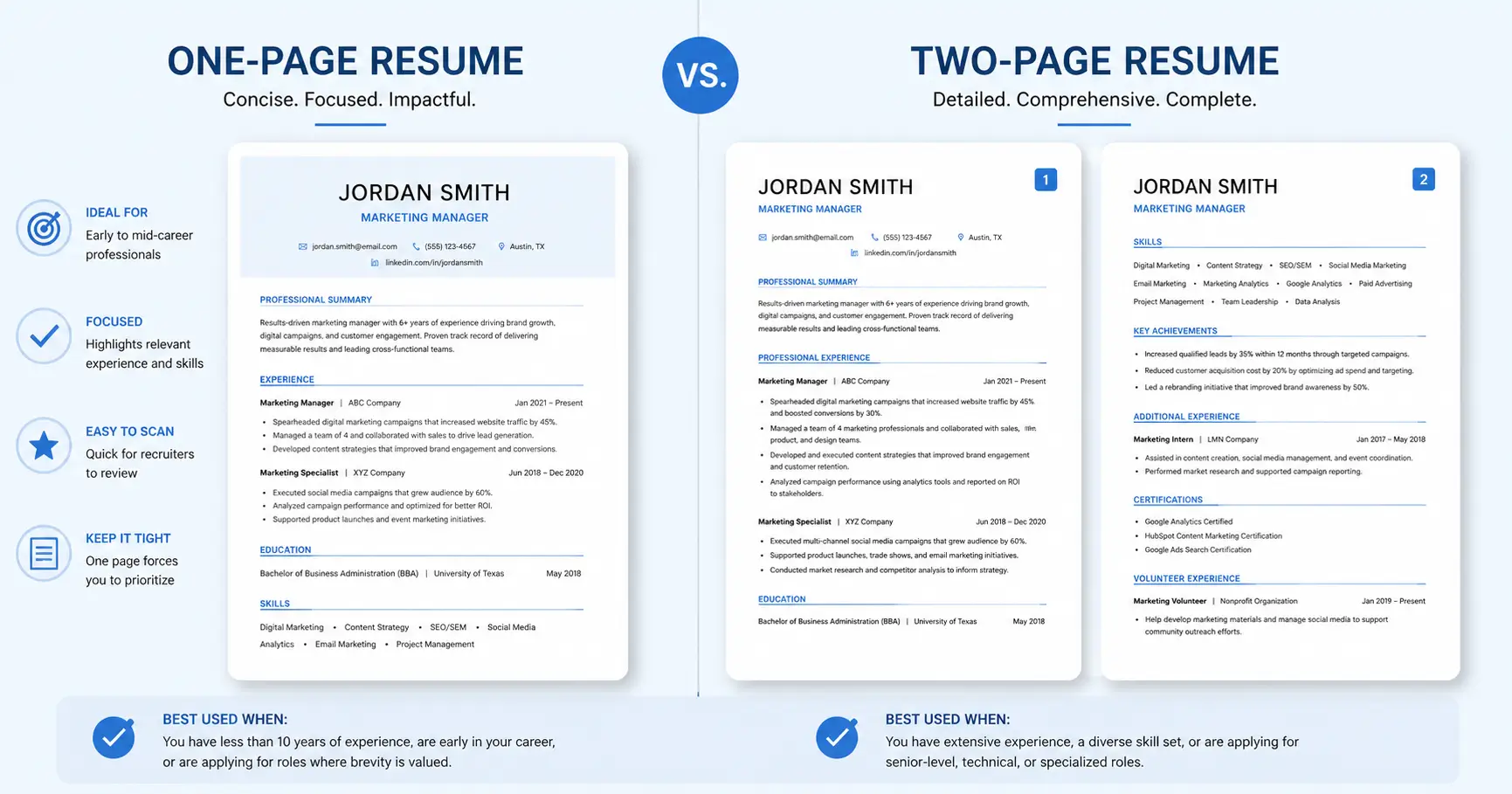
You've probably heard the old rule: keep your resume to one page. It was drilled into career centers and job search advice for decades. But in 2026, that rule is outdated — and following it could actually hurt your chances.
A recent survey found that 68.6% of recruiters now prefer two-page resumes, while only 21.6% still favor the one-page format. The shift is real, and it's backed by callback data: two-page resumes received 2.3 times more callbacks than one-page versions for candidates with 10+ years of experience.
So where does that leave you? The honest answer is that the right length depends on your experience, your industry, and how well you use the space. Here's how to figure out the right length for your situation.
The One-Page Resume: When It Still Works
A single page is appropriate when you have limited professional experience and every line on your resume earns its place. Specifically, a one-page resume works best if you fall into one of these categories:
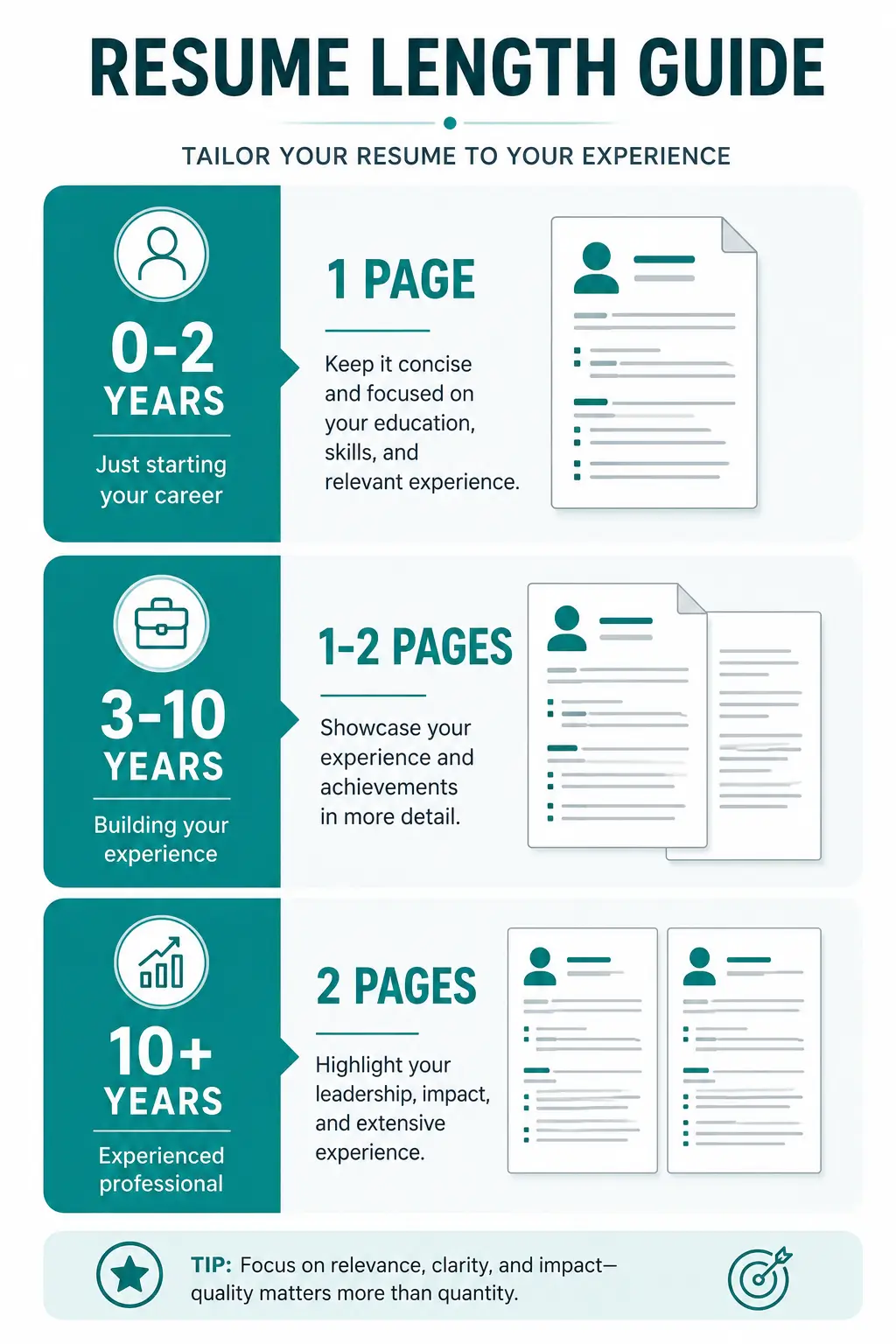
- You have 0–2 years of experience. Recent graduates and early-career professionals typically don't have enough relevant experience to justify a second page. Padding with irrelevant coursework or high school achievements weakens your resume.
- You're applying to a role with a very focused skill set. Some positions — like a junior graphic designer or entry-level sales rep — don't require an exhaustive work history. A tight, focused page can be more compelling than a stretched two-pager.
- The job posting specifically requests a one-page resume. Some companies, particularly startups and creative agencies, state a preference. Follow their lead.
If you're in one of these situations, a well-crafted single page is not a disadvantage. The key word is "well-crafted." A one-page resume that's cramped, uses 9-point font, and has zero white space is worse than a clean two-pager.
The Two-Page Resume: The New Standard
For anyone with three or more years of relevant experience, two pages has become the standard in 2026. The data supports this clearly: 51% of HR professionals specifically prefer two-page resumes, and recruiters spend an average of 4 minutes and 5 seconds reviewing a two-page resume compared to just 2 minutes and 24 seconds on a one-page version.
More time on your resume means more opportunity to make your case. Two pages give you room to:
- Include a meaningful professional summary rather than a one-line objective.
- Detail accomplishments with quantified results for each role.
- List relevant skills, certifications, and technical proficiencies without cramming.
- Add a section for key projects, publications, or volunteer work that strengthens your candidacy.
The important caveat: two pages doesn't mean filler. Every section should serve a purpose. If your second page is half-empty or padded with irrelevant information, cut it back to one strong page.
When Three Pages Might Be Appropriate
Three-page resumes are rare, but they're not always wrong. They make sense for professionals with 25+ years of continuous, relevant experience, or for candidates in fields where extensive documentation is expected — like academia, medicine, or federal government.
Speaking of federal jobs: as of late 2025, USAJobs restricts all resumes to two pages for Title 5 announcements. If you're applying to federal roles in 2026, treat two pages as a hard limit.
For everyone else, if your resume is creeping past two pages, it's usually a sign that you need to edit, not expand. Cut roles from 15+ years ago that aren't relevant. Trim bullet points to your top 3–4 per position. Remove skills that are assumed for your level (like "Microsoft Word" for a senior manager).
What About ATS and Resume Length?
Applicant tracking systems don't penalize longer resumes. In fact, a two-page resume gives you more space to include the keywords that ATS software scans for. The concern with length is never about the ATS — it's about the human reader on the other side.
That said, ATS formatting still matters regardless of length. Avoid headers and footers (many ATS platforms can't read them), use standard section headings, and skip graphics or tables that might confuse the parser. If you want to check whether your resume passes ATS scans, run it through Seekario's AI Resume Assessment tool to catch formatting and keyword issues before you submit.
The Real Rule: Relevance Per Square Inch
Forget counting pages. The better question to ask yourself is: "Does every line on my resume directly support my candidacy for this specific role?"
If the answer is yes and it takes two pages, use two pages. If the answer is yes and it fits on one page, don't stretch it. The recruiters who spend those 7.4 seconds on an initial scan aren't counting pages — they're scanning for relevant experience, recognizable keywords, and clear formatting.
Here are a few practical guidelines for maximizing relevance:
- Lead with your strongest content. Your most recent and relevant experience should dominate the top half of page one.
- Cut anything older than 10–15 years unless it's directly relevant to the role.
- Use bullet points with quantified results. "Managed a team" is forgettable. "Led a 12-person team that increased quarterly revenue by 18%" is not.
- Tailor the length to each application. A role that closely matches your background might need a full two pages. A stretch role might be better served by a focused single page.
Seekario's AI Resume Builder helps you build resumes that are the right length for each application by focusing on the most relevant content for the specific job description. It pulls the right keywords and structures your experience so nothing critical gets buried on page two.
The Ideal Word Count
Research on resume effectiveness points to a sweet spot: resumes in the 475–600 word range produce an interview rate of about 8.2%, nearly double the average. That translates to roughly one well-formatted page or a tight page-and-a-half.
If you're targeting a senior role with a longer resume, aim for 600–800 words across two pages. The principle is the same — dense, relevant content with no filler.
FAQ
Is a one-page resume still expected?
Not for most candidates. Only 21.6% of recruiters now prefer one-page resumes. If you have more than two years of relevant experience, a two-page resume is generally the better choice. The key is that every line adds value — length should be driven by substance, not padding.
Do applicant tracking systems reject longer resumes?
No. ATS platforms parse and index content regardless of page count. A longer resume actually gives you more opportunities to include relevant keywords. The real ATS risk is poor formatting (graphics, tables, unusual fonts), not length.
How do I know if my resume is too long?
Ask yourself whether you could remove any section without weakening your candidacy. If your second page has bullet points from jobs 15+ years ago, generic skills, or irrelevant volunteer work, it's time to trim. Every line should directly support the role you're applying for.
Should I change my resume length for different applications?
Yes. Tailoring your resume to each job description isn't just about keywords — it's also about emphasis and length. A role that matches your core experience might justify a full two-page resume, while a stretch role might benefit from a tighter, more focused single page. Tools like Seekario's AI Resume Tailor can help you adjust quickly.
What about resume length for federal jobs?
As of late 2025, USAJobs limits resumes to two pages for most Title 5 positions. If you're applying to federal roles, stick to two pages maximum and focus on specific qualifications, KSAs (Knowledge, Skills, and Abilities), and measurable outcomes.
Get the Right Length — Automatically
The best resume isn't the shortest or the longest. It's the one where every sentence pulls its weight. Instead of obsessing over page count, focus on building a resume that speaks directly to the job you want.
Seekario's AI Resume Builder takes the guesswork out of resume length by analyzing your experience against the job description and building a resume that includes exactly what matters — nothing more, nothing less. Try it free and see the difference a well-structured resume makes.