The Complete Guide to Resume Sections: Every Part of Your Resume Explained (2026)

Your resume is a collection of sections, each doing a specific job. Get the wrong sections — or arrange them poorly — and even strong qualifications get buried. Get them right, and recruiters see exactly what they need in the six to eight seconds they spend scanning your document.
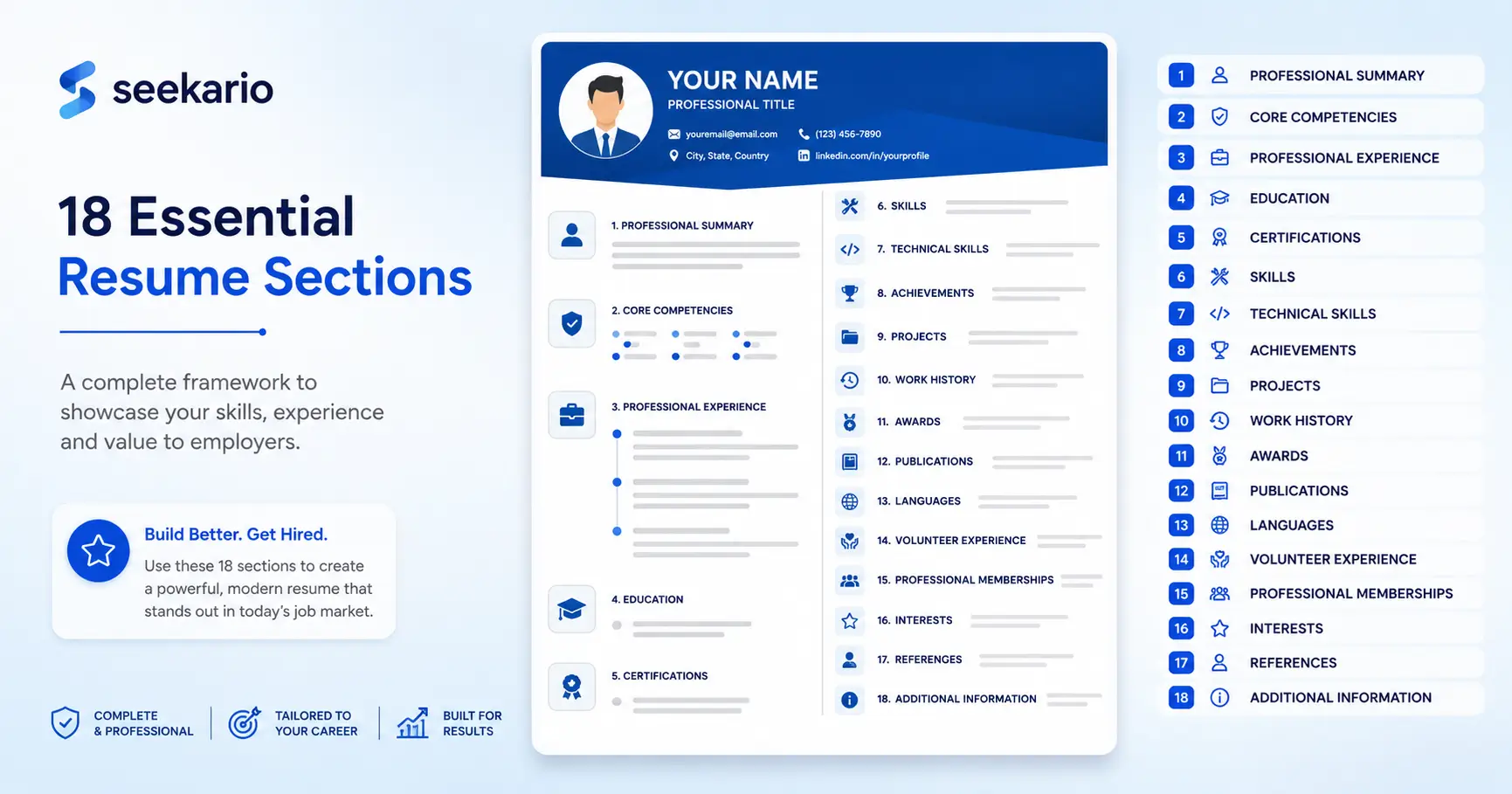
Most guides cover five or six resume sections. This one covers all 18, from the essentials that every resume needs to the optional sections that can set you apart for specific roles. Each section includes formatting guidance, real examples, ATS compatibility notes, and links to deeper articles where you can master the details.
Whether you're writing your first resume or rebuilding one after a decade, this is the only reference you need.
1. Contact Information
Every resume starts here. Your contact information sits at the top of the page and tells the recruiter exactly how to reach you.
What to include:
- Full name (matching your LinkedIn and professional profiles)
- Phone number (one reliable number with a professional voicemail)
- Professional email address (firstname.lastname@email.com, not partyguy99@hotmail.com)
- City and state (full street addresses are outdated and raise privacy concerns)
- LinkedIn profile URL (customized, not the default string of numbers)
What to leave off in 2026:
Skip your date of birth, marital status, photo (in the US, UK, Canada, and Australia), and full mailing address. These open the door to unconscious bias and aren't needed for the hiring process. Some countries — Germany, parts of Asia — still expect a photo, so research norms for your target market.
ATS tip: Use a simple, single-line or stacked format. Avoid placing contact details inside headers or text boxes, since many applicant tracking systems can't read content embedded in those elements.
For a deep dive on what's changed, read our full guide: Resume Contact Information: What to Include and What to Leave Off (2026).
2. Professional Summary
A professional summary is a two-to-four sentence snapshot at the top of your resume. It answers three questions: Who are you? What do you bring? Why should the reader keep going?
When to use it: If you have three or more years of relevant experience, a summary is your strongest opening move. It gives recruiters immediate context before they reach your bullet points.
Formula that works:
[Title/identity] + [years of experience] + [2-3 signature strengths or achievements] + [what you're targeting]
Example:
> Senior product manager with 8 years of experience shipping B2B SaaS products across fintech and health-tech. Led a cross-functional team of 12 to launch a compliance automation tool that reduced client onboarding time by 40%. Seeking a Director of Product role at a growth-stage company.
Common mistakes: Writing vague statements like "results-driven professional seeking new opportunities." Every word should earn its place. If it could apply to anyone, cut it.
Seekario's AI Resume Builder generates tailored professional summaries based on your experience and target role, so you can skip the blank-page problem entirely.
For 50+ examples organized by industry and experience level, see: How to Write a Resume Professional Summary (50+ Examples by Industry).
3. Resume Objective Statement
An objective statement serves a different purpose than a summary. Instead of showcasing what you've done, it states what you're aiming for — and why you're a fit despite limited direct experience.
When to use it: Choose an objective over a summary when you're entering the workforce for the first time, changing careers, or returning after a significant gap. The objective bridges the gap between where you've been and where you're headed.
Example (career changer):
> Former high school science teacher transitioning into instructional design. Bringing 6 years of curriculum development, learner assessment design, and ed-tech tool adoption. Pursuing an instructional designer role where I can apply evidence-based teaching methods to corporate training programs.
When to skip it: If you have direct, relevant experience, a summary will always outperform an objective. The objective signals that you're making a case for fit, which is less compelling when your experience already speaks for itself.
For a visual decision flowchart on choosing between summaries and objectives, check out: Resume Summary vs Resume Objective: Which One Gets You Hired?.
4. Work Experience
This is the section recruiters spend the most time on. Your work experience section documents your professional history in reverse chronological order — most recent role first.
What each entry needs:
- Job title
- Company name and location (city, state or remote)
- Employment dates (month/year format)
- 3-6 bullet points per role describing what you accomplished
The bullet point formula:
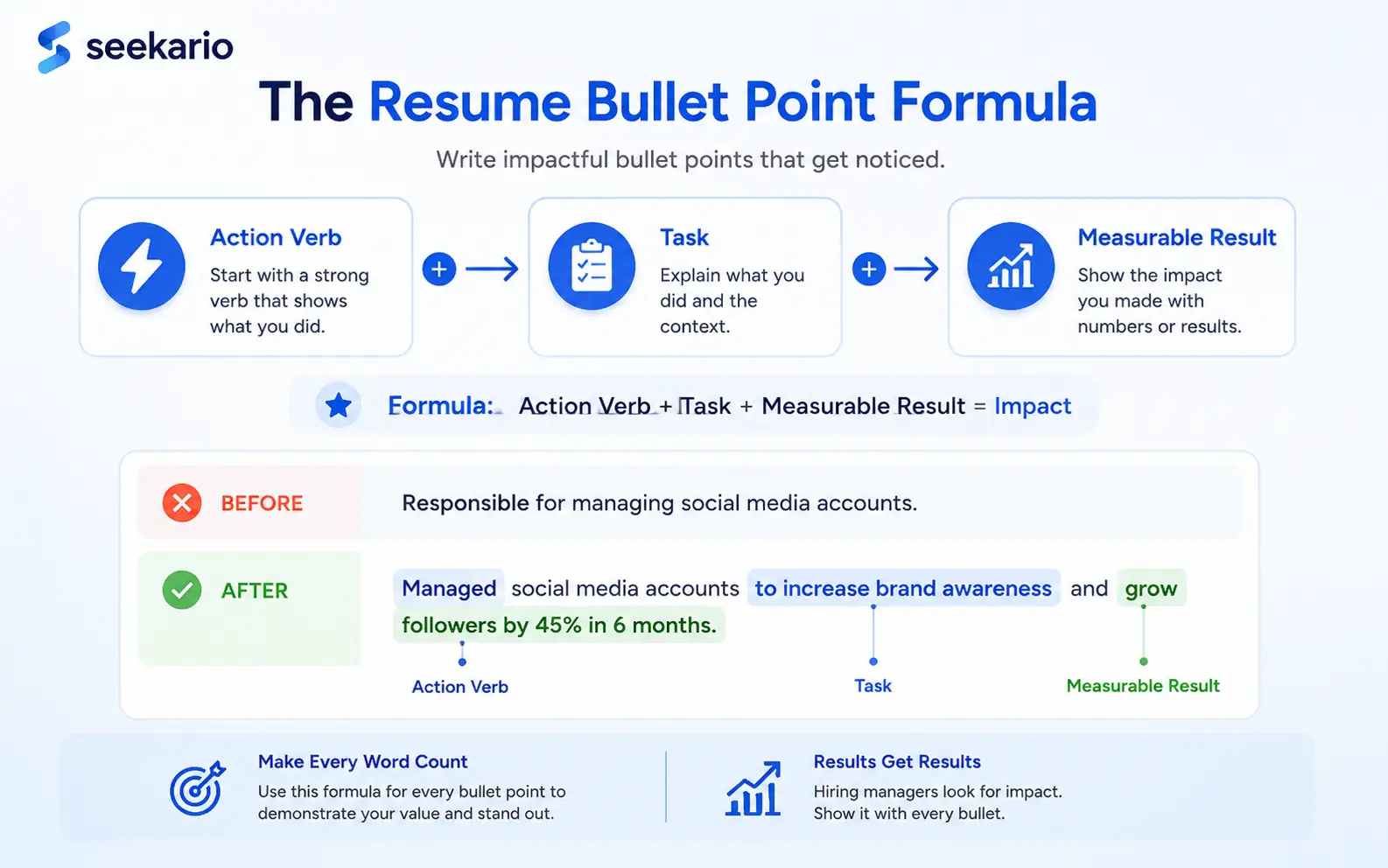
Strong resume bullets follow a consistent pattern: Action verb + what you did + measurable result.
Weak: "Responsible for managing social media accounts."
Strong: "Grew Instagram following from 2,400 to 18,000 in 9 months through a content strategy focused on user-generated stories, increasing engagement rate by 215%."
The difference is specificity. Numbers, percentages, dollar amounts, and timeframes turn generic duties into evidence of impact.
How many roles to include: For most professionals, the last 10-15 years of experience is sufficient. Roles older than that can be summarized in a single line or grouped under an "Earlier Experience" heading.
Remote work: If you worked remotely, list "Remote" where you'd normally put the location. This is standard practice and helps recruiters understand your experience with distributed teams.
ATS formatting: Use standard headers like "Work Experience," "Professional Experience," or "Employment History." Creative labels like "Where I've Made an Impact" confuse ATS parsers.
Need help turning duties into achievements? Seekario's AI Resume Tailor rewrites your bullets to match a specific job description, so each application highlights the right accomplishments.
For 30+ before-and-after examples across industries, see: How to Write Work Experience on a Resume (With 30+ Examples).
5. Skills
The skills section is a curated list of your technical and interpersonal abilities. It serves two audiences: ATS software scanning for keywords and recruiters looking for a quick capabilities snapshot.
Hard skills vs. soft skills:
Hard skills are teachable, measurable abilities: Python, financial modeling, Figma, project scheduling in Jira. Soft skills are behavioral: leadership, communication, problem-solving, adaptability.
Research from LinkedIn's 2025-2026 data shows that the most effective resumes balance both — roughly 60% hard skills and 40% soft skills — though the exact ratio depends on your industry.
How to organize:
Group skills into categories rather than dumping them into a single list. A data analyst might use:
- Languages & Tools: Python, SQL, R, Tableau, Power BI
- Methods: Regression analysis, A/B testing, cohort analysis
- Soft Skills: Cross-functional communication, stakeholder management
AI skills in 2026: Employers increasingly value AI literacy. If you've used tools like ChatGPT, GitHub Copilot, Midjourney, or AI-powered analytics platforms in a professional context, include them. Framing matters — don't just list the tool. Show how you used it: "Prompt engineering for automated report generation using GPT-4."
Matching skills to job descriptions: Pull exact skill phrases from the job posting and incorporate them naturally. If the job says "Salesforce CRM," don't write "CRM software" — match the specific term.
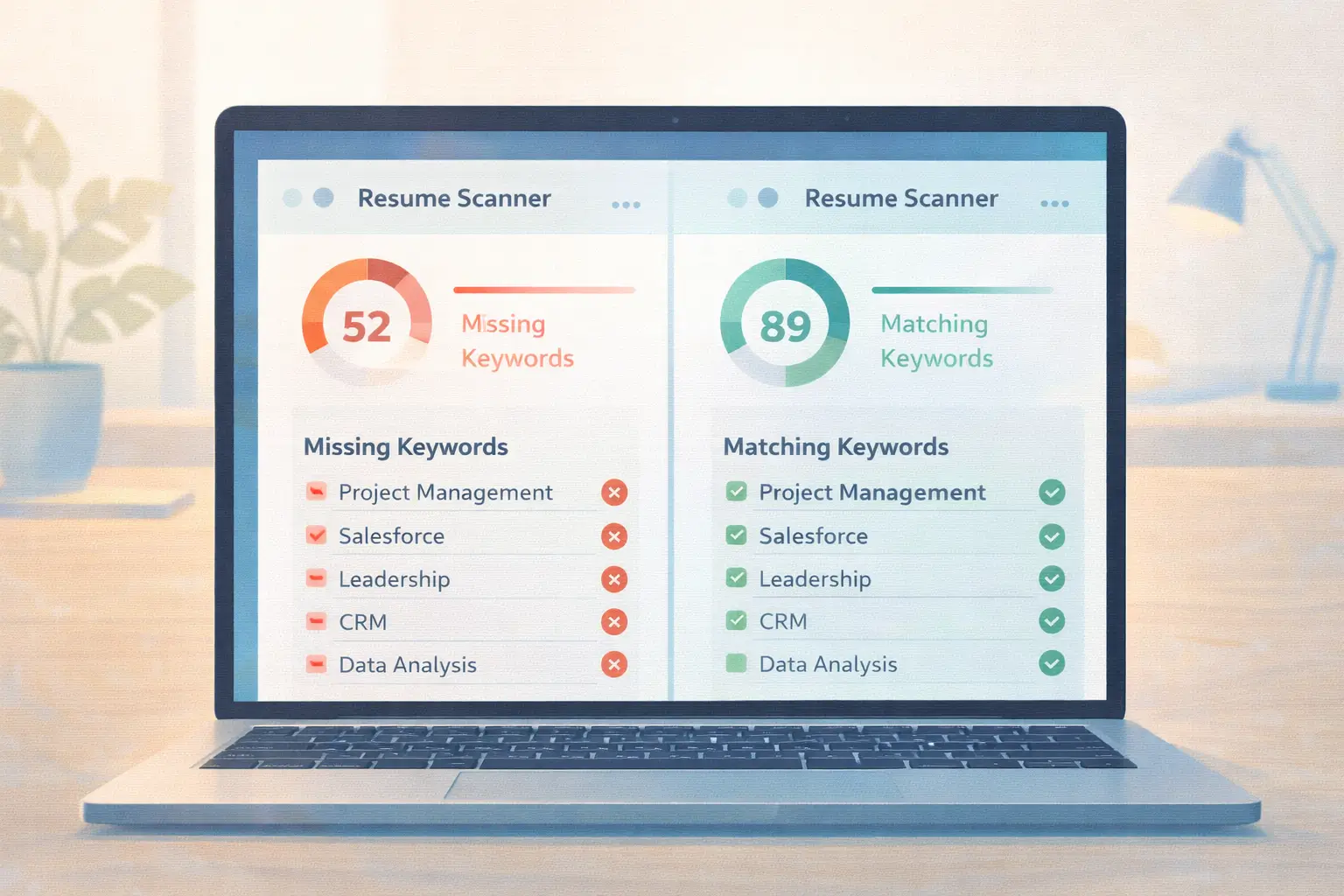
Seekario's AI Resume Scanner scans your resume against any job description and flags missing keywords, so you never leave obvious matches on the table.
For the full breakdown with 200+ examples by industry, see: How to List Skills on a Resume: Hard Skills, Soft Skills & Examples (2026).
6. Education
Your education section lists your academic credentials. Its length and placement depend on where you are in your career.
Standard format:
> Bachelor of Science in Computer Science
> University of Michigan, Ann Arbor, MI — May 2021
For recent graduates (0-3 years out): Place education near the top, after your summary or objective. Include GPA if it's 3.5 or above, relevant coursework, academic honors, and capstone projects.
For experienced professionals (3+ years): Move education below work experience. Keep it brief — degree, institution, graduation year. Drop the GPA, coursework, and graduation honors unless they're directly relevant to the target role.
Special scenarios:
- Incomplete degree: List it as "Coursework toward [Degree], [University], [Dates Attended]."
- Bootcamps: Include the bootcamp name, provider, completion date, and key technologies covered.
- International degrees: Add a US equivalency note if applicable (e.g., "Equivalent to a US Bachelor's degree per WES evaluation").
- Multiple degrees: List in reverse chronological order. An MBA above a Bachelor's.
For every edge case including GPA cutoffs by industry, see: How to List Education on a Resume: Every Scenario Covered (2026).
7. Certifications
Certifications prove that a recognized authority has validated your expertise. In fields like IT, project management, healthcare, and finance, the right certification can be the difference between getting an interview and getting filtered out.
Format:
> AWS Solutions Architect – Associate
> Amazon Web Services — Issued March 2025 (Expires March 2028)
Placement options:
- Dedicated section: Best when you have three or more relevant certifications.
- Within education: Works when you have one or two and they're closely tied to your degree.
- After your name: For industry-standard credentials (CPA, PMP, PE), adding the abbreviation after your name in the header is common and expected.
Expired certifications: If a cert has lapsed and you plan to renew it, note "Renewal in progress." If you don't plan to renew, leave it off.
Certificates vs. certifications: A certification involves an exam and ongoing maintenance (PMP, CISSP). A certificate is a completion credential from a course (Google Data Analytics Certificate). Both have value, but they signal different things — know the distinction.
For ROI data on the most valuable certifications in 2026, see: Best Professional Certifications to Boost Your Resume in 2026 (By Industry).
8. Projects
A projects section showcases applied work outside of traditional employment. This section carries weight for new graduates, career changers, freelancers, and anyone in technical roles.
Types of projects to include:
- Academic capstone or thesis projects
- Personal side projects (apps, websites, data analyses)
- Open-source contributions
- Freelance work
- Hackathon entries
Format:
> Customer Churn Prediction Model — Personal Project (2025)
> Built a gradient-boosted model in Python (scikit-learn) predicting churn with 89% accuracy on a 50K-record telecom dataset. Deployed via Streamlit dashboard. [GitHub link]
What makes a project worth including: Relevance to the target role, a clear outcome or result, and demonstrable skills. A portfolio website you built to learn React belongs on a front-end developer resume. A macramé Etsy shop probably doesn't — unless you're applying for an e-commerce role.
For five project types with formatting templates, see: How to Add Projects to Your Resume (Students, Career Changers & Freelancers).
9. Achievements and Awards
An achievements section spotlights recognition you've earned — awards, honors, rankings, or standout accomplishments that don't fit neatly into your work experience bullets.
When to use a dedicated section:
If you have three or more notable achievements that would clutter your work experience, break them into their own section. Otherwise, weave them into the relevant experience entry.
Context is everything:
A bare award name means nothing to someone outside your organization. Add context.
Weak: "President's Club 2024"
Strong: "President's Club 2024 — awarded to top 5% of sales representatives (12 of 240) for exceeding annual quota by 135%"
Types of achievements:
- Industry awards and recognition
- Internal company awards
- Sales rankings or performance tiers
- Published research or patents
- Speaking engagements at notable conferences
- Scholarships and academic honors
For formatting guidance and 100+ metric examples, see: How to Quantify Achievements on Your Resume (100+ Metric Examples).
10. Volunteer Experience
Volunteer work belongs on your resume when it demonstrates relevant skills, fills an employment gap, or shows alignment with the company's mission.
When volunteer experience shines:
- You're a recent graduate and your volunteer work is more relevant than your paid work.
- You're changing careers and your volunteer role involved skills from your target field.
- The company has a strong social mission and your volunteer work signals cultural fit.
- You have an employment gap and volunteered meaningfully during that period.
Format it like work experience: Give it the same treatment — organization name, your role, dates, and bullet points with outcomes.
> Volunteer Tax Preparer — VITA Program, Chicago, IL (Jan–Apr 2025)
> Prepared federal and state returns for 85+ low-income families. Identified an average of $2,400 in overlooked credits per filing.
For real scenarios where volunteer experience outperformed paid experience, see: How to Include Volunteer Experience on a Resume (And When It Helps).
11. Publications
A publications section is standard for academics, researchers, scientists, and professionals in healthcare, law, and policy. It's also increasingly relevant for thought leaders and content creators in business.
Format by citation style:
Use the standard citation style for your field (APA for social sciences, MLA for humanities, Chicago for history). On a resume, abbreviate where possible — you're not submitting to a journal.
> Smith, J., & Lee, A. (2025). "Predictive maintenance using federated learning in manufacturing IoT." *Journal of Industrial AI*, 12(3), 45-62.
What to include: Peer-reviewed articles, book chapters, white papers, conference proceedings, patents. Blog posts and opinion pieces generally don't belong here unless they're published on recognized industry platforms.
Prioritizing: If you have more than five publications, list the most recent and most relevant. Add "Selected publications; full list available at [link]."
For all citation formats and portfolio linking tips, see: How to List Publications on Your Resume (Academic & Professional).
12. Languages
Multilingual ability is a concrete advantage in global organizations, customer-facing roles, and any position involving international markets. If you speak more than one language, say so — and be precise about your level.
Proficiency scales:
Three systems are commonly used, and recruiters know them:
Format:
> Languages: English (Native), Spanish (Professional working proficiency — DELE B2), Mandarin (Conversational)
Placement: If language skills are central to the role (translator, international sales), place this section higher. For most resumes, it sits near the bottom as a supplementary section.
For a full comparison chart and international resume tips, see: How to List Languages on a Resume: Proficiency Levels & Format Guide.

13. Hobbies and Interests
This is the most debated resume section. Some recruiters appreciate it; others skip it entirely. The data points toward a nuanced answer.
When hobbies help:
- The hobby demonstrates a skill relevant to the role (competitive chess for an analytical position, marathon running for a role requiring discipline and endurance).
- The interest signals cultural alignment (open-source contributions for a tech company, volunteer coaching for a youth-focused nonprofit).
- You're early in your career and the section fills space that would otherwise be blank.
When hobbies hurt:
- They're generic and say nothing ("reading, travel, music").
- They're controversial or politically charged.
- Your resume is already full and the space would be better used for relevant experience.
2026 recruiter data suggests: Hobbies are most valued in creative industries, startups, and roles where personality and culture fit are heavily weighted. In finance, law, and government, they're largely ignored — but rarely harmful if kept brief.
For industry-by-industry recruiter data, see: Should You Include Hobbies on Your Resume? A Definitive Answer for 2026.
14. References
Here's the short answer: don't put references on your resume in 2026.
Survey data consistently shows that fewer than 15% of employers want to see references listed on the resume itself. The phrase "References available upon request" is equally outdated — employers already assume you'll provide them when asked.
What to do instead:
Prepare a separate reference sheet with three to five contacts. Each entry should include:
- Reference's name and title
- Company and relationship to you ("Direct supervisor at [Company], 2022-2025")
- Phone number and email
- A one-line note on what they can speak to
Have this document ready to send within 24 hours of being asked. Coach your references on the role you're pursuing so their responses align with your application.
Exception: Some industries (academia, government, senior executive roles) still expect references as part of the application package. Follow the specific instructions in the job posting.
For a downloadable reference sheet template, see: Resume References in 2026: How to List Them, When to Skip Them.
15. Action Verbs: The Building Blocks of Every Section
Action verbs aren't a section on their own, but they power every section that contains description — summaries, experience, projects, and volunteer work. Weak verbs weaken your entire resume.
Verbs to avoid: "Responsible for," "helped with," "assisted in," "worked on." These are passive, vague, and signal a follower rather than a driver.
Verbs that work, organized by impact:
- Leadership: Spearheaded, directed, orchestrated, championed
- Growth: Accelerated, expanded, scaled, generated
- Efficiency: Streamlined, automated, consolidated, optimized
- Analysis: Identified, diagnosed, evaluated, forecasted
- Creation: Designed, built, launched, engineered
- Communication: Negotiated, influenced, presented, facilitated
The rule: Start every bullet point with a strong action verb. No exceptions. Even your oldest role deserves active language.
For 200+ verbs with contextual examples, see: 200+ Resume Action Verbs That Get Results (Organized by Category).
16. Resume Section Order: How to Arrange Everything
The order of your sections matters as much as the content. Recruiters scan in an F-pattern — heavy attention at the top, declining as they move down. ATS parsers also expect sections in a conventional sequence.
Four templates based on career stage:
New graduate:
- Contact Information
- Objective Statement
- Education
- Projects
- Skills
- Internships / Work Experience
- Volunteer / Activities
Career changer:
- Contact Information
- Professional Summary (highlighting transferable skills)
- Skills (organized by relevance to new field)
- Work Experience (reframed with transferable achievements)
- Education
- Certifications
- Projects
Mid-career professional:
- Contact Information
- Professional Summary
- Work Experience
- Skills
- Education
- Certifications
- Optional sections (volunteer, languages, publications)
Senior executive:
- Contact Information
- Executive Summary
- Key Achievements / Leadership Highlights
- Work Experience
- Board Memberships / Advisory Roles
- Education
- Certifications / Speaking
The universal rule: Lead with your strongest material. If your education is more impressive than your experience, put it first. If your skills are what make you competitive, move them up.
For detailed templates you can follow, see: Resume Section Order: How to Arrange Your Resume for Maximum Impact.
17. Optional Sections: The Decision Framework
Not every resume needs all 18 sections. Adding irrelevant sections dilutes your strongest material and wastes space. Here's a quick decision matrix:
The one-page test: If adding a section pushes your resume past the appropriate length (one page for <10 years experience, two pages for 10+), cut the weakest optional section first.
For a detailed breakdown with yes/no guidance for each section, see: Optional Resume Sections: When to Add Them and When to Leave Them Out.
18. ATS Compatibility: Rules That Apply to Every Section
Applicant tracking systems parse your resume before a human ever sees it. According to multiple studies, up to 75% of resumes are filtered out by ATS before reaching a recruiter. Every section you write needs to pass the machine before it reaches a person.
Rules that apply across all sections:
- Use standard section headers. "Work Experience" not "My Professional Journey." ATS software looks for recognized headings.
- Avoid tables, columns, and text boxes. Many parsers read left-to-right, top-to-bottom. Multi-column layouts scramble the order.
- Stick to standard fonts. Calibri, Arial, Garamond, and Times New Roman parse reliably. Decorative fonts can cause character recognition errors.
- Save as .docx or .pdf depending on the instructions. When in doubt, .pdf preserves formatting and is widely parsable by modern ATS platforms.
- Mirror the job description's language. If the posting says "project management," don't write "PM" or "managing projects." Exact keyword matches score higher.
- No images, logos, or icons. ATS can't read visual elements. That star-rating graphic for your skill level? Invisible to the parser.
Seekario's AI Resume Checker runs a full ATS compatibility check on your resume and tells you exactly what to fix — from formatting issues to missing keywords.
Common Mistakes to Avoid
After reviewing thousands of resumes, certain mistakes come up repeatedly:
Including everything. A resume is a marketing document, not an autobiography. Every section and every bullet should be selected for relevance to your target role.
Using the same resume for every application. Tailoring your resume sections — particularly skills, summary, and experience bullets — to each job description dramatically increases your match rate. Seekario's AI Resume Tailor automates this, adjusting your content to align with each specific posting.
Burying your strongest material. If your certifications are what make you competitive, don't hide them at the bottom. Rearrange sections to lead with strength.
Inconsistent formatting. Mixing date formats, bullet styles, or heading sizes signals carelessness. Pick a format and stick with it throughout.
Listing duties instead of results. "Managed a team of five" tells a recruiter nothing about your impact. "Managed a five-person engineering team that shipped three product features ahead of schedule, reducing backlog by 40%" tells a story.
FAQ
What are the 5 main sections of a resume?
The five core sections every resume needs are contact information, professional summary (or objective), work experience, education, and skills. These form the foundation that ATS systems and recruiters expect to see. Optional sections like certifications, projects, and volunteer experience add depth depending on your background and target role.
What order should resume sections be in?
For most professionals with 3+ years of experience, the standard order is: contact information, professional summary, work experience, skills, education, then optional sections. New graduates should lead with education, and career changers should prioritize skills and a strong summary. The key principle is to lead with whatever makes the strongest case for your candidacy.
How many sections should a resume have?
Most effective resumes include 5-8 sections. The five core sections are mandatory, and you should add 1-3 optional sections that are relevant to your target role. Avoid padding your resume with irrelevant sections just to fill space — recruiters prefer focused, relevant content over length.
Should I include an objective or a summary on my resume?
Use a professional summary if you have 3+ years of relevant experience. Use an objective statement if you're a new graduate, changing careers, or re-entering the workforce. The summary showcases what you've accomplished; the objective explains where you're headed and why you're a fit despite limited direct experience.
What sections should I remove from my resume?
Remove references (prepare a separate sheet instead), "References available upon request," personal details like age or marital status, irrelevant hobbies, and any section that doesn't support your candidacy for the specific role. Also remove outdated information — roles from 15+ years ago can be condensed or cut entirely.
Build Your Resume Section by Section
Every section on your resume has a job to do. The contact info gets you reached. The summary gets you read. The experience gets you interviewed. The skills get you past the ATS. And the optional sections — certifications, projects, languages, volunteer work — provide the texture that separates you from candidates with identical qualifications.
The challenge isn't knowing what to include. It's getting every section polished, keyword-optimized, and tailored to each application you send.
That's where Seekario's AI Resume Builder comes in. It walks you through each section with intelligent suggestions, auto-generates achievement-oriented bullet points, and checks ATS compatibility in real time. You focus on your career story — the AI handles the formatting, keywords, and optimization.