How to Quantify Achievements on Your Resume (With Examples)

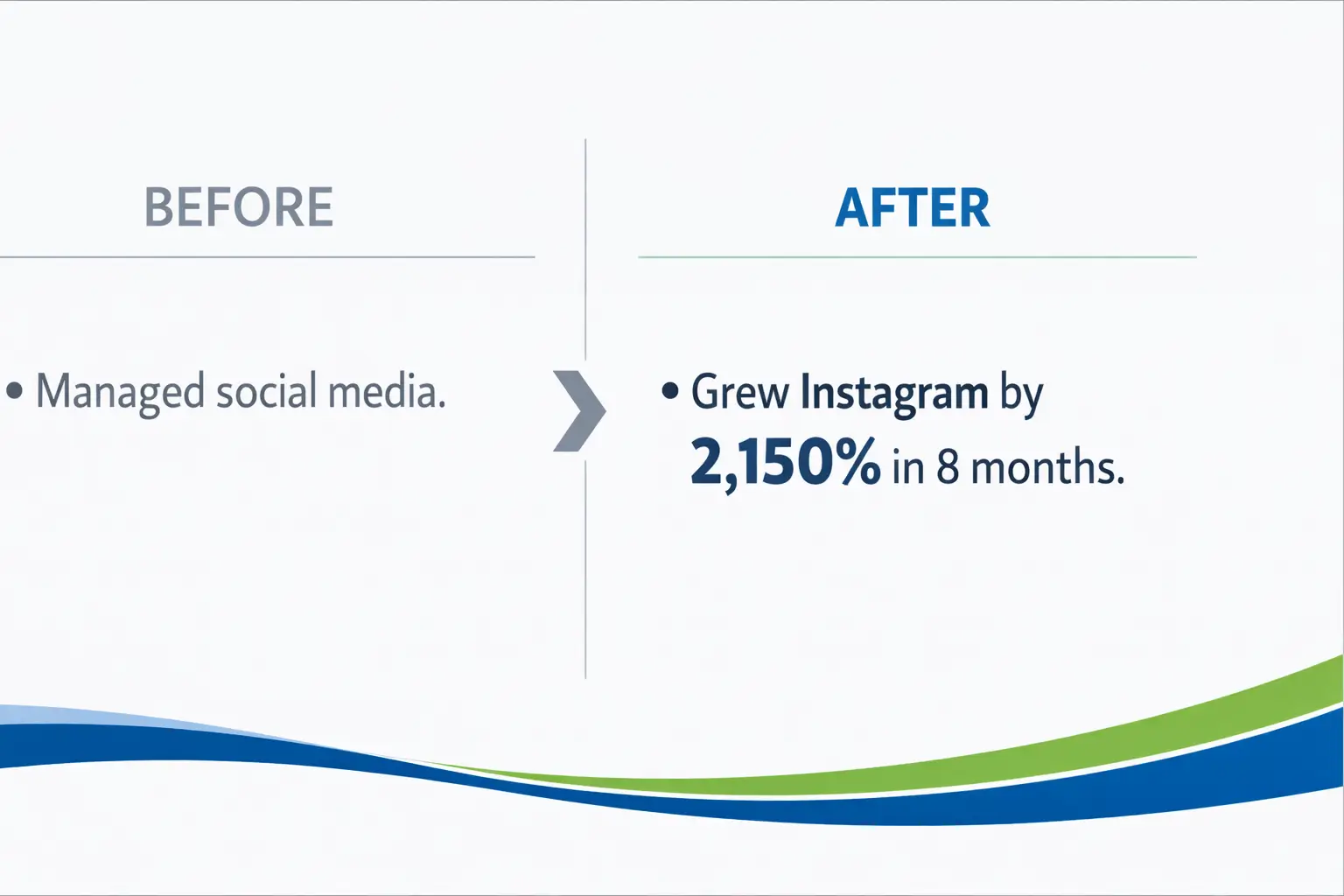
Here's a quick test. Which bullet point would make you want to interview a candidate?
- "Responsible for managing the company's social media accounts."
- "Grew Instagram following from 2,000 to 45,000 in 8 months, increasing website traffic from social by 160%."
The second one wins every time. The difference? Numbers. Quantified achievements tell recruiters exactly what you accomplished, not just what you were assigned. They turn vague job duties into concrete proof that you deliver results.
Studies show that resumes with quantified accomplishments are significantly more likely to catch a recruiter's attention. Yet most job seekers still fill their resumes with responsibility lists instead of measurable results. Let's fix that.
Why Numbers Matter on Your Resume
Recruiters spend an average of six to seven seconds on an initial resume scan. Numbers are the first thing their eyes catch because digits stand out from walls of text. A "25%" or "$50,000" pops off the page in a way that words simply don't.
But it goes deeper than visual attention. Numbers do three things that descriptions alone cannot:
They prove impact. Anyone can claim they "improved sales." Only someone who actually did it can say they "increased quarterly sales by 34%, adding $120,000 in revenue." Specificity signals credibility.
They give context. "Managed a team" could mean three interns or 300 engineers. "Led a cross-functional team of 12 across 4 departments" tells the recruiter exactly what scale you've operated at.
They make comparison easy. When a hiring manager is weighing two candidates, numbers make the decision simpler. A candidate who "reduced customer churn by 18%" is objectively easier to evaluate than one who "helped improve customer retention."
The 5 Categories of Resume Metrics
Not sure what to measure? Nearly every professional achievement falls into one of five categories. Use these as a framework when reviewing your work history.
1. Revenue and Money
This is the most powerful category. If your work directly or indirectly affected the bottom line, lead with dollar figures.
- Closed $2.3M in new business during Q3 2025, exceeding target by 15%
- Reduced operational costs by $85,000 annually by renegotiating three vendor contracts
- Managed a marketing budget of $500,000 across 6 channels with a 4.2x return on ad spend
2. Time and Efficiency
Employers love candidates who make things faster. Time savings translate directly to cost savings.
- Cut average customer onboarding time from 14 days to 5 days by redesigning the workflow
- Reduced monthly reporting time by 60% by automating data collection with Python scripts
- Decreased average ticket resolution time from 48 hours to 12 hours
3. Scale and Volume
How much did you handle? Numbers here show your capacity and reliability.
- Processed 200+ customer inquiries daily with a 97% satisfaction rating
- Managed a portfolio of 85 client accounts totaling $12M in annual recurring revenue
- Published 4 articles per week, generating 150,000+ monthly page views
4. Growth and Improvement
Percentages work well here. Show how things got better because of your work.
- Increased email open rates from 18% to 32% through A/B testing subject lines and send times
- Improved employee retention by 22% after implementing a new mentorship program
- Grew organic search traffic by 200% over 12 months through a targeted content strategy
5. People and Leadership
If you managed, trained, or mentored others, quantify the scope.
- Supervised a team of 8 developers across 3 time zones, delivering all projects on schedule
- Trained 45 new hires on company systems, reducing ramp-up time by 30%
- Mentored 6 junior analysts, 4 of whom were promoted within 18 months
How to Quantify Achievements When You Don't Have Exact Numbers
This is the most common objection: "But I don't have access to those metrics." That's okay. You don't need exact figures to quantify your work. Reasonable estimates are perfectly acceptable on a resume — and far better than no numbers at all.
Here are strategies for finding or estimating your numbers:
Check your old work. Look through emails, performance reviews, project reports, and Slack messages. You'll often find numbers you forgot about — team sizes, project budgets, deadlines met, customer feedback scores.
Use ranges or approximations. "Managed approximately 50 client accounts" or "Handled 100+ support tickets weekly" are both valid. The word "approximately" or the "+" symbol signals honesty while still giving concrete scale.
Calculate backward. If your team had 10 people and you know the department generated $5M in revenue, you can reasonably estimate your share of contribution. If you saved your team 2 hours per week on a process, multiply that by 52 weeks — that's 104 hours saved annually.
Ask former colleagues. A quick message to an old manager or teammate can help you recall project details, team sizes, or results you contributed to.
Use publicly available data. If you worked on a product with public metrics (app downloads, website traffic, social media followers), you can reference those numbers for the period you worked there.
The Formula for Writing Quantified Bullet Points
Every strong resume bullet follows a simple structure:
Action Verb + Task/Project + Method (optional) + Measurable Result
Here's how it looks in practice:
- Weak: Responsible for training new employees on software systems.
- Strong: Trained 30+ new employees on 5 software systems, reducing average onboarding time by 25%.
- Weak: Helped increase company revenue through sales initiatives.
- Strong: Generated $430,000 in new revenue by launching an upselling program targeting existing accounts.
- Weak: Managed the company blog.
- Strong: Grew blog traffic from 5,000 to 28,000 monthly visitors in 6 months, contributing to a 40% increase in inbound leads.
The key is starting with a strong action verb and ending with a measurable outcome. The middle explains what you did to get there.
If you're struggling to rewrite your bullet points, Seekario's AI Resume Builder can help you transform duty-based descriptions into achievement-focused statements with specific metrics.
30+ Quantified Achievement Examples by Industry
Sales and Business Development
- Exceeded annual sales quota by 28%, closing $1.8M in new contracts
- Expanded client base by 35% through targeted outbound campaigns, adding 120 new accounts
- Shortened average sales cycle from 45 days to 28 days by implementing a new qualification framework
Marketing and Communications
- Launched a referral program that generated 2,500 new sign-ups in the first quarter
- Increased email subscriber list from 8,000 to 22,000 in 10 months with a lead magnet strategy
- Reduced cost per acquisition by 42% by shifting budget from paid search to organic content
Software Engineering and IT
- Reduced page load time by 65%, improving user retention by 12%
- Wrote 500+ unit tests, increasing code coverage from 45% to 92%
- Migrated 3 legacy systems to cloud infrastructure, reducing hosting costs by $40,000 annually
Customer Service and Support
- Maintained a 98% customer satisfaction rating across 1,200+ monthly interactions
- Resolved escalated complaints within 4 hours on average, compared to the team average of 24 hours
- Created a knowledge base of 150+ articles that reduced incoming support tickets by 30%
Human Resources
- Reduced time-to-hire from 42 days to 21 days by streamlining the interview process
- Managed open enrollment for 500+ employees with a 99.5% accuracy rate
- Designed a new onboarding program that improved 90-day retention by 18%
Finance and Accounting
- Processed 400+ invoices monthly with a 99.8% accuracy rate
- Identified $200,000 in cost savings through a comprehensive vendor audit
- Reduced month-end close time from 10 business days to 6 by automating reconciliation workflows
Education and Training
- Improved average student test scores by 15% over two academic semesters
- Developed curriculum adopted by 12 schools, reaching 3,000+ students
- Increased course completion rates from 65% to 88% by redesigning the online learning experience
Healthcare
- Managed a patient caseload of 40+ individuals while maintaining a 95% care plan adherence rate
- Reduced medication errors by 35% after implementing a new verification protocol
- Trained 25 nursing staff on updated safety procedures, achieving 100% compliance within 60 days
How to Choose Which Achievements to Quantify
You don't need to quantify every single bullet point on your resume. Two to three quantified achievements per role is the sweet spot. Here's how to decide which ones to highlight:
Match the job description. Read the posting carefully. If the role emphasizes revenue growth, lead with your revenue numbers. If it's about efficiency, highlight your time-saving wins. Seekario's AI Resume Tailor can help you align your achievements with specific job descriptions automatically.
Lead with your biggest wins. Put your most impressive quantified achievement first in each role's bullet list. Recruiters may only read the first two bullets, so make them count.
Prioritize recent results. Achievements from your last two roles carry the most weight. Older roles can have fewer (or less detailed) metrics.
Think about what's verifiable. While estimates are fine, choose achievements you could discuss comfortably in an interview. If someone asks "How did you measure that 40% improvement?", you should have an answer ready.
FAQ
How many quantified achievements should I include on my resume?
Aim for two to three per role in your work experience section, plus one or two in your resume summary. For your most recent position, you can include up to four or five. The goal is to have numbers throughout your resume without making every bullet point feel formulaic.
Is it okay to estimate numbers on a resume?
Yes. Reasonable estimates are standard practice and far better than no numbers at all. Use qualifiers like "approximately," "over," or "nearly" if you want to signal that the figure is an estimate. Avoid inflating numbers — if an interviewer asks you to walk through the math, you should be able to.
What if my job doesn't have measurable outcomes?
Every job has measurable elements. Think about volume (how many tasks, clients, or projects), time (how fast you completed work), quality (error rates, satisfaction scores), and scope (budget size, team size). Even creative roles can be quantified — number of campaigns launched, content pieces published, or awards won.
Should I use percentages or dollar amounts?
Use whichever makes your achievement sound most impressive. "$500,000 in new revenue" is more impactful than "15% increase" if the percentage sounds small. Conversely, "reduced costs by 40%" might sound better than "saved $8,000" if the dollar amount seems modest. When possible, include both: "Reduced operating costs by 40%, saving $120,000 annually."
Where should quantified achievements go on my resume?
Primarily in your work experience bullet points, but also in your resume summary at the top. Your summary should feature your one or two most impressive metrics to hook the reader immediately. If you have notable achievements in education, certifications, or volunteer work, quantify those too.
Start Turning Duties Into Results
The gap between a forgettable resume and one that lands interviews often comes down to numbers. Every role you've held has measurable outcomes — you just need to find them, frame them, and put them front and center.
Take 30 minutes today to review your current resume. Pick your three most important bullet points and rewrite them using the formula above. If you want help identifying and quantifying your strongest achievements, Seekario's AI Resume Builder can analyze your experience and suggest data-driven bullet points that highlight your real impact.


