Resume Gaps: How to Explain Employment Gaps in 2026


A two-year gap sits in the middle of your resume. Maybe you were raising kids. Maybe you burned out and needed time to recover. Maybe a layoff blindsided you and the job search took longer than expected.
Whatever the reason, that blank space on your resume probably feels like a flashing neon sign screaming "don't hire me."
Take a breath. The reality in 2026 is far less dramatic. A survey by MyPerfectResume found that 95% of employers say they're more understanding about employment gaps than they used to be. LiveCareer's research shows more than half of job seekers had at least a one-month gap in 2025, and one in four had a gap of 12 months or longer. Gaps are normal. Poorly explained gaps are the problem.
This guide shows you exactly how to address resume gaps — on paper, in your cover letter, and in interviews — so you can move forward with confidence.
What Counts as a Resume Gap (And What Doesn't)
Not every break in employment needs an explanation. A gap of less than six months rarely raises eyebrows — that's a standard job search timeline. If you left one job in March and started another in August, most hiring managers won't blink.
Gaps that typically need addressing are those longer than six months, especially if they're recent (within the last five years). Older gaps — say, a year off in 2015 — matter much less, particularly if you've had steady employment since.
Here's a quick framework:
Gaps under 6 months: Usually no explanation needed. A normal job search takes three to six months.
Gaps of 6–12 months: Brief explanation helpful, especially if the gap is recent. One to two sentences on your resume or in your cover letter is sufficient.
Gaps over 12 months: Needs a clear explanation. Treat the gap period like a job entry on your resume, showing what you did during that time.
Gaps older than 10 years: Often irrelevant. Most career advisors recommend limiting your resume to the past 10–15 years of experience, which may eliminate the need to address older gaps entirely.
Why Hiring Managers Care About Gaps (And What They're Really Looking For)
When a recruiter sees a gap on your resume, they're not thinking "this person is lazy." They're thinking one of three things:
First, they want to know if your skills are current. A two-year gap in a fast-moving field like tech raises legitimate questions about whether you're up to speed on the latest tools and practices.
Second, they're checking for reliability. Hiring and onboarding is expensive. Managers want to know you're committed to working and won't disappear after three months.
Third, ATS systems can be tricky with gaps. Applicant tracking systems don't judge gaps emotionally, but they do flag timeline inconsistencies. Unexplained breaks can reduce your resume's confidence score and push it lower in ranked results.
The good news? Addressing all three concerns is straightforward when you know how. Tools like Seekario's AI Resume Checker can scan your resume and identify where gaps might trigger ATS flags, so you can fix formatting issues before they cost you an interview.
8 Strategies to Explain Resume Gaps Effectively
1. Be Honest — Always
Trying to hide or fabricate employment dates is a losing game. Background checks, LinkedIn profiles, and reference calls will expose discrepancies. In 2026, 80% of hiring managers say they regularly encounter mismatches between resumes and actual experience. Getting caught in a lie eliminates you instantly, while an honest explanation usually doesn't.
2. Use Your Resume Summary to Frame the Narrative
Your resume summary sits at the top of the page — it's the first thing recruiters read. Use it to briefly acknowledge your gap and immediately pivot to your current readiness.
For example: "Marketing manager with 8 years of experience in B2B SaaS. After a planned career break for family caregiving, I completed a Google Analytics certification and am ready to bring refreshed skills and perspective to a growth-focused team."
This approach controls the narrative. The reader knows about the gap, understands the reason, and sees that you've stayed engaged with your field.
3. Create a "Career Break" Entry on Your Resume
For gaps longer than a year, treat the period as its own entry in your experience section. Give it a title, date range, and bullet points showing what you did.
Career Break — Family Caregiving
*January 2024 – March 2026*
- Completed Google Project Management Professional Certificate
- Volunteered as event coordinator for a local nonprofit, managing budgets of $15K+
- Maintained industry knowledge through weekly participation in product management forums
This format shows initiative and keeps your timeline clean for ATS systems.
4. Choose the Right Resume Format
A chronological resume puts dates front and center. If your gap is significant and recent, consider a hybrid (combination) format that leads with a skills section before diving into work history. This puts your qualifications ahead of your timeline.
That said, don't use a purely functional resume unless you have no other choice. Most recruiters and ATS systems prefer chronological or hybrid formats, and a functional resume can actually raise more suspicion than it resolves.
Seekario's AI Resume Tailor can help you restructure your resume into the format that best minimizes your gap while keeping it ATS-compatible for each specific job you're applying to.
5. Use Years Instead of Months (Strategically)
If your gap falls between jobs and is relatively short, listing only years on your resume can smooth over the break. For instance:
- Content Strategist, Company A — 2022–2024
- Content Manager, Company B — 2020–2022
If you left Company B in March 2022 and started at Company A in November 2022, that eight-month gap disappears in the year-only format.
A word of caution: this only works for gaps of roughly six months or less. Larger gaps will still be visible even with year-only dates, and some ATS systems prefer month/year formats. Be prepared to discuss the exact timeline if asked in an interview.
6. Highlight What You Did During the Gap
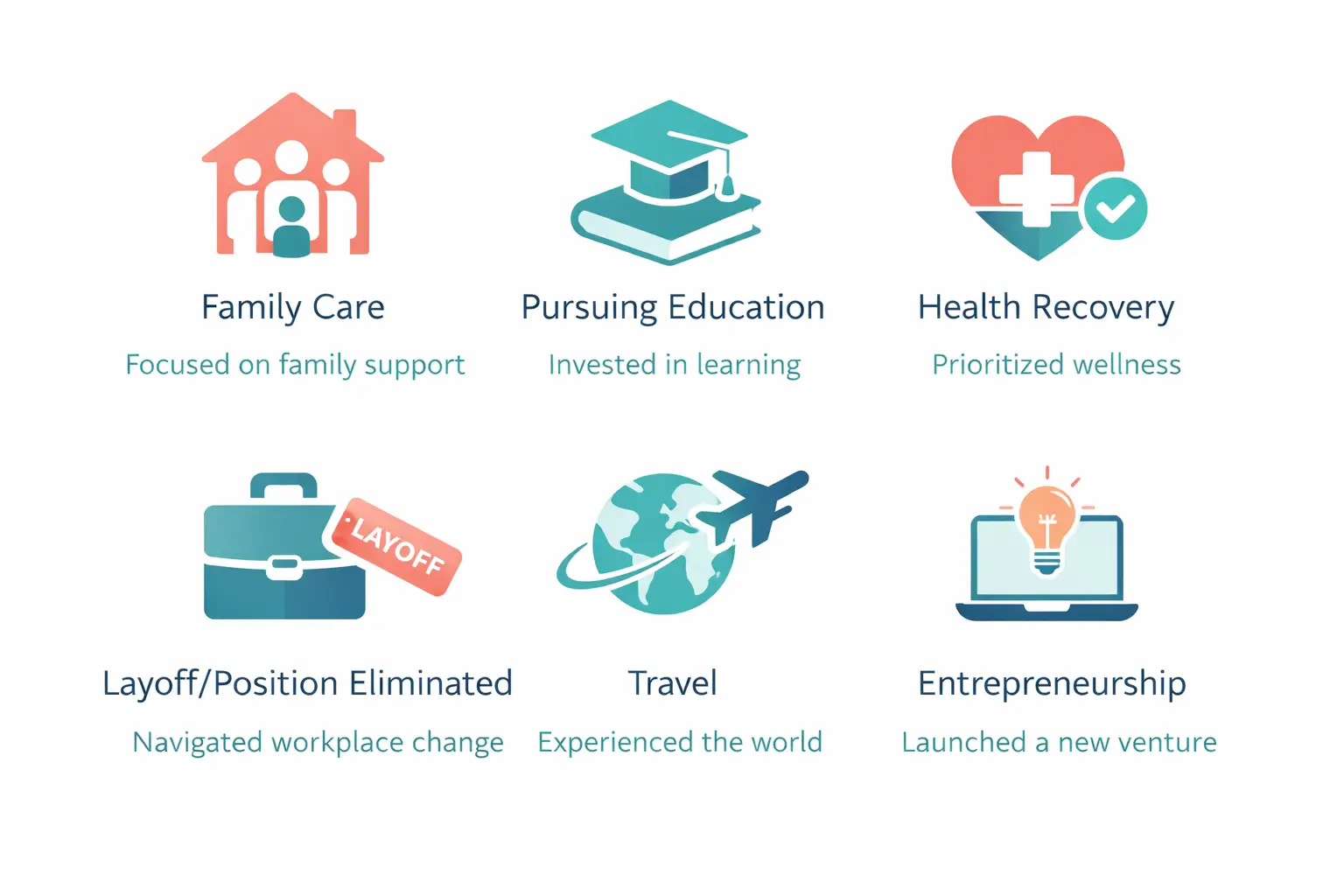
The worst thing you can do with a resume gap is leave it blank and unexplained. Even if your primary reason for the break was personal, chances are you did something productive during that time:
- Freelance or consulting work (even small projects count)
- Online certifications or courses
- Volunteer work or community involvement
- Caring for family members (this is real, valuable work)
- Travel that expanded your cultural competency or language skills
- Personal projects, side businesses, or creative pursuits
Listing these activities shows initiative and keeps your resume from looking like you simply checked out.
7. Address the Gap in Your Cover Letter
Your cover letter gives you space to tell the story behind the gap in a way that a resume can't. Keep it to two to three sentences, placed naturally within the flow of your letter — not as the opening line.
For example: "After spending 2024 caring for an aging parent, I used the experience to develop stronger organizational and crisis-management skills that I'm eager to apply professionally. During that time, I also earned my PMP certification to ensure my project management skills remained sharp."
An AI cover letter generator can help you draft this section quickly while keeping the tone natural and confident.
8. Prepare Your Interview Answer
Your resume and cover letter get you to the interview. But you need a polished verbal explanation too. Use this structure:
Acknowledge the gap briefly. One sentence explaining what happened. "I took a planned break to focus on family responsibilities."
Pivot to what you did. One to two sentences about how you stayed productive or grew. "During that time, I completed two industry certifications and took on a freelance project for a former colleague."
Connect to the present. One sentence showing you're ready and motivated. "I'm excited to bring that renewed energy and updated skill set to a team like yours."
Keep the entire answer under 60 seconds. Practice it until it sounds conversational, not rehearsed.
Common Gap Scenarios and How to Handle Each
Layoff or Company Closure
This is one of the easiest gaps to explain because it's clearly not your fault. State it plainly: "My position was eliminated during a company-wide restructuring." If you used the time to upskill, mention that. Don't badmouth your former employer.
Caregiving (Children, Parents, or Family Members)
Caregiving gaps are increasingly common and widely understood. Frame it as a deliberate choice, not something that happened to you. Mention any skills you maintained or developed. Many caregivers manage complex schedules, budgets, and logistics — that's project management in action.
Health Issues
You don't owe anyone details about your medical history. A simple "I took time off to address a health matter, which has been fully resolved" is sufficient. Redirect quickly to your current readiness and enthusiasm.
Going Back to School
Education gaps are the easiest to explain. List the degree or certification in your education section, and the dates will naturally fill the gap. If you worked part-time while studying, include that too.
Failed Business or Startup
Entrepreneurial experience is valuable even when the venture doesn't succeed. Frame it around what you built, what you learned, and the transferable skills you developed. Most hiring managers respect the initiative it takes to start something from scratch.
Burnout or Mental Health Break
This is becoming more accepted but still requires careful framing. You don't need to label it as burnout. "I took a deliberate career break to recharge and reassess my professional goals" works well. Pair it with evidence of what you did to prepare for your return.
Extended Job Search
Sometimes finding the right role takes longer than expected, especially in a competitive market. Frame it as selective rather than unsuccessful: "I took time to find the right fit rather than jumping at the first opportunity." Mention any skills development or freelance work you did during the search.
How ATS Systems Handle Resume Gaps
Applicant tracking systems process resumes differently than humans do. They don't read between the lines or give you the benefit of the doubt. Here's what happens when an ATS encounters a gap:
Timeline mapping: ATS software tries to create a continuous timeline from your work history. Unexplained breaks create gaps in this timeline, which can lower your resume's match score.
Keyword matching still matters most. Even with a gap, a resume packed with the right keywords will score higher than a gap-free resume without them. Focus on matching the job description's language.
Formatting affects parsing. If you use creative formats to disguise gaps, you might confuse the ATS entirely. Stick to clean, standard formatting with clear dates and job titles.
Running your resume through an ATS assessment tool before submitting can show you exactly how your resume will be parsed — including whether your gap is causing problems with timeline scoring.
What Not to Do When Explaining Resume Gaps
Don't lie about dates. Extending a previous job's end date or moving a start date earlier is easily caught and immediately disqualifying.
Don't over-explain. A three-paragraph explanation of your gap signals insecurity. Keep it brief and confident.
Don't apologize. Phrases like "Unfortunately, I had to take time off" put you on the defensive. You made a decision. Own it.
Don't leave the gap completely unaddressed. Hoping nobody notices a 15-month hole in your employment history is not a strategy. Someone will ask, and being caught unprepared looks worse than the gap itself.
Don't trash-talk former employers. Even if a toxic workplace caused your departure, keep your explanation neutral and forward-looking.
FAQ
How long of an employment gap is too long?
There's no universal cutoff, but gaps longer than two years typically require a more detailed explanation. The key factor isn't the length — it's whether you can show you stayed engaged, developed skills, or had a valid reason. A well-explained two-year gap beats an unexplained six-month one every time.
Do I need to explain a gap from 10 years ago?
Usually not. Most career advisors recommend limiting your resume to the past 10–15 years of experience. If the gap falls outside that window, you likely don't need to include it at all. Focus your resume on recent, relevant experience.
Should I use a functional resume to hide my employment gap?
Functional resumes (which emphasize skills over chronology) can minimize the appearance of gaps, but most recruiters and ATS systems prefer chronological or hybrid formats. A purely functional resume can actually raise more questions than it answers. A hybrid format that leads with a skills section before listing your work history is usually the better choice.
How do I explain being fired in a job interview?
Be honest without being dramatic. Say something like, "The role wasn't the right fit, and the company and I mutually decided to part ways." If you were terminated for cause, briefly acknowledge what you learned from the experience and how you've grown since. Never badmouth your former employer.
Can an employment gap affect my salary negotiation?
It can, but it doesn't have to. Some employers may try to offer a lower salary citing your time away from the workforce. Counter this by focusing on the value you bring, your relevant skills, and current market rates for the role. Your gap doesn't reduce your worth — your skills and results determine your salary.
Your Gap Doesn't Define Your Career
Employment gaps are a normal part of working life in 2026. Layoffs happen. People take time for family, education, health, and personal growth. The hiring managers reviewing your resume know this because many of them have gaps of their own.
What matters is how you present it. Be honest, be brief, and shift the focus to what you can do right now. Show that you stayed engaged during your break, and demonstrate that you're ready to contribute from day one.
If you're returning to the job market after a career break, Seekario's AI Resume Tailor can help you restructure your resume to present your gap in the best possible light — optimized for both human readers and ATS systems — so your skills speak louder than your timeline.


