How to Write a Resume With No Experience (2026 Guide)


Every professional you admire started with zero work experience. Every CEO, every senior developer, every marketing director — they all faced the same blank page you're staring at right now. The good news? You don't need years of job history to write a resume that gets callbacks. You need the right strategy, the right structure, and a clear understanding of what hiring managers actually want to see from entry-level candidates.
This guide walks you through exactly how to build a resume with no experience that stands out — even when you're competing against hundreds of other applicants.
Why Having No Experience Isn't the Dealbreaker You Think It Is
Here's something most career advice glosses over: nearly 65% of employers now use skills-based criteria when evaluating entry-level candidates. That means they care more about what you *can do* than where you've done it.
The real problem isn't your lack of experience. It's how you present what you already have. Class projects, volunteer work, freelance gigs, student organizations, personal projects — all of these count. The trick is framing them the way hiring managers expect to see them.
Another encouraging stat: the skills-based hiring movement has accelerated significantly through 2025 and 2026. More employers are dropping degree requirements and focusing on demonstrated abilities. Your resume just needs to prove you have those abilities.
Choose the Right Resume Format
The format you pick matters more when you have limited experience. Here are your three options:
Functional resume: Organizes your resume around skill categories rather than job titles. This works well if your experience is scattered across volunteer roles, school projects, and freelance work. However, some applicant tracking systems (ATS) struggle to parse functional formats, so use this cautiously.
Combination (hybrid) resume: Leads with a skills summary, then includes a brief chronological section for any experience you do have. This is the best option for most entry-level candidates because it highlights your skills while still giving ATS software something to parse.
Chronological resume: Lists experience in reverse chronological order. If you have internships, part-time jobs, or substantial volunteer work, this traditional format works fine.
For most first-time job seekers, the combination format hits the sweet spot. It lets you lead with strengths while keeping your resume ATS-friendly. Tools like Seekario's AI Resume Builder can help you pick the right format and structure your content for maximum impact.
Write a Resume Objective That Actually Says Something
Skip the generic "hardworking individual seeking an entry-level position" opening. Hiring managers have read that line thousands of times. Instead, write a two-to-three sentence objective that includes three things: who you are, what relevant skills you bring, and what you want to contribute.
Weak example:
"Recent graduate looking for an entry-level marketing position where I can grow my skills."
Strong example:
"Marketing graduate from UCLA with hands-on experience running social media campaigns for three campus organizations, growing combined follower counts by 40%. Looking to apply data-driven content strategy skills at a B2B SaaS company."
Notice the difference? The strong version includes specific accomplishments, numbers, and a clear direction. Even without formal work experience, you can write an objective like this using school projects, side hustles, or volunteer roles.
Lead With Your Education Section
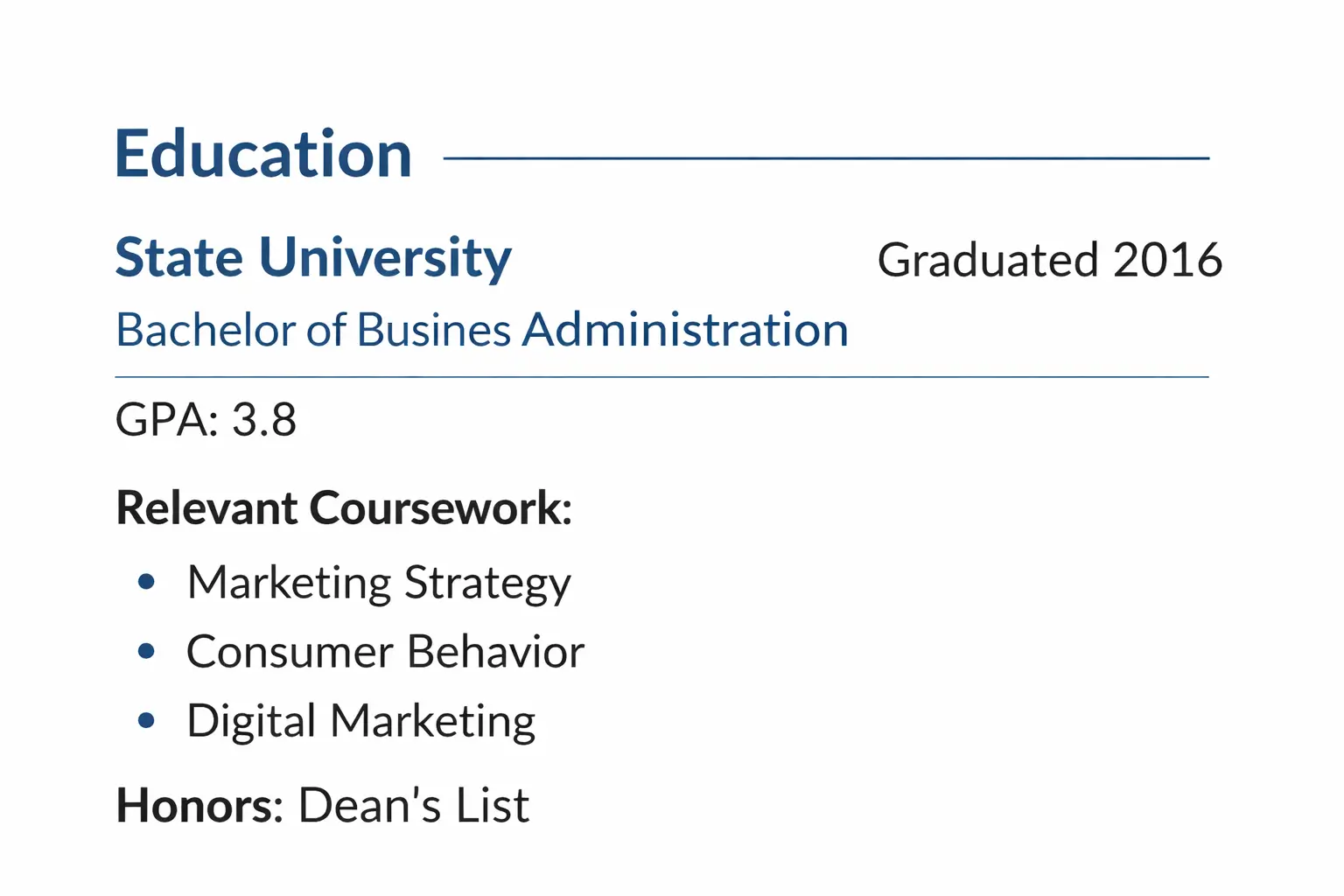
When you don't have a work history section to anchor your resume, your education section does the heavy lifting. Place it near the top, right after your objective.
Include these details:
- Degree and major (or expected graduation date if you're still in school)
- University or college name and location
- GPA — include it if it's 3.3 or above. Otherwise, leave it off.
- Relevant coursework — list three to five courses directly related to the job you're applying for
- Academic honors — Dean's List, scholarships, awards
- Capstone or thesis projects — especially if they demonstrate skills the employer values
If you've completed relevant certifications through platforms like Coursera, Google, or HubSpot, create a separate "Certifications" section below your education. These carry real weight with employers, especially in tech and marketing roles.
Build a Skills Section That Proves Your Value
Your skills section is the most important part of a resume with no experience. It's where you show employers you have the capabilities they need, even without a traditional work history.
Here's how to build it effectively:
Step 1: Study the job description. Pull out every skill mentioned — both technical (hard) skills and interpersonal (soft) skills. Make a list.
Step 2: Match your skills. Go through your list and honestly identify which skills you possess. Include ones you've developed through coursework, personal projects, volunteering, or self-study.
Step 3: Organize by category. Group your skills into two or three categories. For example: "Technical Skills," "Communication & Leadership," and "Tools & Software."
Step 4: Be specific. Don't just write "Microsoft Office." Write "Advanced Excel (pivot tables, VLOOKUP, conditional formatting)." Specificity signals competence.
Aim for six to ten skills total. Make sure at least half of them come directly from the job posting — this is critical for getting past ATS filters. If you're not sure how well your skills match a specific job posting, Seekario's AI Resume Scanner tool can analyze your resume against any job description and show you exactly where the gaps are.
Turn Non-Traditional Experience Into Resume Gold
You have more experience than you think. The key is presenting it professionally — using the same format and language you'd use for paid work.
Volunteer Work
Treat volunteer roles like jobs. Include the organization name, your title (or create an accurate one), dates, and bullet points describing what you accomplished.
Example:
Social Media Coordinator | Habitat for Humanity, Los Angeles Chapter | Sep 2024 – May 2025
- Managed Instagram and Facebook accounts, increasing engagement by 35% over two semesters
- Created a weekly content calendar and coordinated with 4 team members on campaign messaging
- Organized a fundraising event that raised $3,200 for local housing projects
Academic Projects
Employers love seeing relevant projects because they demonstrate applied skills.
Example:
Market Research Capstone Project | UCLA Anderson School | Jan 2025 – Apr 2025
- Conducted primary research with 200+ survey respondents to analyze Gen Z purchasing behavior
- Built a data visualization dashboard in Tableau to present findings to a panel of industry professionals
- Delivered actionable recommendations that the partnering company implemented in Q3 2025
Freelance or Side Projects
Even informal work counts. Did you build a website for a friend's small business? Tutor classmates? Manage a Discord community? Put it on your resume.
Extracurricular Leadership
Club president, team captain, event organizer — these roles show initiative, communication skills, and the ability to manage responsibilities.
Use Action Verbs and Quantify Everything
Vague descriptions kill entry-level resumes. Compare these two bullet points:
- "Helped with social media" ❌
- "Created and scheduled 45+ social media posts across Instagram and Twitter, contributing to a 28% increase in page engagement" ✅
Every bullet point should start with a strong action verb: led, designed, built, organized, analyzed, launched, improved, managed, coordinated, developed.
And whenever possible, include numbers. Numbers make your accomplishments concrete and credible. Even estimates work — "managed a team of approximately 10 volunteers" is far better than "worked with a team."
Tailor Your Resume for Every Single Application
This is where most entry-level candidates lose. They write one generic resume and blast it to 50 companies. The result? ATS systems filter them out because the keywords don't match.
Here's the fix: for every job you apply to, adjust your resume to mirror the language in the job description. If the posting says "project management," your resume should say "project management" — not "managed projects" or "oversaw initiatives."
This doesn't mean rewriting your entire resume each time. Focus on three areas:
- Your objective statement — reference the specific company and role
- Your skills section — reorder or swap skills to match the job posting
- Your bullet points — adjust phrasing to use the same keywords
This process takes 15 to 20 minutes per application and dramatically increases your callback rate. Seekario's AI Resume Tailor can automate this process — just paste in a job description and it restructures your resume to match the role's requirements.
Keep It Clean, Keep It to One Page
As an entry-level candidate, your resume should be one page. Period. Hiring managers spend an average of six to seven seconds on an initial resume scan, so every line needs to earn its place.
Formatting tips:
- Use a clean, professional font (Calibri, Arial, or Garamond) in 10-12pt
- Set margins to 0.5 to 1 inch
- Use clear section headers with consistent formatting
- Leave enough white space so the page doesn't feel cramped
- Save your file as a PDF unless the application specifically asks for .docx
- Name your file professionally: "FirstName_LastName_Resume.pdf"
Avoid graphics, icons, photos, columns, and text boxes. These elements often confuse ATS software and can cause your resume to be misread or rejected before a human ever sees it.
What to Leave Off Your Resume
Knowing what to exclude is just as important as knowing what to include:
- "References available upon request" — this is outdated filler. Employers will ask when they're ready.
- High school information — once you have any college education, drop your high school details.
- Irrelevant hobbies — "enjoys hiking and cooking" doesn't help unless it's relevant to the role.
- Personal information — don't include your age, marital status, or photo. In the US, these aren't expected and can introduce bias.
- Every skill you've ever learned — only include skills relevant to the specific job you're applying for.
FAQ
Can I get a job with no work experience at all?
Yes. Employers hiring for entry-level roles expect candidates with limited or no formal work experience. Focus on transferable skills, education, volunteer work, and personal projects to demonstrate your capabilities.
What should I put on my resume if I've never had a job?
Include your education, relevant coursework, academic projects, volunteer experience, certifications, technical skills, and extracurricular activities. Frame each item with action verbs and quantified results, just as you would with paid work experience.
Is a functional resume better for no-experience candidates?
A combination (hybrid) resume is usually the best choice. It lets you lead with skills while still providing a chronological section that ATS systems can parse. Purely functional resumes can raise red flags with both ATS and human reviewers.
How long should a resume be for someone with no experience?
One page. As an entry-level candidate, you should keep your resume concise and focused. Every line should serve a purpose. If you're struggling to fill the page, add relevant coursework, certifications, or a projects section.
Should I include a cover letter with my resume?
Absolutely. A cover letter gives you space to explain your motivation, address your lack of experience directly, and show personality that a resume can't capture. Nearly half of employers will reject an application that doesn't include one.
Start Building Your Resume Today
Writing a resume with no experience feels intimidating, but it's really about reframing what you already have. You've been building skills through school, projects, volunteer work, and life — now you just need to present them the right way.
Start with the combination format, lead with a strong objective and skills section, and tailor every application to the specific job. If you want to speed up the process and make sure your resume is ATS-optimized from the start, Seekario's AI Resume Builder can walk you through it step by step — helping you create a polished, professional resume in minutes, even if it's your very first one.