How to Use ChatGPT for Your Resume (Tips, Prompts, and Pitfalls)


You've probably heard that ChatGPT can help you write a resume. And that's true — sort of. The catch is that most people use it wrong. They dump their job history into the chat box, hit enter, and paste whatever comes out straight into a Word doc. That's how you end up with a resume that reads like it was written by a committee of robots who've never actually held a job.
Used well, though, ChatGPT becomes a powerful brainstorming partner. It can help you rewrite weak bullet points, find the right keywords, and organize your experience more clearly. The key is knowing which prompts to use, when to step in with your own edits, and where AI falls short.
This guide walks you through the entire process — from smart prompts to common mistakes — so you get a resume that sounds like *you*, not like everyone else using the same tool.
Why Job Seekers Are Turning to ChatGPT for Resume Help
The numbers tell a clear story. A 2024 Canva survey found that 45% of job seekers had already used AI tools to build or improve their resumes. By early 2026, that number has climbed even higher as AI writing tools have become more capable and accessible.
There are real reasons for this shift. Writing about yourself is hard. Translating years of work into concise, impactful bullet points is a skill most people were never taught. ChatGPT lowers that barrier significantly — it can help you articulate achievements, find stronger action verbs, and structure your experience in a format that both hiring managers and applicant tracking systems (ATS) can parse easily.
But here's the nuance that gets lost in the hype: ChatGPT works best as a *drafting partner*, not a ghostwriter. It doesn't know what you actually did at your last job. It can't verify your numbers or understand the politics of your team restructuring. What it *can* do is take raw material you provide and help shape it into polished, professional language.
How to Use ChatGPT for Your Resume: A Step-by-Step Approach
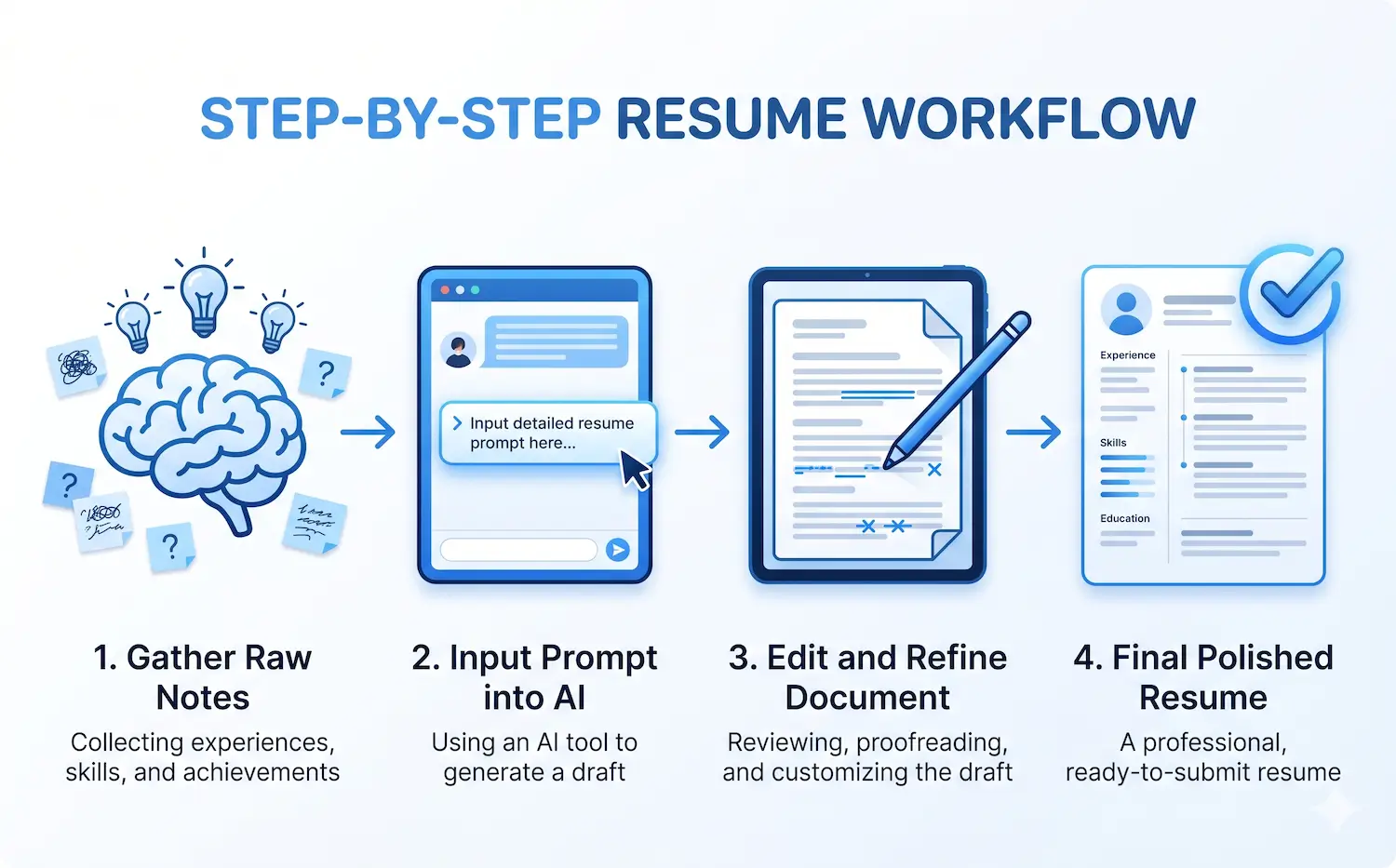
The biggest mistake people make is asking ChatGPT to generate an entire resume from scratch. That produces generic, forgettable content. Instead, use a section-by-section approach where you feed the AI real information about your background and let it help you refine each piece.
Step 1: Start With Your Own Draft
Before you open ChatGPT, spend 20 minutes jotting down the raw details of your work history. Include job titles, companies, dates, and — most importantly — what you actually accomplished. Don't worry about polish. Notes like "led the project that cut customer wait times from 8 minutes to 3 minutes" are exactly what ChatGPT needs to produce something specific and credible.
Starting with your own material prevents the most common AI resume problem: fabricated or vague achievements that you can't back up in an interview.
Step 2: Feed ChatGPT Context, Not Just Commands
Generic prompts produce generic output. Compare these two approaches:
Weak prompt: "Write a resume for a marketing manager."
Strong prompt: "I'm a marketing manager with 6 years of experience in B2B SaaS. I've managed a team of 4, grown organic traffic by 180% over two years, and launched a content strategy that generated $2.3M in pipeline. Help me write 4-5 bullet points for this role that highlight measurable results."
The second prompt gives ChatGPT the specifics it needs. The more context you provide — industry, years of experience, team size, key metrics — the more useful the output becomes.
Step 3: Work Section by Section
Break your resume into discrete tasks:
- Professional summary — Ask ChatGPT to draft a 3-4 sentence summary based on your background and the type of role you're targeting.
- Work experience bullet points — Feed it your raw accomplishments one role at a time.
- Skills section — Have it extract relevant skills from a target job description and compare them to your experience.
- Education and certifications — Less need for AI here, but useful for formatting consistency.
This focused approach gives you more control over each section and makes it easier to catch errors or generic language before it sneaks into your final resume.
10 ChatGPT Resume Prompts That Actually Work
Here are tested prompts you can copy, customize, and use right away. Each one is designed to produce specific, useful output rather than generic filler.
Prompt 1: Rewrite Weak Bullet Points
> "Rewrite the following resume bullet points using strong action verbs and measurable results. Keep each bullet under 20 words. Where possible, include metrics like percentages, time saved, revenue impact, or project scale. Here are my current bullets: [paste your bullets]"
Prompt 2: Generate a Professional Summary
> "Write a 3-sentence professional summary for a [job title] with [X] years of experience in [industry]. Key strengths include [list 3-4 strengths]. I'm targeting roles at [type of company]. Make it specific, not generic."
Prompt 3: Extract Keywords From a Job Description
> "Read the following job description and extract the top 15 keywords and phrases an ATS would scan for. Then compare them to my resume below and tell me which keywords are missing. Suggest where to add them naturally. Job description: [paste JD]. My resume: [paste resume]."
Prompt 4: Tailor Your Resume to a Specific Role
> "I'm applying for [job title] at [company]. Here's the job description: [paste JD]. Here's my current resume: [paste resume]. Suggest specific changes to my bullet points, skills section, and summary to better align with this role while staying truthful to my actual experience."
Prompt 5: Quantify Vague Achievements
> "I want to add numbers to these resume bullet points but I'm not sure how. Help me estimate reasonable metrics or suggest what I should measure. Here are my bullets: [paste bullets]. My role was [brief context about scope — team size, budget, customer base]."
Prompt 6: Improve Action Verbs
> "Replace the weak verbs in these bullet points with stronger, more specific action verbs. Avoid overused words like 'managed,' 'helped,' and 'responsible for.' Here are my bullets: [paste bullets]."
Prompt 7: Create a Skills Section
> "Based on this job description [paste JD] and my background in [brief description], create a skills section with 8-12 relevant technical and soft skills. Organize them into two categories: Technical Skills and Core Competencies."
Prompt 8: Write Bullet Points for a Career Gap
> "I took a [length] career break for [reason — caregiving, health, education, travel]. During that time, I [any relevant activities — freelancing, volunteering, coursework]. Write 2-3 bullet points that frame this period positively for a resume targeting [job type] roles."
Prompt 9: Convert Job Duties Into Achievements
> "These resume bullets describe what I did, not what I achieved. Rewrite each one to focus on the result or impact rather than the task. Add a measurable outcome where possible. Here are my bullets: [paste bullets]."
Prompt 10: Check for ATS Compatibility
> "Review my resume for ATS compatibility. Flag any formatting issues, missing standard section headers, or keyword gaps compared to this job description: [paste JD]. Suggest corrections."
The Pitfalls: What Can Go Wrong With a ChatGPT Resume
Using ChatGPT carelessly creates real risks. Here's what to watch out for — and how to avoid each problem.
Pitfall 1: Fabricated Achievements
ChatGPT will happily invent impressive-sounding metrics. If you ask it to "make my resume stronger" without providing real data, it might add numbers you never achieved. A hiring manager who asks "Tell me about that 300% increase in revenue" during an interview will know immediately if you're bluffing.
Fix: Always provide your own accomplishments as raw material. Review every number and claim in the output. If you can't verify it, remove it.
Pitfall 2: Generic, Buzzword-Heavy Language
About 8 in 10 hiring managers say they can spot an AI-written resume. The telltale signs? Phrases like "results-driven professional" and "leveraged cross-functional synergies" that could describe literally anyone. When every bullet point sounds polished but says nothing specific, it raises a red flag.
Fix: After generating content, read it out loud. If it sounds like something you'd never actually say in a conversation, rewrite it in your own voice.
Pitfall 3: One-Size-Fits-All Content
A resume that isn't tailored to a specific job description will underperform — both with ATS filters and human reviewers. ChatGPT's default output tends to be broad and general unless you specifically prompt it to align with a particular role.
Fix: Always include the target job description in your prompt. Better yet, use a purpose-built tool like Seekario's AI Resume Tailor, which automatically maps your experience to specific job requirements and optimizes for ATS keywords in one step.
Pitfall 4: Data Privacy Risks
Anything you paste into ChatGPT could potentially be used for model training (unless you've opted out or are using an enterprise plan). This matters if you're including confidential information about your current employer, proprietary project details, or sensitive metrics.
Fix: Anonymize company-specific details before pasting. Replace exact figures with approximate ranges if needed. Or use a dedicated resume tool like Seekario's AI Resume Builder, which is built specifically for resume creation and doesn't use your data for training purposes.
Pitfall 5: Losing Your Voice
Your resume should sound like a more polished version of you — not like a corporate press release. ChatGPT tends toward formal, slightly stilted language that can make your resume feel impersonal.
Fix: Edit the output. Swap out words that don't match how you naturally communicate. Keep the structure ChatGPT suggests, but put it in your own language.
ChatGPT vs. Dedicated AI Resume Tools
ChatGPT is a general-purpose AI. It can write poems, debug code, plan meals, and yes — help with resumes. But that generality is also a limitation. It doesn't understand ATS algorithms, can't scan job descriptions automatically, and requires you to craft the right prompts every time.
Dedicated AI resume tools are built specifically for this task. They come with resume-specific templates, built-in ATS optimization, and workflows designed around the job application process.
Here's how the two approaches compare:
Tools like Seekario's AI Resume Builder combine the language generation capabilities of AI with resume-specific features — ATS scoring, keyword matching, and professional formatting — so you don't need to be a prompt engineer to get a great result.
Best Practices: Getting the Most From ChatGPT
If you're going to use ChatGPT for your resume, these habits will keep the quality high:
Always start with real information. Your actual accomplishments, metrics, and career details are the foundation. AI shapes the language — you provide the substance.
Edit every line. Treat ChatGPT's output as a first draft. Read through it, cut the fluff, and make sure every bullet point reflects something you actually did.
Use it for specific tasks, not the whole resume. ChatGPT excels at rewriting bullet points, brainstorming action verbs, and extracting keywords. It's less reliable for creating an entire resume from a blank page.
Run your final resume through an ATS checker. After making ChatGPT-assisted edits, use a tool like Seekario's AI Resume Scanner to verify your resume will pass ATS filters for your target role.
Keep a master resume. Maintain one comprehensive document with all your experience. Use ChatGPT to help you pull from that master and tailor shorter versions for specific applications.
Iterate on your prompts. If the first output isn't great, refine your prompt rather than starting over. Add more context, specify the tone you want, or ask ChatGPT to try a different approach.

<!-- IMAGE PROMPT: A split-screen illustration showing a rough, messy resume draft on the left side and a clean, polished final resume on the right side with subtle edit marks and highlights showing the transformation. Modern minimalist design, blue and teal accents, white background. Dimensions: 800x500. -->
FAQ
Is it okay to use ChatGPT to write my resume?
Yes — as long as you use it as an editing and brainstorming tool, not a replacement for your own input. The best approach is to write a rough draft yourself, then use ChatGPT to improve the language, strengthen action verbs, and optimize for ATS keywords. Always review and personalize the output before submitting.
Can hiring managers tell if I used ChatGPT for my resume?
Many can. Surveys suggest around 80% of hiring managers can spot AI-generated content based on generic phrasing, buzzword overuse, and a lack of specific details. The fix is simple: provide ChatGPT with real, specific accomplishments and then edit the output to sound like your natural voice.
What's the best ChatGPT prompt for a resume?
There's no single best prompt — it depends on what you need. For bullet point improvement, try: "Rewrite these resume bullets using strong action verbs and measurable results. Keep each bullet under 20 words." For ATS optimization, ask ChatGPT to extract keywords from a job description and compare them to your resume. The more specific your prompt, the better the output.
Is ChatGPT better than a dedicated resume builder?
ChatGPT is more flexible but requires more effort. Dedicated AI resume tools like Seekario offer built-in ATS optimization, professional templates, and one-click job tailoring that ChatGPT can't match on its own. For most job seekers, combining both — ChatGPT for brainstorming and a dedicated tool for the final product — delivers the best results.
Will using AI on my resume get me rejected?
Not if you do it well. The risk comes from submitting generic, unedited AI content that lacks specifics. A resume that clearly reflects your actual experience and is tailored to the job you're applying for will perform well regardless of whether AI assisted in the writing process.
Make Your Resume Work Harder
ChatGPT is a solid starting point for resume writing — but it's just that: a starting point. The real power comes from combining AI assistance with your own knowledge of your career, your target roles, and what makes you a strong candidate.
If you want to skip the prompt engineering and get a resume that's already optimized for ATS systems, tailored to specific job descriptions, and formatted professionally, give Seekario's AI Resume Builder a try. It takes the guesswork out of the process so you can focus on landing interviews instead of writing prompts.