How to Write Work Experience on a Resume (With 30+ Examples)

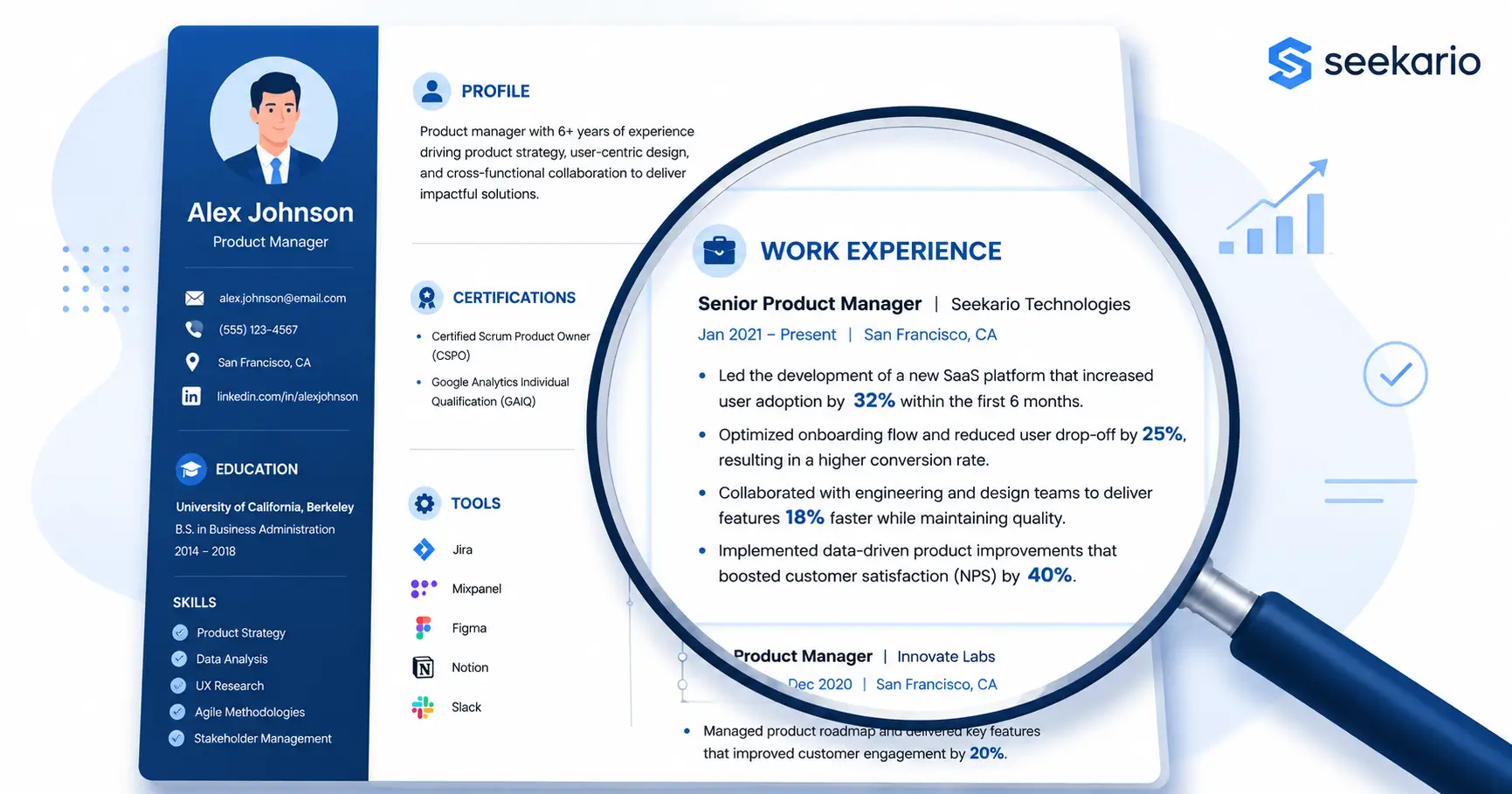
Hiring managers spend roughly 67% of their resume screening time on one section: your work experience. That's not a guess — it's what recruiter tracking studies consistently find. And yet, most resumes fill this section with vague duty descriptions that read like a copied job posting. "Responsible for managing client relationships." "Assisted with marketing campaigns." These lines tell a recruiter nothing about what you actually accomplished.
This guide breaks down exactly how to structure each work experience entry, gives you a repeatable formula for writing bullet points that show impact, and includes 30+ real before/after examples across 10 industries so you can see the difference strong writing makes.
The Anatomy of a Great Work Experience Entry
Every work experience entry needs five elements, and the order matters.
Job Title — Lead with your title. It's the first thing a recruiter scans for, and it's what ATS software matches against the job posting.
Company Name — Include the full company name. If it's not well-known, add a brief descriptor in parentheses: "Greenfield Analytics (B2B SaaS, 50 employees)."
Location — City and state. If you worked remotely, write "Remote" or "Remote (based in Austin, TX)."
Dates — Use month and year format (e.g., March 2023 – Present). Avoid using only years, which can look like you're hiding short stints.
Bullet Points — This is where most people fail. Aim for 4–6 bullets for your most recent role, 3–4 for the one before, and 2–3 for anything older than five years.
Here's a clean example:
Senior Marketing Manager
Greenfield Analytics (B2B SaaS, 50 employees) | Remote | Jan 2024 – Present
- Grew organic blog traffic from 12K to 85K monthly sessions in 14 months by building a pillar-cluster content strategy
- Launched a paid LinkedIn campaign that generated 340 MQLs in Q3 2025 at $38 per lead
- Managed a $220K annual marketing budget, reallocating 30% from paid search to content after ROI analysis
- Hired and mentored a 3-person content team, reducing external freelancer spend by 60%
Notice: no fluff, no "responsible for," and every bullet includes either a number or a concrete outcome.
The Action Verb Formula That Makes Bullets Pop
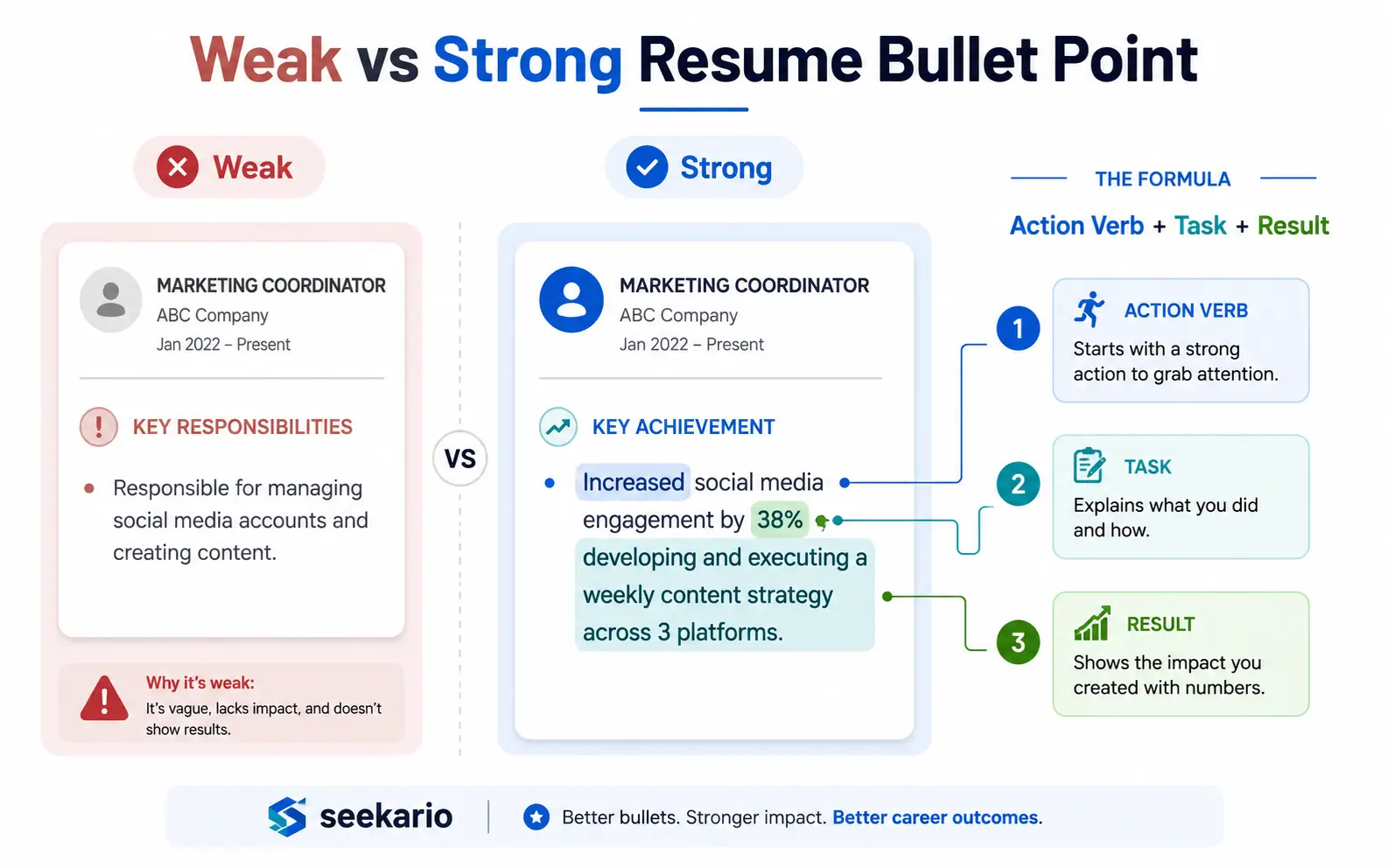
Weak bullet points almost always start with the same words: "Responsible for," "Helped with," "Assisted in." These phrases are passive. They describe the job, not what you did with it.
Strong bullets follow a simple formula: Action Verb + What You Did + Measurable Result.
Here's the pattern:
- Led a cross-functional team of 8 to redesign the onboarding flow, reducing new-user churn by 22%
- Negotiated vendor contracts worth $1.2M annually, saving $180K through consolidated pricing
- Built an automated reporting dashboard in Tableau, cutting weekly reporting time from 6 hours to 45 minutes
The action verb carries weight. According to recruiter surveys, words like "managed," "led," "built," "increased," and "redesigned" signal ownership and initiative — exactly what hiring managers screen for.
Here are action verbs grouped by what you want to convey:
Leadership: Led, Directed, Oversaw, Mentored, Championed, Spearheaded
Growth: Increased, Expanded, Grew, Scaled, Accelerated, Doubled
Efficiency: Streamlined, Automated, Consolidated, Reduced, Optimized, Eliminated
Creation: Built, Designed, Developed, Launched, Established, Pioneered
Analysis: Analyzed, Evaluated, Assessed, Identified, Forecasted, Audited
Pick the verb that most accurately describes your role in the outcome. If you led the project, say "Led." If you contributed to a team effort, say "Collaborated on" or "Contributed to" — but then specify your piece of it.
30+ Before/After Examples by Industry
The best way to understand good work experience writing is to see bad bullets transformed into strong ones. Here are real examples across 10 industries.
Software Engineering
Before: Responsible for developing new features for the mobile app.
After: Developed 12 new features for the iOS app (1.2M users), including a real-time notification system that increased daily active usage by 18%.
Before: Worked on fixing bugs and code reviews.
After: Resolved 200+ production bugs over 6 months and conducted 50+ code reviews weekly, reducing post-release defect rate by 35%.
Before: Helped with the migration to cloud infrastructure.
After: Co-led migration of 14 microservices from on-prem to AWS, achieving 99.95% uptime and cutting infrastructure costs by $42K annually.
Marketing
Before: Managed social media accounts.
After: Grew Instagram following from 8K to 47K in 10 months through a UGC-driven content strategy, driving 12% of total e-commerce revenue from social.
Before: Responsible for email marketing campaigns.
After: Designed and A/B tested a 6-email nurture sequence that converted 23% of trial users to paid subscribers, generating $340K in annual recurring revenue.
Before: Created marketing materials for events.
After: Produced collateral for 8 trade shows and 3 product launches, contributing to a pipeline worth $2.1M in qualified opportunities.
Sales
Before: Met sales targets and managed client accounts.
After: Exceeded quarterly quota by an average of 118% across 6 consecutive quarters, closing $3.8M in new business annually.
Before: Responsible for cold calling and prospecting.
After: Built a prospecting system combining LinkedIn outreach and cold calling that generated 45 qualified meetings per month, up from 12.
Before: Managed key accounts.
After: Managed a portfolio of 28 enterprise accounts ($4.2M ARR), achieving a 96% renewal rate and identifying $620K in upsell opportunities.
Healthcare
Before: Provided patient care and documented records.
After: Delivered direct care to 15–20 patients per shift in a 40-bed ICU, maintaining a 98.5% documentation accuracy rate across Epic EHR.
Before: Assisted with training new nurses.
After: Designed and delivered a 4-week preceptor program for new hires, reducing orientation-to-competency time by 3 weeks.
Before: Managed medication administration.
After: Administered 100+ medications daily with zero adverse events over 18 months, earning unit-level safety recognition.
Finance & Accounting
Before: Prepared financial reports and analysis.
After: Prepared monthly financial reports for a $50M revenue division, identifying $1.2M in cost-saving opportunities through variance analysis.
Before: Managed accounts payable.
After: Processed 500+ invoices monthly with 99.7% accuracy, reducing average payment cycle from 45 to 28 days.
Before: Assisted with annual audit.
After: Coordinated the annual external audit for 3 consecutive years, reducing audit findings by 60% through improved internal controls.
Education
Before: Taught high school math classes.
After: Taught Algebra II and AP Calculus to 120+ students annually, with 82% of AP students scoring 3 or higher (vs. 61% national average).
Before: Developed curriculum materials.
After: Redesigned the 9th-grade science curriculum to integrate project-based learning, increasing student engagement scores by 27% on end-of-year surveys.
Customer Service
Before: Handled customer complaints and inquiries.
After: Resolved an average of 65 tickets daily with a 94% customer satisfaction rating, ranking in the top 5% of a 200-person support team.
Before: Helped improve customer service processes.
After: Proposed and implemented a tiered escalation system that reduced average resolution time from 4.2 hours to 1.8 hours.
Project Management
Before: Managed projects and timelines.
After: Delivered 12 cross-functional projects (average budget: $350K) on time and under budget, saving a cumulative $180K in projected costs.
Before: Coordinated with stakeholders.
After: Facilitated weekly standups and quarterly reviews with 6 department leads, reducing scope creep incidents by 40% through structured change-request processes.
Human Resources
Before: Handled recruitment and onboarding.
After: Sourced, screened, and hired 85 employees across 4 departments in 12 months, reducing average time-to-fill from 52 to 31 days.
Before: Managed employee relations.
After: Resolved 40+ employee grievances annually while maintaining a 92% retention rate in a 300-person division, beating the industry average by 11 points.
Operations & Logistics
Before: Oversaw warehouse operations.
After: Managed daily operations for a 120K-sq-ft distribution center processing 3,000+ orders daily, reducing fulfillment errors by 28% in 6 months.
Before: Improved supply chain processes.
After: Renegotiated contracts with 5 logistics providers, cutting shipping costs by 15% ($320K annually) while maintaining 99.2% on-time delivery.
If writing these transformations feels difficult, tools like the Seekario AI Resume Builder can help you rewrite flat duty statements into achievement-focused bullets with metrics — without having to start from scratch.
How to Handle Short Tenures Without Raising Red Flags
Short stints (under a year) make recruiters pause. They wonder: were you fired? Did you quit? Are you a flight risk? But short tenures are increasingly common — contract roles, startup layoffs, and restructurings are a normal part of modern careers.
Here's how to frame them:
Contract or freelance roles: Label them clearly. Write "Contract" or "Freelance" next to the job title. Recruiters understand contract work and won't hold it against you.
Layoffs: You don't need to explain on the resume itself. Just focus on what you accomplished during your time there. If three months produced meaningful results, say so.
Multiple short roles at one company: Group them under the company name with sub-entries for each title. This shows progression, not job-hopping.
Roles under 3 months: Consider leaving them off unless they're highly relevant or you have a gap to fill. An unexplained 3-month gap raises fewer questions than a 2-month stint at a company.
The key: every entry you include should demonstrate value. If you can't write at least two strong bullet points for a role, it might not be worth listing.
Writing Work Experience for Remote Roles
Remote work is standard now, but your resume still needs to communicate it clearly.
Include "Remote" in the location line. If the company is based elsewhere, note it: "Remote (Company HQ: San Francisco, CA)." This helps recruiters understand the context.
For remote-specific achievements, call out skills that matter in distributed environments: asynchronous communication, cross-timezone collaboration, self-directed project management. These are signals that you thrive without in-person oversight.
Example:
- Coordinated product launches across a fully remote team of 14 spanning 4 time zones, using Notion and Slack async workflows to maintain zero missed deadlines over 8 sprints
Work Experience Tips for Career Changers
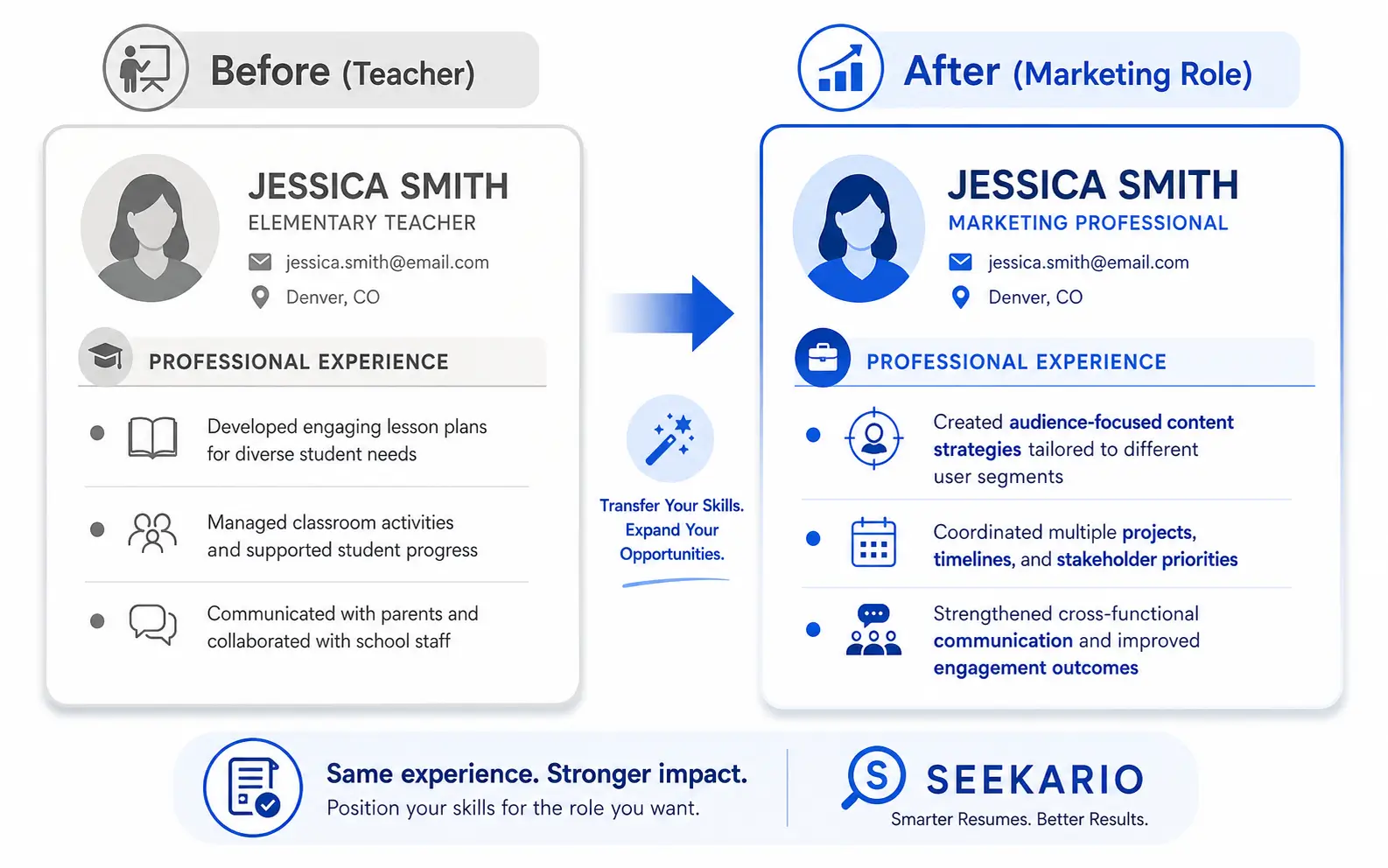
Switching industries? Your work experience section needs to do extra work. Recruiters scanning your resume for a marketing role won't immediately see the relevance of your teaching background — unless you frame it right.
Lead with transferable outcomes. Don't describe what you did in education terms if you're applying for corporate roles. Instead of "Developed lesson plans," write "Designed and delivered structured training programs for groups of 30+, incorporating feedback loops that improved comprehension scores by 25%."
Mirror the job posting's language. If the posting says "stakeholder management," use that phrase when describing how you worked with parents, administrators, or community partners. The Seekario AI Resume Tailor can scan a job description and suggest exactly which keywords to weave into your experience bullets.
Add a brief context line. If your previous industry is very different, a one-line company description helps: "BlueBridge Academy (K-8 private school, 400 students)" gives a recruiter enough context to understand your scope without guessing.
Formatting Your Work Experience Section
Formatting mistakes can tank an otherwise strong work experience section. Here's what to get right:
Reverse chronological order. Your most recent role goes first. This is what 95% of recruiters expect, and it's what ATS software is built to parse.
Consistent date formatting. Pick "Jan 2024 – Present" or "January 2024 – Present" and stick with it throughout. Inconsistency looks careless.
Bullet points, not paragraphs. Recruiters scan — they don't read. Bullets let them grab key details in seconds. Aim for one to two lines per bullet, never more than three.
Standard section headings. Use "Work Experience," "Professional Experience," or "Employment History." Creative headings like "Where I've Made an Impact" confuse ATS parsers.
10–15 years of experience maximum. Unless you're in academia or a senior executive role, anything older than 15 years can be summarized in a single line or dropped entirely. This keeps your resume focused and avoids age-related bias.
Run your finished resume through the Seekario AI Resume Checker to catch formatting issues, missing metrics, and ATS compatibility problems before you submit.
Frequently Asked Questions
How far back should work experience go on a resume?
For most professionals, 10–15 years is the sweet spot. Recent graduates should include internships, part-time jobs, and relevant volunteer work. Senior professionals can add a "Previous Experience" line summarizing earlier roles without full bullet points.
What if I don't have exact numbers for my achievements?
Estimate honestly. If you know your team handled "a lot" of customer tickets, check old reports or ask former colleagues for ballpark figures. Phrases like "approximately," "50+," or "averaging" signal honesty while still providing scale. A rough number always beats no number.
Should I include every job I've ever had?
No. Include roles that are relevant to the position you're targeting, plus enough history to show a coherent career path. Short-term roles, unrelated part-time jobs from years ago, or positions that don't add value can be left off. Your resume is a marketing document, not a comprehensive employment record.
How do I write work experience if I've been at the same company for many years?
Break your time into distinct phases or promotions. List each title separately under the company name with its own set of bullet points. This shows growth and avoids the appearance of stagnation. For example, list "Senior Analyst (2023–Present)" and "Analyst (2020–2023)" as separate entries under the same company header.
Is it okay to use the same bullet points for similar roles at different companies?
Avoid it. Even if the roles were similar, tailor your bullets to highlight different achievements or scale. Identical bullets suggest copy-paste effort, and recruiters notice. Each role should tell a slightly different story about your capabilities.
Build a Stronger Work Experience Section
Your work experience section carries more weight than any other part of your resume. The difference between a generic entry and a strong one often comes down to specificity — concrete numbers, clear outcomes, and action verbs that show ownership.
Use the before/after examples in this guide as templates. Pick the industry closest to yours, study the pattern, and rewrite your own bullets using the Action Verb + What You Did + Measurable Result formula.
If you want to speed up the process, the Seekario AI Resume Builder can transform flat duty descriptions into polished, metric-driven bullets in seconds — so you spend less time wordsmithing and more time applying.
For a complete breakdown of every resume section beyond work experience, check out our Complete Guide to Resume Sections.