20 Pieces of Standard Resume Advice That Are Now Actively Wrong — and What to Do Instead

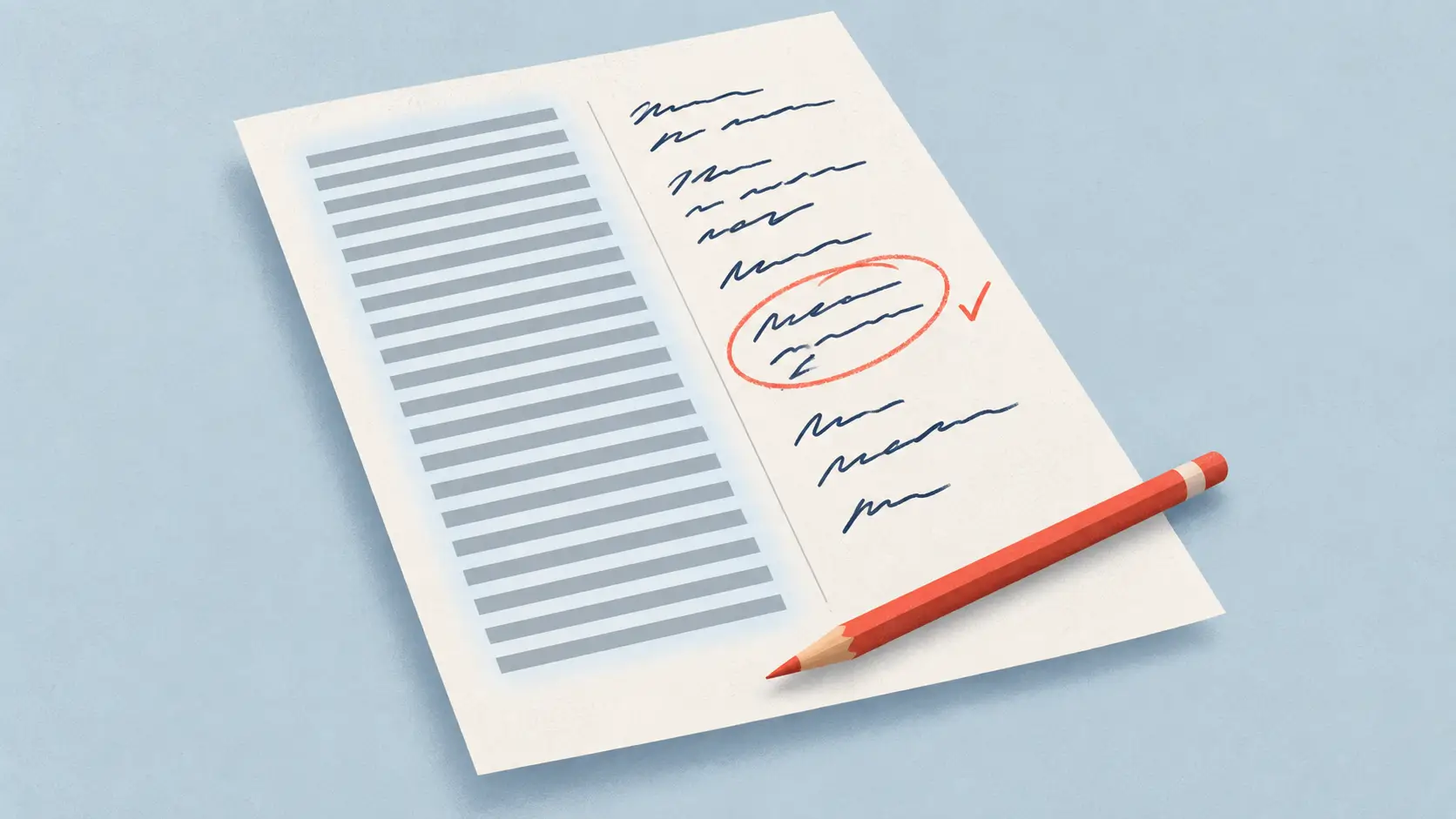
Most resume advice doesn't expire because it was bad. It expires because the conditions that made it work quietly changed underneath it.
A one-page limit made sense when resumes were printed and stacked on a desk. A tailored cover letter meant something when tailoring took an hour. A metric on every bullet stood out when almost nobody was using metrics. Each of those rules was a genuine signal — it cost the candidate something to produce, so it told the reader something real.
Two things have since eroded that. Application volume rose to the point where a single opening can draw hundreds of applicants, and generative AI collapsed the cost of polish to near zero. When anyone can produce a flawless, keyword-matched, action-verb-heavy resume in ten seconds, polish stops being evidence of anything. The signal doesn't just weaken — it inverts, because the reader now has to work out which of the identical-looking documents in front of them is describing real work.
We asked founders, CTOs, recruiters and hiring managers which specific piece of conventional resume advice they'd now tell candidates to ignore, and what they want to see instead. Twenty of them answered. A clear pattern runs through the responses: the things that still work are the things a model can't manufacture — verifiable numbers, concrete scope, named failures, plain language, and details only you could have written.
Here's what they said.
Contents
- Replace Objectives With Proven Outcomes
- Remove GPA After Your First Jobs
- Quantify Only Defensible Results
- Standardize Your Resume, Expand Outreach
- Write Cover Letters Only You Could Write
- Feature Problem-Solving Projects, Not Tool Lists
- Expand Beyond One Page When Necessary
- Prove Skills Beyond ATS Keywords
- Embrace Strategic Job Changes
- Meet Core Requirements Before You Apply
- Highlight Recent Relevant Experience
- Make Your Resume a Visual Experience
- Include Technical Work Samples
- Prioritize Selective Evidence Over Duties
- Lead With Specific Scope, Not Summaries
- Describe How You Reversed Failures
- Elevate Community Service Experience
- State Your Principles Openly
- Clarify Employment Gaps in One Line
- Use Plain, Specific Details
Replace Objectives With Proven Outcomes
The traditional career objective statement at the top of a resume is now a waste of prime real estate that actively signals an outdated mindset. For decades, candidates were told to open with a sentence like seeking a challenging position in a dynamic company where I can grow and utilize my skills. This worked when hiring was slower and recruiters used these statements to manually sort applicants into basic categories. In the modern hiring landscape, where initial reviews happen in seconds and competition is global, an objective statement is self-centered. It tells me what you want from the company rather than what you can deliver for us. As someone who has scaled teams to over 650 professionals, I can confirm that we look for solutions, not aspirations. A generic objective is essentially fluff that forces a hiring manager to work harder to find your actual value.
Instead of telling an employer what you hope to gain, you should use that space for a data-backed impact summary. We have moved entirely toward skills-based hiring where measurable outcomes are the only currency that matters. If you are a digital marketer, do not tell me you have strong SEO skills. Tell me that you increased organic traffic by 40 percent over six months for a SaaS client. If you are a project manager, show me how you led a distributed team to ship a mobile app three weeks ahead of schedule. We look for candidates who understand that their role is to solve a specific business problem.
I also advise moving away from static skills lists that include subjective terms like leadership or communication. These are empty claims unless they are woven into your professional history as proven results. A modern resume should function as a marketing document for the value you provide. If a recruiter cannot see the direct correlation between your past performance and their future growth within the first few seconds, your resume has failed. Shift your focus from what you seek to the specific outcomes you have already achieved, and you will immediately stand out from the sea of generic applications.
Amit Agrawal, Founder & COO, Developers.dev
Remove GPA After Your First Jobs
Listing your GPA on a resume—that's the piece of advice I'd flag now, especially past your first job or two. It used to signal effort and discipline right out of school, back when nobody had real work history to point to yet.
Now, when I see a GPA on a resume from someone with five or six years of experience, it reads like they're still leaning on something from years ago instead of standing on actual results. It's a small detail, but it shifts how I read the rest of the page before I've even gotten to the experience section.
A candidate applied for a growth role last year and led with a 3.9 GPA from a decade ago, right above two solid jobs worth mentioning instead. I skipped straight past it and went looking for numbers tied to actual outcomes, and that's what ended up getting them the interview.
My advice now is drop the GPA once you have real experience to show instead. Nobody hiring for a role like ours is weighing a college transcript against what someone built last year.
Will Yang, Head of Growth, Chronicle Technologies
Quantify Only Defensible Results
"Put a metric on every bullet point."
For years, a bullet without a quantifiable result on it was treated as filler.
That worked when numbers on resumes were still rare. It differentiated the applicant who had been tracking their own results.
Now almost every resume has numbers on every line and most of them cannot be verified. "Improved efficiency by 30%" with nothing saying 30% of what. Once a recruiter cannot separate the invented ones from the real ones, none of them count for anything. It costs the candidate later too, because the number nobody can support is the one the interviewer asks about.
So, my advice would be to quantify only what you can defend to someone who asks where the figure came from. Where you can't, give the scope instead: how big the accounts were, how big the team was, what you were actually responsible for.
A few genuine metrics you can stand behind are much more effective than 15 that look assembled.
Peter Vermes, Founder, Resume Studio
Standardize Your Resume, Expand Outreach
Tailoring the resume to every posting is the advice that has stopped working.
It was sound when a human read every application and the volume was low. Now the first pass is usually automated or takes seconds, and the cost of rewriting for each role is paid entirely by the candidate. The observable result is a smaller number of applications, each marginally better aligned, from a person who needed volume more than alignment.
What replaces it is narrower and far less punishing. Maintain one document that states scope and results plainly, and vary only the opening line and the ordering of the most recent role. That captures nearly all of the value of tailoring at a fraction of the effort, so the same hours produce several times the applications.
The deeper problem with the original advice is that it treats the resume as the lever. For most roles above entry level, the lever is who forwards the document, and time spent rewriting is time not spent asking. A referred application with an average resume outperforms a cold application with an excellent one, consistently enough that effort should follow.
Advice that quietly moves work onto the person with the least power in the exchange deserves re-examination, whatever its origin. Tailor the approach. Standardize the document.
Kamyar Shah, Fractional COO, World Consulting Group
Write Cover Letters Only You Could Write
Definitely the classic "tailor your cover letter to every application." That was excellent advice and it's now pretty much useless, because tailoring was what got automated first.
A tailored letter used to be evidence of effort, and effort was a real signal because it cost the candidate something. Now the cost is four seconds, and the output is more fluent than what most people would write themselves. So the whole signal has been arbitraged away, and I'm reading dozens of letters that are perfectly customized and contain no information about the person.
To be fair, I don't blame candidates for using these tools. The other side is screening with AI too, and refusing to use them out of principle just means being filtered out for formatting.
What I'd recommend instead is that a cover letter should contain at least one thing a model could not have produced. Something you noticed, something you disagree with, a reason you want this role rather than the adjacent one at a competitor. That's not stylistic. It's the only part with actual information in it.
Isabella Rossi, CPO, Fruzo
Feature Problem-Solving Projects, Not Tool Lists
The above advice made more sense at a time when resumes were the only way to assess a potential candidate. In technical hires, the advice would eventually lead to pages of technology, job duties and frameworks. The issue here is that a long list of technologies gives me a list of technologies that the person has used. It does not give me a solution to a problem.
As a CTO of an international company consisting of over 100 people, I did not care so much about what languages someone could use or how many of them he or she could name. Instead, I would like to communicate with someone who knows a couple of languages very well and who can make sound judgments on technology.
The advent of AI only reinforces the trend. Help in understanding new syntax, generating standard code, researching technologies, or developing resume language is now easier to obtain. Thus, it becomes less relevant to claim familiarity with an extensive array of software.
While I would still use technologies relevant to my skillset, the skills section should no longer be the highlight of your resume. Give me some projects to work with—two or three should suffice. Just let me know the problem you were dealing with, what you owned, what you decided, and how things got better because of your efforts.
The resume should simply start the dialogue, not try to capture everything you've done in your career.
I don't need to know about every tool you've ever touched. I need to know what you can do with one.
Vitaliy Kononov, Co-Founder & CTO, Atty
Expand Beyond One Page When Necessary
One commonly repeated piece of resume advice that I think has become outdated is the conventional wisdom that a resume must be kept to one page. That was sound advice when resumes were delivered as printed documents and recruiters had stacks of physical paper that they needed to be able to scan quickly. Now, though, the vast majority of resumes are delivered and reviewed digitally, and the one-page limit isn't nearly as important as whether the information on the resume is easy to understand.
I would actually say that, for professionals who are at the midpoint of their career or later, trying to force everything to fit on one page can make your resume less useful and end up working against you. It often means you need to strip out the context and measurable results that you would otherwise include, or have to pick and choose which of your relevant experience makes it into the document. This doesn't mean that every resume justifies more than a single page. You should still keep it focused on the current role you're applying for and keep it clean, concise, and easy to scan. But if getting it down to one page will mean removing information that demonstrates your suitability for the role, then I would much prefer to see a strong two-page resume than a cramped one that's a single page and doesn't tell me what the candidate actually knows.
Steven Speet, VP of Marketing & Communications, Equiliem
Prove Skills Beyond ATS Keywords
One widely repeated piece of advice that is now actively wrong is to tailor your resume solely to beat applicant tracking systems by stuffing it with keywords and standard templates. With AI and mass application workflows, that tactic often produces resumes that look automated or gamed, and hiring teams may discard them. Instead, focus on clear examples of your work and be prepared to demonstrate your abilities through a short task or sample that proves fit. At my company, we set expectations up front and use a paid trial to see actual performance rather than relying only on a resume.
Nick Baudoin, Founder & President, Alkali
Embrace Strategic Job Changes
That rule about hiding job hopping is outdated. Staying put used to mean you were stable, but now I look for people who switched jobs to take on bigger teams or budgets. When GRIN scaled from 2 to 480, we hired people who could handle change. Don't erase those moves. Just show the one specific thing you improved at each stop.
Brandon Brown, CEO, Joymore
Meet Core Requirements Before You Apply
The advice that "you should apply even if you're not qualified for the role" is something I disagree with.
I think that's actually very misleading because every role has must-have requirements and nice-to-haves. Of course, there are some things that can be flexible. For example, maybe you have the right experience but you don't come from the same industry.
But what I mean is, if you're not really qualified for the role and you don't check the must-have requirements, I don't think you should just apply anyway because someone told you to. Companies are still looking for someone who has the experience to do the job.
So I think check the must-haves first. If you have those and you don't have some of the nice-to-haves, then go for it. You're still qualified for the role. But if you're missing the actual must-haves, applying to hundreds of jobs isn't necessarily going to help you.
Friddy Hoegener, Co-Founder, SCOPE Recruiting
Doing this well, at volume
A theme worth noting across these answers: the experts aren't asking for less work on your application — they're asking for different work. Specific scope instead of generic summaries. Defensible numbers instead of decorative ones. A gap explained in six words instead of left blank.
That's harder to produce than polish, not easier, and most people are doing it across dozens of applications. Seekario is built for that gap: the AI Resume Builder turns raw career history into achievement statements using the STAR method rather than dressing up duties, the AI Resume Checker gives you recruiter-level feedback on impact statements and formatting before you send, and the free application tracker keeps the whole search in one place instead of a spreadsheet. You get 5 free AI credits, no card required.
Highlight Recent Relevant Experience
You don't need to list every job you've ever had. In cloud computing, anything older than 10 or 15 years is usually just noise. I stick to the recent projects that actually matter. Summarize the early stuff and highlight the fresh experience instead. It keeps the resume clean and shows off what you can do right now.
Alvin Poh, Chairman, Singapore Domain Names
Make Your Resume a Visual Experience
The old advice to keep resumes plain doesn't work for designers. A visually striking resume proves you have skills before I read a single word. At Musemind, the people who got hired turned their application into an experience. Show your creative personality, just make sure the important details are still easy to find.
Nasir Uddin, CEO, musemind
Include Technical Work Samples
Telling people to stick to old-school resume formats is actually hurting them in construction and field services. In solar and HVAC, I would rather see photos or links to technical work than a boring list of duties. When candidates show off actual examples, I get the real picture. Throw in a sample project or quick case study. It shows what you can actually do.
Joseph Melara, Chief Operating Officer, Truly Tough Contractors
Prioritize Selective Evidence Over Duties
One piece of resume advice that is now actively wrong is to write your resume like a dense job description so it will look comprehensive. That used to help when the bar was simply proving you had touched the right functions. Today it often reads like keyword inflation and makes it harder to see judgment, ownership, and trajectory.
What I would rather see is selective evidence. Show the work that changed something, the decisions you influenced, and the pattern behind your growth. A strong resume should help a hiring manager understand how you think and where you create value, not just how many tools or responsibilities you can list.
At Pigment, we spend a lot of time thinking about fit and self-awareness. The best candidates usually present themselves with that same clarity.
Kenneth Shen, CEO & Founder, Pigment
Lead With Specific Scope, Not Summaries
The advice that has stopped working is opening a CV with a professional summary.
For years it was sound. Three or four lines at the top, framing the experience for a busy reader, gave a screener a way in. It worked because writing those lines well was hard, so a good one told me something about the person's judgement before I reached their history.
That signal has gone. The summary is now the most model-generated block on the page. I read 40 applications for one marketing role earlier this year, and several opened with a variation of the same sentence about being a results-driven professional with a proven track record of driving growth in dynamic environments. Four different people, one small supplement brand, the same opening. I stopped reading three of them there.
What I would put in its place is two lines of scope. What you owned, at what size, and who it touched. Ran acquisition for a direct-to-consumer brand doing seven figures, four people reporting in, held the budget end to end. A tool that has never seen your work cannot produce that sentence, which is precisely why it survives a screen.
If you still want a summary, write it last, and make every clause something only you could have written. The moment a line would sit comfortably on somebody else's CV, it has stopped doing any work for you.
Neill David Watson, Founder, APMZEE
Describe How You Reversed Failures
"Never mention what went wrong" is the advice I'd overturn, especially for anyone applying to senior roles. Keeping failures off the page made sense when resumes were pure marketing documents and any admission of difficulty gave a screener an easy reason to move on.
But at director level and above, I'm hiring someone to handle situations that have already gone sideways. A resume showing only clean wins tells me nothing about how they operate when a site underperforms or a client relationship breaks down.
The best hire I made in the past five years described inheriting a program that was losing money and what he did over eighteen months to turn it around. He named the problem plainly rather than dressing it up as an opportunity. That one line told me more about his judgment than a page of achievements would have.
Ian Lovell, Vice President of Strategy & Technical Solutions, Reconext
Elevate Community Service Experience
As president of Swift Printing and a Cannon Township trustee, I hire for a values-driven print shop that has prioritized community since 1950.
The old advice was to list only paid job titles and duties while skipping local roles like volunteering or government service. That worked when companies wanted narrow specialists, but it now masks the exact traits we need in a Certified B Corporation setting.
When I review candidates I check for signs they have organized events or served neighbors, because those experiences show they will put people and place ahead of short-term output the way my family has.
Instead put those commitments near the top and tie them directly to how you will support customers and the team.
Jessica Gutowski-Slaydon, President, Swift Printing
State Your Principles Openly
As the CEO and co-founder of Mercha, with a background spanning corporate roles at Citi and Visa to building my own e-commerce platforms, I've vetted talent across very different work cultures. The standard advice that has aged terribly is: "Strip away your personal values and ethics to look like a hyper-polished, generic corporate fit."
That rigid, box-ticking approach may have worked in legacy corporate environments, but modern agile teams want to see authentic culture alignment and real decision-making principles. A candidate who masks what they actually stand for just to look safe ends up blending into the noise.
In my own business, we intentionally walked away from a lucrative order for up to a million single-use plastic whistles because selling low-quality waste violated our core commitment to sustainability. I look for that same principle-driven mindset in candidates—people who explicitly state what they stand for rather than just listing standard corporate duties.
Instead of relying on sanitized corporate speak, highlight your personal ethics, how you foster team collaboration, and what environment you need to thrive. Presenting your true principles and working style is what actually attracts the right company for long-term success.
Ben Read, CEO, Mercha
Clarify Employment Gaps in One Line
The advice that has stopped working is "never explain a gap on your resume; deal with it in the interview."
That was sound when a gap was unusual and a hiring manager who was curious about one would call and ask. The premise was that you would get the conversation. That premise has gone. A single opening at a small practice now draws enough applications that nobody rings to satisfy a curiosity. An unexplained gap does not raise a question anymore. It quietly loses to the application underneath it that has no gap in it.
What I would advise instead is a plain line where the gap sits: caring for a parent, recovering from an injury, laid off when the clinic closed, spent the time finishing a certification. No apology and no paragraph. Six or seven words removes the only reason I might have set the page down.
I hired someone last year who wrote, under a fourteen-month gap, that she had been at home with a new baby and had kept her certification current. It read as straightforward, so I moved on to her experience, which was strong. The same gap left blank would have gone into the no pile with 40 others, and neither of us would ever have known what was missed.
Say the true thing briefly. Silence used to read as discretion. Now it reads as a missing answer.
Anna Evans, Founder, Interlinked Wellness
Use Plain, Specific Details
The advice to sound polished on paper is backwards now. People were told to use strong action verbs and a clean, uniform format. That read as competent. It worked back when polish took real effort, and most people skipped it. Now anyone can paste a job listing into an AI tool and get a flawless resume in ten seconds. Polish doesn't tell me anything about the person anymore. I go through hundreds of applications for cleaning positions. Only about 1 in 60 make it through our process. The ones that stand out are never the smoothest. They mention an address they actually cleaned or a mistake they caught before it became a complaint. My advice now is to write plain and specific, even if it reads a little rough.
Carolyn Vasquez, Founder, Ready Rental Cleaning
The Common Thread
Read the twenty answers together and they converge on a single idea: the cost of looking good has collapsed, so looking good is no longer information. Every rule on this list that stopped working stopped for the same reason — it used to be expensive to follow, and now it isn't.
What survives a screen in 2026 is whatever a model that has never seen your work couldn't have produced. Peter Vermes wants numbers you can defend in an interview. Neill David Watson wants two lines of scope — what you owned, at what size, who it touched. Ian Lovell wants the program you inherited that was losing money. Anna Evans wants seven honest words where the gap sits. Carolyn Vasquez wants the address you actually cleaned. None of those sentences could have been written by someone else about someone else.
There's a practical takeaway in that. Don't ask whether your resume looks professional — it almost certainly does, and so does everyone else's. Ask a harder question of every line: could this sentence sit unchanged on a stranger's resume? If it could, it's doing no work for you. Replace it with something only true of you.
The tools are worth using — refusing to use AI in a search where everyone else is using it just means being filtered out on formatting, as Isabella Rossi points out. But use them on the part that's genuinely hard: pulling the specific, defensible, slightly-rough details out of your own history and getting them onto the page. That's where the remaining signal lives.
Ready to rebuild your resume around evidence instead of polish? Seekario brings the resume builder, tailoring, role assessment, cover letters, KSC responses and interview prep into one platform — built around what recruiters and ATS actually look for. Start free with 5 AI credits and a job tracker that's free forever.


