25 Things Candidates Add to Their Resume That Quietly Cost Them the Interview


Most resume advice deals with the obvious problems: typos, five pages, a photo nobody asked for, an email address you made in high school. This article is about something harder to catch, because it doesn't look like a mistake at all.
Every item on this list was added on purpose. Someone sat down, thought carefully about how to make their application stronger, and put in the line that got them rejected. The inflated title. The skills section with forty tools in it. The follower count. The number of returns filed. None of it reads as an error to the person who wrote it, which is exactly why it survives every round of proofreading.
We asked hiring managers, recruiters, founders and partners across law, mortgage lending, roofing, recruitment, tax, counselling, real estate and tech the same question: what is the one thing candidates add deliberately that quietly costs them the interview? Twenty-five answered, and a pattern showed up almost immediately.
Nearly every answer describes the same trade. The candidate swapped a piece of evidence for a claim.
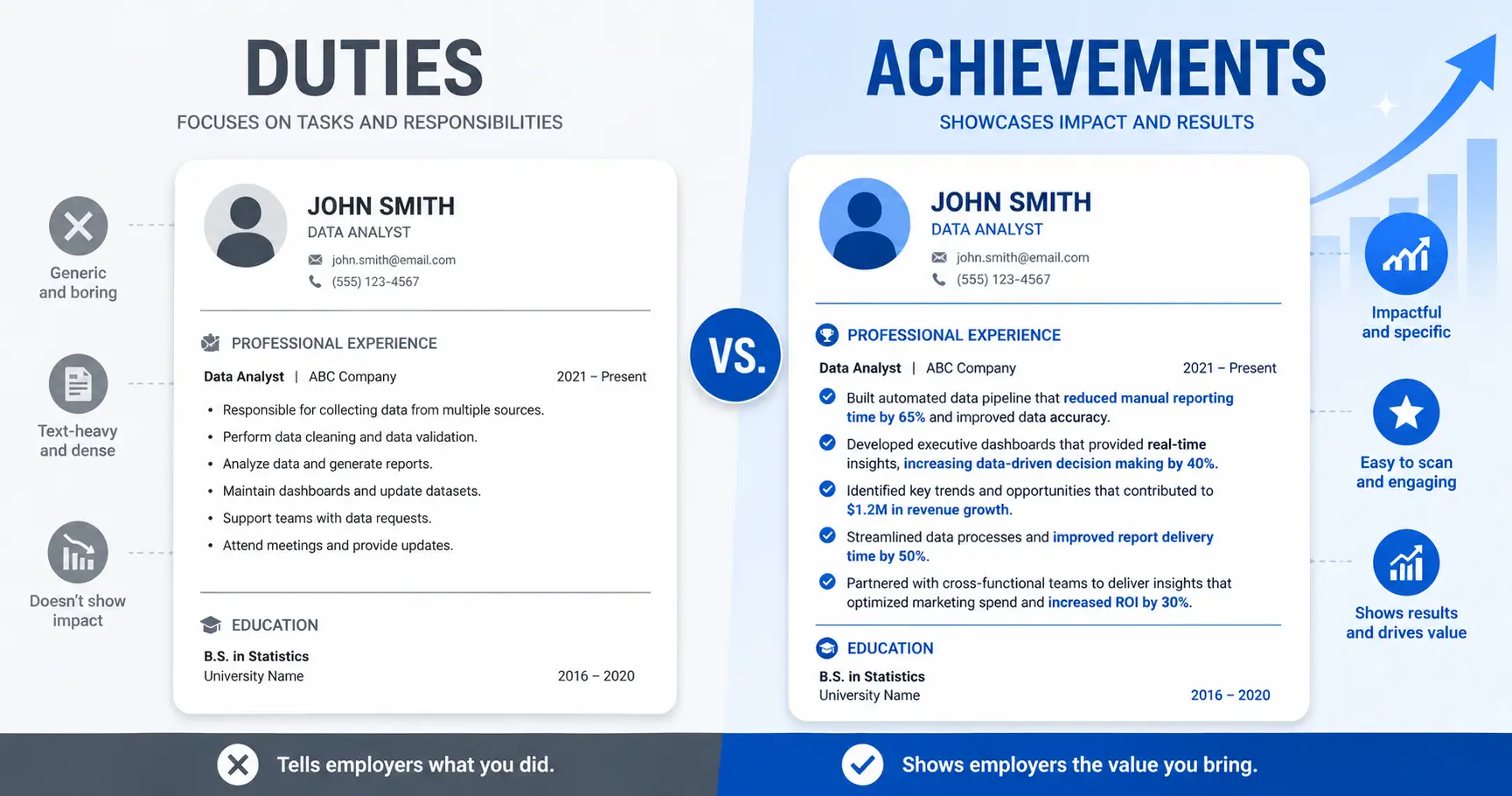
"Detail oriented" instead of a moment where the details mattered. "Passionate about the mission" instead of one observation about the product. "Expert in all loan products" instead of the specific workflow they've run a hundred times. "Managed a team of 12" instead of what changed because they managed it. The claim is faster to write and feels safer, because a specific example can be judged and a vague adjective can't. But that's the problem. If it can't be judged, it can't count in your favour either. It just takes up the space where something checkable should have gone.
The other thread running through these answers is what happens after the resume. Several people here describe candidates who got the interview on a strong-looking line and lost it in the first five minutes of follow-up questions. Anything you can't discuss for two minutes under mild pressure is a liability, not an asset.
Their answers are below, in their own words.
Contents
- Curate Skills That Prove Expertise
- Use Honest Titles and Scope
- Use Your Own Work Vocabulary
- Prove Mission Interest Specifically
- Lead With Client-Centered Advocacy
- Highlight Courtroom Results Over Admissions
- Name Verifiable Installer Credentials
- Ship Outcomes Beyond Process Ceremonies
- Avoid Identical AI Resume Templates
- Protect Client Confidentiality
- Specify Loan-Product Expertise
- Verify Every Resume Claim
- Replace Responsibilities With Demonstrated Impact
- Show Judgment Beyond Production Volume
- Replace Generic Objectives With Role Insight
- Condense Distant Early-Career Roles
- Demonstrate Resilience Through Crisis Examples
- Select Projects That Show Depth
- Prioritize Focus Over Multitasking
- Prioritize Role-Relevant Credentials
- Explain On-the-Ground Contributions
- Showcase Tough Negotiations Over Seminars
- Let Evidence Replace Self-Ratings
- Define Clinical Boundaries and Methods
- Tie Audience Reach to Revenue
Curate Skills That Prove Expertise
I think the most common mistake I see screening resumes that fits this category is packing the "Skills" section with every technology and industry buzzword the candidate has ever encountered. On the screening side, this kind of overloaded skills section comes across as someone trying to stuff keywords into their resume so it gets past screening, which automatically makes me doubt that they have real expertise with the majority of the things they list. For the specialized and leadership roles I fill in the energy sector, the context around tech skills matters much more than simple familiarity, and a bloated list of platforms and tools doesn't tell me anything about how they've actually used their skills.
When I'm screening resumes, I would much rather see 5-6 relevant capabilities that are reinforced in the candidate's experience than a huge list that hits every keyword from the job description but doesn't give me any information on how the candidate has applied those skills. A focused, more streamlined resume that highlights a professional's true strengths makes it much easier to see what they've actually done, and that is the information I really need to evaluate whether they would be a fit for a client's role.
Jon Hill, Chairman & CEO, The Energists
Use Honest Titles and Scope
Inflated job titles. Somebody who was the operations person at a small company calling themselves Head of Operations, or the one person doing all the marketing appearing as Marketing Director.
I understand why it happens. The title is free, it makes a small role look substantial next to bigger companies, and nobody thinks of it as a lie because the work was real. From the screening side, it does the opposite of what is intended. Small businesses are the ones most likely to hire from other small businesses, and we know exactly what those companies look like inside. A director title on a team of five tells me either the company was generous with titles or the candidate has decided to present themselves as more senior than they were. Both make me read the rest of the page more carefully, and once I am reading sceptically, the good parts get discounted along with everything else.
It came up in an interview last year. A candidate with an impressive title turned out to have done a job I would have been pleased with under its honest name, and half our conversation went on unpicking the gap rather than talking about the work.
What I would rather see is the plain title with a line of scope underneath: Sole marketer, reporting to the owner, responsible for the website, the email programme and around 40 supplier listings. That tells me more than any title, and it cannot read as an exaggeration because it is checkable.
Jake Wardle, Founder, EV Cable Hub
Use Your Own Work Vocabulary
Candidates who mirror our job posting word for word are the ones I pass on most often. What it signals is that someone is trying to pass a keyword check rather than tell me what they've done, and it strips their own vocabulary out of the page in the process.
Four resumes came in for a supply chain role a few years back and I couldn't tell them apart. Every one had been tailored so tightly to our posting that they used our exact phrasing throughout. Everyone started sounding the same, which is the opposite of what tailoring is supposed to accomplish.
The person I hired from that batch described her experience in her own terms. She mentioned a data cleanup project I hadn't asked about anywhere in the posting, and six months in, that turned out to be exactly what the role needed.
Here's what I'd rather see. Match the substance of what we're asking for. Then tell me the rest in your own words and let me connect the dots, because how you describe your work tells me plenty about how you think.
Ian Lovell, Vice President of Strategy & Technical Solutions, Reconext
Prove Mission Interest Specifically
I'd go with the line about "being passionate about the mission," written before they know anything about the mission.
What it signals is that this resume was sent to forty companies with one word swapped. Which is fine, honestly, and I don't hold the volume against anyone. What I hold against it is that the candidate spent their most valuable real estate telling me something unfalsifiable instead of telling me something true.
The bigger problem is that enthusiasm is free to claim, so it carries no information. Everyone who applies says it. What I'd rather see in that space is one specific observation about the product or the problem, even a critical one.
A candidate once told me flatly that our onboarding was confusing and named the exact step. That got her an interview faster than any statement of passion would have, because it proved she'd actually looked.
Isabella Rossi, CPO, Fruzo
Lead With Client-Centered Advocacy
"Bulldog litigator" branding costs candidates interviews.
I'm the Managing Partner for Singleton Schreiber's Southeastern Region in Jackson, and I screen lawyers for civil rights, environmental, personal injury, and medical malpractice work. When someone leads with "pit bull," "shark," or "win at all costs," it signals ego, poor client judgment, and a risk they may escalate when the client actually needs strategy.
In environmental racism cases and injury cases, our clients are often dealing with grief, illness, displacement, or distrust of institutions. I'd rather see "prepared witnesses for deposition," "handled difficult client communications," or "built trust with affected communities."
One resume I remember framed "never settles" as a strength. That sounds tough, but in real litigation, justice is not always the loudest option; I want someone who knows when to fight, when to negotiate, and how to keep the client's dignity at the center.
Letitia S. Johnson, Managing Partner, Singleton Schreiber Injury Attorneys
Highlight Courtroom Results Over Admissions
Listing every bar you've passed or every jurisdiction you're admitted to without context — candidates think it signals range, but it often signals they don't know their audience.
I screen attorney candidates personally at Marko Law, and when I see someone lead with a laundry list of admissions and bar memberships before showing me a single case they've actually tried, it tells me they're credential-stacking to hide thin real-world experience. Admissions are table stakes. What I want to know is: have you stood in front of a jury?
I once interviewed a candidate who opened with six jurisdictions and three bar memberships. Impressive on paper. But when I asked about their last trial, they'd never taken a case to verdict. That resume got them the interview — but that answer ended it.
What I'd rather see: one or two specific matters where you owned the result, win or lose. "Second-chaired a three-week employment discrimination trial" beats "admitted in Michigan, Ohio, and D.C." every single time.
Jonathan R. Marko, Founder & Principal Attorney, Marko Law
Name Verifiable Installer Credentials
Listing vague "certifications" or "trained installer" lines on a resume is the one thing I screen out first. As the owner of Big River Roofing, I review every application against real manufacturer standards like IKO Craftsman Premier or Owens Corning Preferred Installer, so those blank claims jump out immediately.
They signal the candidate is hoping the title alone will carry the interview rather than showing they met the documented training and audit requirements those programs demand. In our work, that same shortcut shows up when crews skip proper flashing or ventilation steps and the roof fails early.
I would rather see the exact program name, the issuing manufacturer, and the year it was earned so I can match it directly to the warranties we honor on every job. That single line tells me the person will follow the nail patterns, underlayment overlaps, and ice barrier rules that actually protect homeowners.
Don Kovac, Owner, Big River Roofing
Ship Outcomes Beyond Process Ceremonies
The long list of processes and ceremonies somebody ran. Scrum, sprint planning, daily stand-ups, "coordinated across four teams." Candidates put that there on purpose because it looks like leadership, and at a large company it is.
From the screening side it reads as somebody who was productive inside a structure that already existed. We're small and fully remote, and there's no structure here to plug into. Nobody is going to assign your week. If you need someone to manage you, you don't belong in a startup, and a resume built mostly out of process is usually a resume built by someone who does.
What I'd rather see is one thing you shipped, what it did for the business, and how you knew it worked. At looch the rule is that the code you ship is yours to test. A candidate who writes down how they checked their own work, without being asked to, has told me more than any list of ceremonies.
Michel Myara, Co-founder & Product Designer, looch
Avoid Identical AI Resume Templates
I have noticed that a lot of people are putting their resumes through AI checking tools or formatting tools, and they literally come out looking exactly the same, right down to the font, format, and content. This is likely because they want to "beat the ATS" or get through some of these systems. However, as a human recruiter who looks at every resume that comes through, these AI/ATS-formatted resumes blur together. They usually get passed on because not only do they all look the same, they sound exactly the same for the same job.
I've gotten multiple resumes in for the same role where it's very obvious that they have all put the job description and their resume into AI, and it pumped out almost the exact same resume as a result. So when I see two or more of these in one batch of applicants for the same job — which has happened — they all get passed on, and I move on to the next person.
Joanne Acri, Partner & Executive Recruiter, Junction Collective
A note on AI, since three people here raised it
>
> Joanne Acri, Ian Lovell and Friddy Hoegener are describing the same failure from different angles: a candidate pastes the job ad and their resume into a general-purpose chatbot, and out comes a document that mirrors the posting, sounds like everyone else's, and contains claims the candidate can't defend in the interview.
>
> That's a real problem, and it's worth being clear about what causes it. A general chatbot has nothing to work with except the job ad, so the job ad is what it gives back to you. The fix isn't to avoid AI. It's to use something that starts from your actual career history and works to surface what's specific in it.
>
> That's the distinction Seekario is built around. You upload your real resume once and it becomes your source of truth, so every tailored version is drawn from work you actually did rather than generated to match a posting. The AI Resume Tailor matches the substance of a role instead of parroting its phrasing, and the AI Resume Checker flags exactly the things this article is about — vague responsibility statements where an outcome should be, claims with no evidence attached, filler taking up your top third.
>
> The test is still the one Friddy Hoegener names below: if you can't talk about a line for two minutes under questioning, it shouldn't be on the page, whatever wrote it.
Protect Client Confidentiality
Client-name dropping with sensitive campaign detail quietly costs candidates interviews.
I co-founded RankingCo and have screened plenty of SEO, Google Ads and analytics people while building digital teams. If someone casually lists client names, ad strategy, revenue details or internal campaign mechanics, it signals they may not understand confidentiality.
I'd rather see anonymised proof: "local service business," "national ecommerce brand," or "multi-location retailer," followed by what you were responsible for and how you approached the problem.
I've seen candidates mention recognisable brands and describe the exact campaign setup like it was a trophy. From my side, that doesn't build trust — it makes me wonder what they'd reveal about our clients later.
Kerry Anderson, Co-Founder, RankingCo
Specify Loan-Product Expertise
As a Producing Branch Manager with over 25 years in residential mortgage lending, screening talent for our direct lending team, listing "Expert in all loan products" is the deliberate choice that quietly costs candidates the interview.
To a direct lender with in-house processing, claiming total mastery across every niche — from Jumbo and FHA to Construction and Reverse mortgages — signals a superficial understanding of distinct guidelines. Specialty programs require exact operational focus, so claiming broad mastery usually tells me a candidate only touched the surface of those files.
I would much rather see precise depth in specific niches, such as experience structuring VA loans or coordinating signed builder contracts for construction financing. In a recent screening, a candidate who detailed their specific workflow for handling complex renovation and government-backed files instantly beat out applicants claiming universal expertise.
Dale Gremillion, Senior Loan Officer & Producing Branch Manager, Capital Home Mortgage California
Verify Every Resume Claim
Adding metrics, numbers, or claims that aren't actually true or that they don't really have experience with.
A lot of candidates are using AI now, but they're not always careful with it. AI can create these hallucinations. For example, they might paste the job description into their resume and add all these keywords or experiences because they think it's going to get them through.
But at the end of the day, you're still going to have an interview. And once the recruiter starts asking follow-up questions and really grills you on that experience, if you can't back it up, or you can't really explain what you did, you're going to fall through anyway.
So I think, only put numbers, claims, or experience on your resume if it's actually true and you can talk about it. Because getting through the ATS doesn't really matter if you can't get through the conversation.
Friddy Hoegener, Co-Founder, SCOPE Recruiting
Replace Responsibilities With Demonstrated Impact
I've noticed that many candidates disguise their job descriptions as accomplishments.
They list responsibilities they think sound impressive, but that only signals they were doing the job. It doesn't show how the candidate created value for their previous employer.
For instance, I've often seen bullet points like "responsible for managing a team of 12" or "managed a product roadmap."
But the person screening the resume doesn't know what the candidate actually changed while sitting in that position. This is because almost every candidate can describe their responsibilities in polished language.
I'd rather see the decisions and interventions the candidate made as part of their job responsibilities, as well as the outcomes that followed. This already sets the foundation for many interview questions and gives me a reason to shortlist the candidate.
Himanshu Agarwal, Co-Founder, Zenius
Show Judgment Beyond Production Volume
The one I see most often, and the one candidates are proudest of, is the production number. Some version of prepared over seven hundred returns, or managed a book of three hundred clients.
It is placed there on purpose, it feels like proof of experience, and it works against the candidate almost every time I read it. Volume tells me throughput. It tells me nothing about correctness, and correctness is the whole job. In my field, the work that went fastest is not the work I worry about. When I see a large number with nothing attached to it, the questions that form are unhelpful ones. Who reviewed this person. What happened to the ones that were wrong. Did anybody ever find out.
There is a second problem with it. A number invites comparison against candidates whose numbers are bigger, which turns a resume into a contest the candidate cannot win and never needed to enter.
What I would put in its place is one hard case. Not the outcome, the reasoning. A situation where the documents did not agree, or the rule had changed midway through the year, or the client wanted a position you were not willing to take, and what you did about it. Three sentences of that beats any statistic, because it is the only thing on a resume that cannot be copied from somebody else's.
The close second is the software list. Candidates name every platform they have ever touched, believing it demonstrates range. It reads as somebody who operates tools rather than somebody who decides things, and software is the easiest part of this profession to teach. I have never declined a person for not having used our system. I have declined people who could not explain why they made a call.
One smaller offender worth naming. Detail oriented. Everyone writes it, nobody can be assessed on it, and it sits on the line where the evidence should have gone.
Pellumb Kabashi, Founder and CEO, Tax Expert Today
Replace Generic Objectives With Role Insight
The one that quietly costs candidates is a generic objective statement at the top of the resume, something like seeking a challenging role where I can grow and contribute. Candidates add it thinking it shows ambition, but from the screening side it signals they did not take the time to tailor anything to the actual role, since that line could apply to almost any job at any company.
What I would rather see is that same space used to show they understand what the role actually involves, even in one line. When I am hiring for sales or support at our shop, a candidate who mentions something specific about customer-facing work or attention to detail in a proofing process tells me more in five seconds than a vague ambition statement ever could.
Eric Turney, President / Sales and Marketing Director, The Monterey Company
Condense Distant Early-Career Roles
Candidates are intentionally listing multiple bullets on old entry-level jobs in order to make it seem like there is no gap or a long work history. From the screener's perspective, providing an exhaustive description of a job working in a college retail store while looking to get hired for a senior administrative role indicates a lack of professionalism, and requires the reviewer to search through your resume for relevant experience. I would prefer to have a well-tailored resume with unnecessary distant or irrelevant jobs condensed down into a one line "Additional Experience" summary located at the bottom. The applicant during my most recent review for a facility manager gave equal space to his summer cashier job from 2012 as he gave to his current administrative coordination experience, thus diluting the value of his relevant experience.
Jennifer Hogshead, Director of Finance and Human Resources, New Waters Recovery
Demonstrate Resilience Through Crisis Examples
Writing that you are a "people person" on an application for our treatment center usually doesn't help. I work in admissions, and I look for resilience and boundaries instead. I would much rather read a specific story about how you handled a crisis on shift and what you learned. That actually shows me if you can handle the pressure here.
Travis Wilson, Chief Operating Officer, The Lakes Treatment Center
Select Projects That Show Depth
Look, listing every single side project usually hurts more than it helps. When I'm screening for AI or SaaS roles, a long list of gigs just signals a lack of focus. I can't tell if you have real depth in the areas that matter to us. I'd rather see one summary section, maybe called 'Selected Projects,' with just the two or three most relevant examples. This keeps your main career path clear and easy to follow.
Alykhan Kara, CEO, Appear
Prioritize Focus Over Multitasking
I get nervous when candidates brag about multitasking. It usually means they struggle to prioritize. In real estate, focus matters more than doing five things at once. I would rather hear a specific story about hitting a tight deadline or managing a difficult client. Show me exactly how you balanced those priorities and what the outcome was.
Lane Forhetz, Owner, Fast Lane Real Estate
Prioritize Role-Relevant Credentials
Listing unrelated certifications and training courses hurts candidates' chances. During screening, that signals a lack of focus and suggests the candidate is padding their resume rather than matching the role. I prefer to see a concise set of credentials that are directly relevant to the position, with a brief note on how each was applied in practice. In my screenings, I have passed over resumes crowded with every certificate the candidate ever earned in favor of applicants who highlighted two or three relevant credentials and how they used them. That clarity helps hiring teams make faster, more confident decisions.
Kevin Byford, Founder, HRStudyPro
Explain On-the-Ground Contributions
I always skip the section where candidates list every country they visited. It feels like a vacation itinerary, not a resume. I need to know what you actually handled on the ground. Did you manage a specific tour type or fix a logistics problem? Tell me about the work you did, not just where you went for fun.
Marcel Perkins, Managing Director, Latin Trails
Showcase Tough Negotiations Over Seminars
Honestly, that long list of real estate seminars makes me pause. It feels like you're focused on theory, not actual deals. I'd rather hear about a tough negotiation you won or how you handled a tricky seller. Those stories show me what you're made of, which is what matters when things get complicated.
Alexis Orivri, CEO/Founder, Riv Buys Properties
Let Evidence Replace Self-Ratings
One thing that quietly hurts candidates is the self-rated skills section, where someone gives themselves numbers like leadership 9 out of 10 or communication 10 out of 10. Candidates add it on purpose because they think it creates confidence. From the screening side, it usually does the opposite. It signals weak judgment because the strongest candidates assume the evidence should do the talking.
I would rather see a resume show those strengths through choices, not self-scoring. Tell me what you owned, what changed because of you, and what level of ambiguity or responsibility you handled. That is more credible than grading yourself.
The pattern I see is that resumes get stronger when they sound less like self-promotion and more like a clear operating record. Confidence is useful. Self-ranking is usually noise.
Kenneth Shen, CEO & Founder, Pigment
Define Clinical Boundaries and Methods
As founder of Grace Christian Counseling, I screen every counselor we bring on and see how resumes land in a faith-based clinical setting.
Candidates often list broad phrases like "integrates Biblical principles with therapy" expecting it to stand out. That line can signal they have not yet learned where prayer ends and licensed clinical work begins.
In one case, a strong-looking applicant listed multiple church counseling roles yet offered no attachment or trauma training. The resume read as if spiritual enthusiasm alone would cover complex cases with foster families.
I would rather see a short line naming the actual model used, such as "attachment-based work with prayer integrated only after assessment." That shows the candidate understands scope and safety.
Stephen A. Luther MSEd, MEd, LPC, Founder, Grace Christian Counseling
Tie Audience Reach to Revenue
Follower counts and impression numbers on a resume — that's the one that quietly works against a candidate every time I see it.
I get why people add it. It feels like proof of reach, something concrete to point to. But when I'm screening for growth roles, a number like that tells me almost nothing about whether someone can actually move revenue. Anyone can grow a following without ever touching pipeline, retention or a real sales number.
I ran into this last year with a candidate who led their resume with a follower count from a side project. It looked impressive at first glance, and then I asked what it converted to and got a vague answer. That gap is the actual signal I'm reading for.
What I'd rather see instead is one number tied directly to revenue, retained clients or pipeline generated, even a small one. That tells me the person understands what actually moves a business forward, not just what looks good on a slide.
Will Yang, Head of Growth, Chronicle Technologies
What all 25 answers have in common
Read these together and the industries stop mattering. A roofer, a litigator, a tax accountant and a growth lead are all describing one behaviour: the candidate reached for something that sounds strong instead of something that can be checked.
Three tests will catch most of it on your own resume.
Could anyone applying for this job write this exact sentence? If yes, it's carrying no information. "Passionate about the mission," "detail oriented," "people person," "expert in all loan products," "seeking a challenging role" — every one of these passed someone's internal quality check before it got them rejected. Delete the line and replace it with the thing that made you write it.
Does it name something that happened? A title is not an event. A certification with no issuer or year is not an event. A follower count is not an event. Six bar admissions are not an event. A three-week trial you second-chaired is. A data cleanup nobody asked you to do is. A return where the documents disagreed and you had to make a call is. Jake Wardle's version of this test is the most useful one in the article: write the plain fact with a line of scope underneath, because a checkable line can't read as an exaggeration.
Can you talk about it for two minutes under questioning? This is the one that decides interviews rather than screenings. Two contributors here describe candidates who cleared the resume stage on a strong line and lost the room on the follow-up. If a bullet would collapse the moment someone asked "what did you actually do there," it's already working against you — you just won't find out until you're sitting in front of them.
Fixing this on your own resume
The frustrating part is that most people know their good material. It's in the projects they'd tell a friend about at the pub, not the bullets they wrote at 11pm while applying to the twentieth role that week. Under that kind of time pressure, the vague line always wins, because it's faster and it feels safe.
Seekario is built to close that gap. It's an AI job-application platform designed around what recruiters and ATS filters actually respond to, used by more than 100,000 job seekers:
- AI Resume Builder — turns your raw history into achievement statements using the STAR method, so responsibilities become outcomes. There's a voice-to-text option too: talk through what you did and let it do the framing.
- AI Resume Tailor — matches the substance of a job description rather than its wording, which is exactly the distinction Ian Lovell describes above.
- AI Resume Checker and AI Role Assessment — recruiter-level feedback before you send, flagging unquantified bullets, keyword gaps and filler.
- AI Interview Assistant — generates role-specific questions from your resume and the job ad, so you find out which of your lines you can't defend before a recruiter does.
- AI Cover Letter Generator, KSC Response Writer, LinkedIn Profile Builder and a free application tracker for everything after the resume.
The free plan includes the tracker, unlimited applications and five AI credits, with no card required.
Start building a resume that survives the follow-up questions →