Common Interview Questions for 2026 (And How to Answer Them)


You've submitted your resume, passed the screening call, and now the interview is on your calendar. The nerves kick in — and the first thing most people do is Google "common interview questions" and try to memorize answers.
Here's the problem with memorized answers: interviewers can tell. They've heard the same rehearsed responses hundreds of times. What actually works is understanding the intent behind each question, then preparing flexible answers you can adapt in the moment.
This guide covers the most frequently asked interview questions in 2026, explains what hiring managers are really looking for, and gives you answer frameworks you can make your own. Whether you're interviewing for your first job or your fifth career move, these strategies apply.
How Interviews Have Changed in 2026
Before diving into specific questions, it helps to understand what's shifted in interviewing this year. Three trends are shaping how companies evaluate candidates.
Behavioral questions dominate. Structured behavioral interviewing has become the standard across industries, not just at large tech companies. Expect 60–70% of your interview to be "Tell me about a time when..." questions. Interviewers are trained to score responses against specific competencies, and many companies use standardized rubrics.
AI-assisted screening is widespread. Many companies now use AI tools to analyze video interviews, score written assessments, and even evaluate candidate responses in real time. This doesn't change how you should answer — it means your answers need to be clear, structured, and evidence-based, because both human and AI evaluators reward those qualities.
Culture and values questions carry more weight. Companies have learned that skills can be taught, but values alignment is harder to change. Expect questions about how you handle disagreement, what motivates you, and how you approach learning. These aren't throwaway questions — they often determine the final hiring decision.
The 20 Most Common Interview Questions (With Answer Strategies)
1. "Tell Me About Yourself"
What they're really asking: Give me a quick overview of who you are professionally, so I can decide what to dig into next.
How to answer: Use the Present → Past → Future structure. Start with your current role and a recent win (one to two sentences). Then briefly explain the experience that brought you here (one to two sentences). End with why you're excited about this opportunity (one sentence).
Example: "I'm a product marketing manager at a B2B SaaS company, where I recently led the launch of our enterprise tier — that campaign drove a 34% increase in qualified leads last quarter. Before that, I spent three years at an agency working with tech clients, which gave me a strong foundation in positioning and competitive analysis. I'm drawn to this role because your team is tackling the same go-to-market challenges I find most interesting, and I'd love to bring that experience here."
Keep it under 90 seconds. This is a warm-up, not your life story.
2. "Why Do You Want to Work Here?"
What they're really asking: Have you done your homework, and are you genuinely interested — or are you applying everywhere?
How to answer: Reference something specific about the company — a recent product launch, a value from their careers page, a piece of news, or something an employee shared. Then connect it to your skills or career goals.
What to avoid: Don't say "I've always admired your company" without specifics. Don't focus only on what the company can do for you (salary, perks, brand name). Show mutual value.
3. "Why Are You Leaving Your Current Job?"
What they're really asking: Are you running away from something, or running toward something? Is there a red flag I should know about?
How to answer: Stay positive and forward-looking. Frame your departure around growth: you've accomplished what you set out to do, and now you're looking for new challenges that align with where you want to grow.
Example: "I've had a great run at my current company — I built the analytics function from scratch and grew the team to five people. But the company's focus is shifting in a direction that doesn't align with my interest in machine learning applications, and this role is a much better fit for where I want to take my career."
Never badmouth your current employer. Even if the situation is genuinely bad, it reflects poorly on you.
4. "What Is Your Greatest Strength?"
What they're really asking: Do you have self-awareness, and can you back up your claims with evidence?
How to answer: Pick one strength that's directly relevant to the role. State it clearly, then immediately support it with a specific example.
Example: "My strongest skill is translating technical complexity into clear communication. At my last company, I was the person engineering teams pulled into client meetings when they needed to explain system architecture to non-technical buyers. That ability to bridge the gap between technical and business audiences led to us closing our two largest enterprise deals last year."
One well-supported strength beats a list of five generic ones.
5. "What Is Your Greatest Weakness?"
What they're really asking: Can you be honest about your development areas, and are you actively working to improve?
How to answer: Choose a real weakness — not a fake one like "I work too hard." Then explain what you're doing to address it. The best answers show self-awareness and a growth mindset.
Example: "I tend to over-research before making decisions, which can slow me down when speed matters more than perfection. I've been working on this by setting time limits for research phases — I give myself a fixed window to gather information, then make the best call I can with what I have. My manager mentioned in my last review that she's noticed real improvement in my decision-making speed."
6. "Tell Me About a Time You Faced a Challenge at Work"
What they're really asking: How do you handle difficulty? Do you take ownership, or do you blame others?
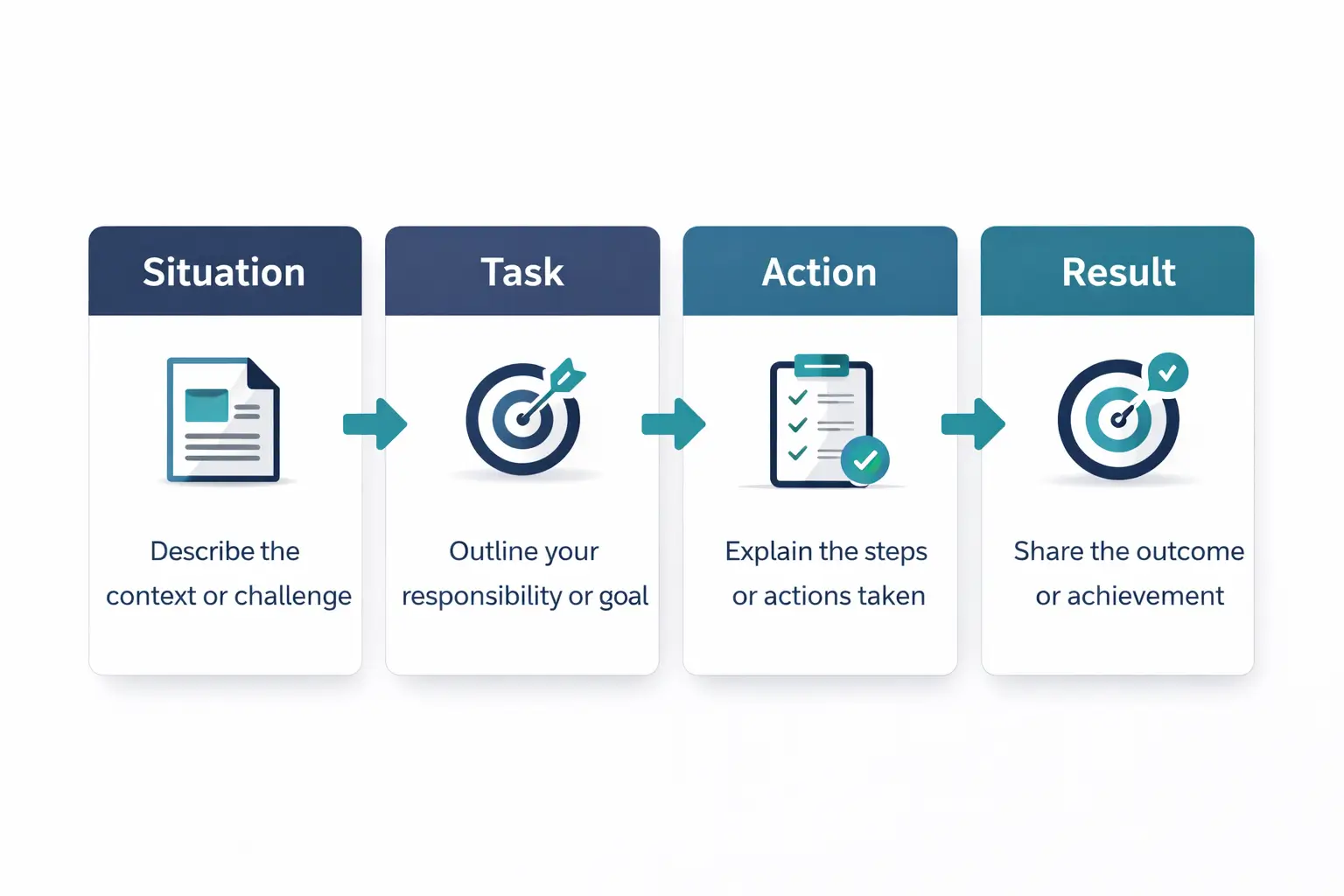
How to answer: Use the STAR method. Describe the Situation briefly (two sentences max), explain your specific Task or responsibility, detail the Actions you took (this should be the longest part), and share the Result with a measurable outcome.
Example: "Our team's main product had a 23% churn rate, and we were losing customers faster than we could acquire them. As the customer success lead, I was tasked with reducing churn by at least 10 percentage points within two quarters. I built a proactive outreach program triggered by usage signals — when engagement dropped below a threshold, my team would reach out within 48 hours with tailored solutions. I also created a quarterly business review framework so customers could see their ROI clearly. After six months, churn dropped to 12%, and we identified $800K in expansion revenue from the accounts we saved."
7. "Where Do You See Yourself in Five Years?"
What they're really asking: Are you going to stick around, and does this role fit into a realistic career path?
How to answer: Show ambition that aligns with the company's trajectory. You don't need a detailed five-year plan — just demonstrate that you've thought about your professional growth and that this role is a meaningful step.
Example: "In five years, I want to be leading a team that's shaping product strategy — not just executing on it. This role is appealing because it sits at the intersection of customer insights and product direction, which is exactly where I want to build deeper expertise. I see myself growing into a senior leadership position where I can mentor others while driving the roadmap."
8. "Why Should We Hire You?"
What they're really asking: Can you make a concise case for yourself that connects your skills to our needs?
How to answer: Identify the top two or three requirements from the job description and map your experience directly to them. End with something that differentiates you from other candidates.
Tip: This question is really asking you to deliver your value proposition. Prepare a 60-second pitch that connects your unique combination of skills to the role's key challenges.
9. "Tell Me About a Time You Worked on a Team"
What they're really asking: Are you collaborative? Do you handle different perspectives well? Can you contribute without dominating?
How to answer: Choose an example that shows you working with people who had different skills, opinions, or working styles. Highlight how you contributed to the team's success — not just your individual work. Mention how you handled any friction productively.
10. "How Do You Handle Stress or Pressure?"
What they're really asking: Will you fall apart when things get hard, or do you have coping strategies that keep you effective?
How to answer: Give a specific example of a high-pressure situation and explain the systems or strategies you used to manage it. Focus on the actions you took, not on how stressed you felt.
Example: "During a product launch last year, we discovered a critical bug 48 hours before go-live. I organized a war room with engineering, QA, and product, prioritized the fix based on user impact, and set up two-hour check-in cycles so everyone stayed aligned. We shipped the fix with six hours to spare. The experience reinforced my belief that clear communication and structured problem-solving are the best tools for handling pressure."
11. "Describe a Time You Disagreed With Your Manager"
What they're really asking: Can you push back respectfully? Do you handle conflict professionally?
How to answer: Show that you can voice disagreement with data and respect, and that you ultimately support the final decision even if it's not your preferred choice. This question tests your maturity, not whether you were right.
12. "What Motivates You?"
What they're really asking: Will the day-to-day work of this role keep you engaged, or will you get bored?
How to answer: Connect your motivation to the actual work of the role. If you're interviewing for a data role, talk about the thrill of finding patterns in messy data. If it's a management role, talk about developing people. Avoid generic answers like "I'm motivated by challenges" — be specific.
13. "Tell Me About a Mistake You Made"
What they're really asking: Do you take accountability? Can you learn from failure?
How to answer: Choose a genuine mistake (not something trivial), explain what went wrong and why, describe how you fixed it, and — most importantly — share what you learned and how you've applied that lesson since.
14. "How Do You Prioritize Your Work?"
What they're really asking: Can you manage competing demands without someone micromanaging you?
How to answer: Describe your actual system — whether it's a framework like Eisenhower Matrix, a tool like Notion or Jira, or a simple daily planning habit. Give a specific example of a time you had to make a tough prioritization call.
15. "What's Your Expected Salary?"
What they're really asking: Are we in the same ballpark, and how do you handle this conversation?
How to answer: If possible, deflect until you have more information about the full compensation package. If pressed, give a researched range based on market data. Always emphasize that you're flexible and interested in the total package, not just base salary.
Example: "Based on my research and the scope of this role, I'd expect a range of $120K to $140K, but I'm open to discussing the full compensation package including equity and benefits."
16. "Do You Have Any Questions for Us?"
What they're really asking: Are you genuinely curious about this role and company?
How to answer: Always have at least three questions prepared. Ask about team dynamics, upcoming challenges, how success is measured in the first 90 days, or what the interviewer personally enjoys about working there. Avoid questions about perks or time off in early rounds — save those for later.
Strong questions to ask:
- "What does success look like in this role after six months?"
- "What's the biggest challenge the team is currently facing?"
- "How would you describe the team's working style?"
- "What's something you wish you'd known before joining?"
17. "Tell Me About a Time You Showed Leadership"
What they're really asking: Can you influence outcomes and people, even without formal authority?
How to answer: Leadership doesn't require a management title. Share an example where you took initiative, rallied others around a goal, or made a decision that moved a project forward. Focus on how you inspired or organized people, not on giving orders.
18. "How Do You Stay Current in Your Field?"
What they're really asking: Are you a continuous learner, or did you stop growing after your last job change?
How to answer: Be specific. Mention newsletters you read, courses you've taken recently, communities you're part of, or side projects that keep your skills sharp. Vague answers like "I read a lot" don't carry weight.
19. "Tell Me About a Time You Had to Learn Something Quickly"
What they're really asking: How adaptable are you? Can you ramp up fast in a new role?
How to answer: Use STAR to describe a situation where you had to acquire a new skill or domain knowledge under time pressure. Emphasize your learning process — how you broke down the problem, what resources you used, and how quickly you became effective.
20. "What Makes You Unique?"
What they're really asking: Among all the qualified candidates, what's your differentiator?
How to answer: Identify a combination of skills, experiences, or perspectives that's unusual. Maybe you're an engineer with a background in psychology, or a marketer who can write SQL. The most compelling answers connect your unique angle to a specific way you'll add value in the role.

Answer Frameworks That Work for Any Question
You don't need to memorize twenty different answers. Instead, master these two frameworks and adapt them on the fly.
The STAR Method (For Behavioral Questions)
Use this whenever you hear "Tell me about a time when..." or "Give me an example of..."
- Situation: Set the scene in two sentences (company, context, challenge)
- Task: Explain your specific role or responsibility
- Action: Describe what you did — be detailed and specific (this is the most important part)
- Result: Share the outcome with numbers when possible, plus what you learned
The most common mistake with STAR is spending too long on Situation and Task. Aim for 70% of your answer to be Action and Result.
The Present-Past-Future Method (For Open-Ended Questions)
Use this for "Tell me about yourself," "Why this role," or "What are you looking for?"
- Present: What you're doing now and what you're good at
- Past: How your experience built the foundation for where you are
- Future: Why this opportunity is the right next step
Both frameworks keep your answers structured and concise — which is exactly what interviewers want.
How to Prepare: A Practical System
Reading about interview questions helps, but preparation requires practice. Here's a system that works.
Step 1: Build Your Story Bank. Write down 8–10 stories from your career that cover different competencies: leadership, teamwork, conflict, failure, achievement, innovation, time management, and adaptability. Each story should follow the STAR format.
Step 2: Map Stories to Common Questions. Most stories can answer multiple questions. Your "handling a difficult client" story might work for teamwork, conflict resolution, and communication questions. Create a simple matrix matching your stories to the 20 questions above.
Step 3: Practice Out Loud. Reading your answers silently is not the same as saying them. Practice with a friend, record yourself, or use an AI mock interview tool. Aim for answers between 60 and 120 seconds — long enough to be substantive, short enough to keep the interviewer engaged.
Step 4: Research the Company. Spend 30 minutes learning about the company's recent news, product updates, competitors, and culture. This research feeds into your answers for "Why this company," "Do you have questions for us," and any role-specific discussions.
Seekario's AI Interview Prep can simulate realistic interview sessions based on the specific job you're applying for. It generates role-specific questions, evaluates your answers, and gives targeted feedback so you can improve before the real thing.
Questions to Prepare for by Industry
While the core questions above apply everywhere, different industries have their own favorites.
Tech: Expect system design questions, coding challenges, and "How would you approach..." product questions alongside behavioral ones. Technical interviews often have separate rounds for coding and behavioral evaluation.
Finance: Prepare for case studies, market analysis questions, and ethics scenarios. "Walk me through a financial model" and "How do you handle confidential information?" come up frequently.
Healthcare: Patient safety scenarios, ethical dilemmas, and teamwork under pressure are common themes. Expect questions about compliance, documentation, and handling emotional situations.
Marketing: Be ready to discuss campaign metrics, attribution challenges, and creative problem-solving. "Walk me through a campaign you ran from strategy to results" is almost guaranteed.
Sales: Expect role-playing scenarios, objection handling, and pipeline management questions. "Tell me about your biggest deal" and "How do you handle rejection?" are staples.
Common Mistakes That Cost Candidates the Job
Even well-prepared candidates sabotage themselves with avoidable errors. Watch out for these.
Rambling. If your answers regularly go past two minutes, you're losing the interviewer. Practice being concise. It's a skill, and it takes effort.
Being too generic. "I'm a hard worker and a team player" tells the interviewer nothing. Every claim needs a specific example.
Not asking questions. Saying "No, I think you've covered everything" signals low interest. Always have questions ready.
Badmouthing previous employers. Even if your last job was genuinely terrible, frame your departure positively. Negativity raises red flags about your professionalism.
Failing to connect your experience to the role. Don't assume the interviewer will connect the dots. Explicitly explain how your past experience prepares you for this specific position.
Not following up. Send a brief thank-you email within 24 hours referencing something specific from the conversation. It's a small thing that makes a real difference.
Frequently Asked Questions
How many interview questions should I prepare for?
Prepare stories and frameworks rather than scripted answers. If you have 8–10 strong STAR stories and can adapt them on the fly, you'll be ready for virtually any behavioral question. For role-specific technical questions, research the company's interview process on Glassdoor or similar sites to know what to expect.
How long should my interview answers be?
Most answers should be 60–120 seconds. For behavioral questions using STAR, aim for closer to 90 seconds. For quick questions like "What motivates you?" or "What's your management style?", 30–60 seconds is fine. If the interviewer wants more detail, they'll ask follow-up questions.
What's the best way to practice for interviews in 2026?
Combine three approaches: rehearse your STAR stories out loud (solo or with a friend), research the specific company and role thoroughly, and use an AI mock interview tool for realistic practice with feedback. Seekario's AI Interview Prep simulates role-specific interviews and gives you targeted coaching on your responses.
Should I bring notes to an interview?
For virtual interviews, having brief notes nearby is acceptable — just don't read from them. For in-person interviews, bring a notebook with your questions for the interviewer and a few bullet points you want to remember. Using notes shows preparation, not weakness.
How do I answer questions about salary expectations?
Research market rates using sites like Levels.fyi, Glassdoor, and Payscale before the interview. When asked, provide a researched range rather than a single number. If possible, delay this conversation until you understand the full scope of the role and compensation package. Always base your range on market data, not your current salary.
Walk Into Your Next Interview Ready
Interview preparation doesn't need to be stressful. Focus on building a bank of strong stories, practicing your delivery, and researching each company thoroughly. The questions themselves rarely surprise well-prepared candidates — it's the structure and specificity of your answers that set you apart.
If you want personalized practice before your next interview, Seekario's AI Interview Prep generates questions tailored to the specific role you're targeting and gives you real-time feedback on your answers. Think of it as a dress rehearsal that actually makes you better — not just more nervous.