Resume Summary vs Objective: Which to Use and When

.webp)
You've got about six seconds. That's how long the average recruiter spends scanning your resume before deciding whether to keep reading or move on. The section at the top of your resume — whether it's a summary or an objective — carries enormous weight in that window.
But here's where most job seekers get stuck: should you write a resume summary or a resume objective? They sound similar, but they serve different purposes, and picking the wrong one can cost you interviews. Let's break down exactly what each one does, when to use it, and how to write one that actually works.
What Is a Resume Summary?
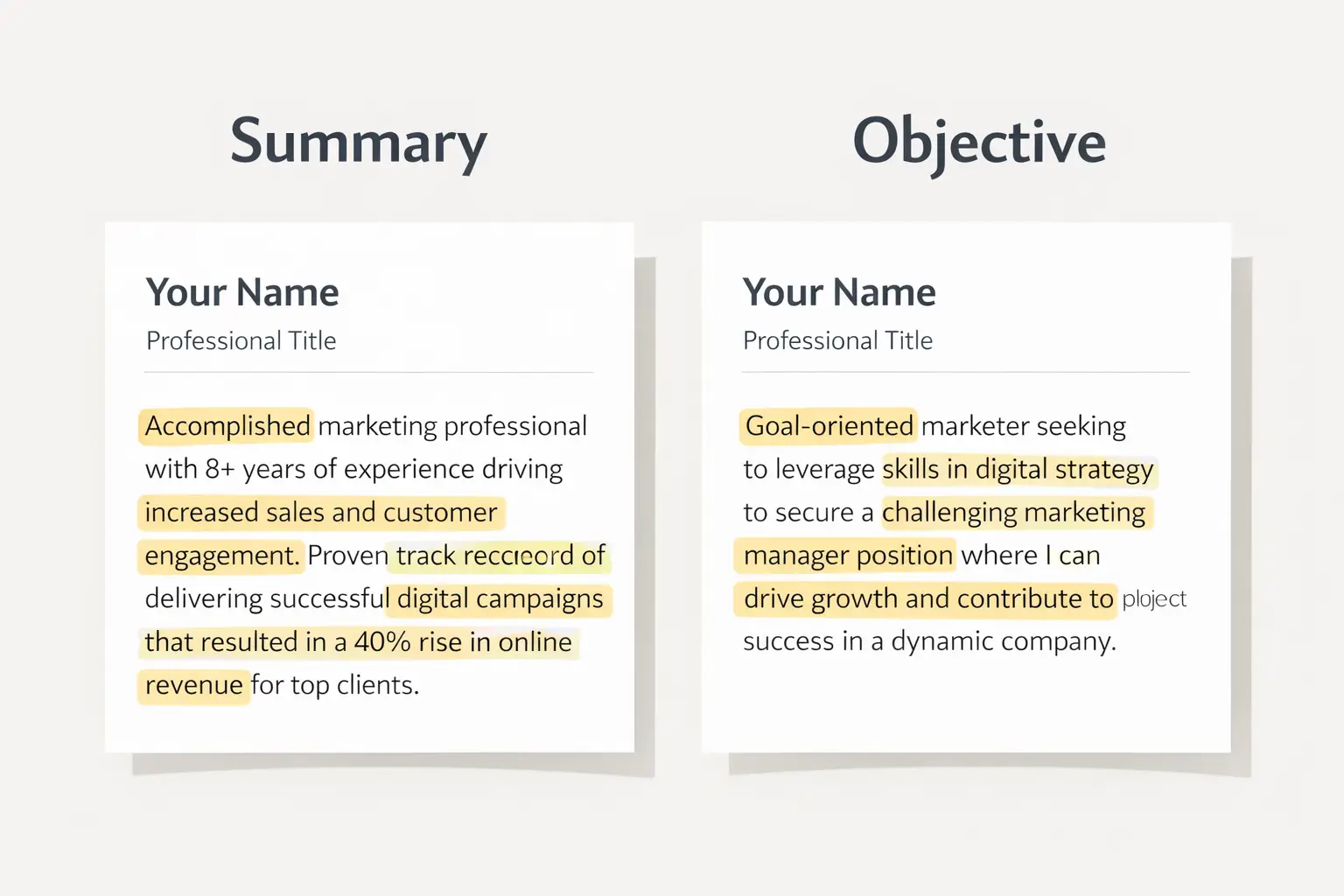
A resume summary is a short paragraph (3–5 sentences) at the top of your resume that highlights your most relevant skills, experience, and accomplishments. Think of it as your career highlight reel — a snapshot that tells a hiring manager exactly what you bring to the table.
A strong resume summary uses active voice, includes measurable results, and is tailored to the specific role you're applying for.
Example:
> Results-driven marketing manager with 7+ years of experience leading cross-functional campaigns for B2B SaaS companies. Increased qualified leads by 45% through data-driven content strategies and reduced cost-per-acquisition by 30%. Skilled in SEO, marketing automation, and team leadership.
Notice the pattern: job title, years of experience, key achievements with numbers, and core skills. That's the formula.
What Is a Resume Objective?
A resume objective is a brief statement that describes your career goals and what you hope to achieve in the role you're applying for. Instead of looking backward at what you've done, it looks forward at where you want to go.
Example:
> Recent computer science graduate seeking an entry-level software development role where I can apply my Python and JavaScript skills while contributing to a collaborative engineering team.
Objectives work best when you don't have a deep well of professional experience to draw from yet.
The Core Difference
The fundamental difference comes down to perspective:
- A resume summary looks backward. It says: "Here's what I've accomplished and what I'm capable of."
- A resume objective looks forward. It says: "Here's what I want to do and why I'm motivated."
Summaries focus on how you'll benefit the company. Objectives tend to focus on how the role benefits you. That distinction matters because hiring managers are scanning for evidence that you can solve their problems — not that you have career aspirations.
When to Use a Resume Summary
Use a resume summary if you meet any of these criteria:
- You have 2+ years of relevant work experience. You've got accomplishments to showcase — use them.
- You're staying in the same industry or field. Your track record speaks directly to the role.
- You want to pass ATS screening. Summaries packed with relevant keywords from the job description perform better with applicant tracking systems.
- You're applying for mid-level or senior positions. Hiring managers at this level expect evidence of impact, not statements about goals.
For the vast majority of job seekers in 2026, a resume summary is the stronger choice. ATS algorithms are looking for skills and keywords — not career aspirations. A well-written summary gives both the software and the human reviewer exactly what they need.
If you're not sure how to craft a summary that hits the right keywords, Seekario's AI Resume Builder analyzes job descriptions and helps you write summaries that align with what recruiters and ATS systems are scanning for.
When to Use a Resume Objective
There are specific situations where an objective statement still makes sense:
- You're a recent graduate with limited work experience. You don't have years of achievements to summarize, so explaining your direction is the next best thing.
- You're making a major career change. An objective helps bridge the gap between your past experience and your new target role.
- You're re-entering the workforce after a gap. An objective can briefly frame your return and your focus going forward.
- You're targeting a very specific niche role. Sometimes stating your precise intent signals strong fit.
Even in these cases, the best objectives still include skills and value — not just aspirations. "Seeking a challenging role in a dynamic company" tells a recruiter nothing. But "Seeking a junior data analyst role where I can apply my SQL and Tableau skills to support data-driven business decisions" gives them something to work with.
The Hybrid Approach: Best of Both Worlds
Here's a move that's gaining popularity in 2026: combine both. Start with a summary of your skills and background, then weave in a brief mention of your career goal.
Example:
> Customer success specialist with 3 years of experience managing enterprise SaaS accounts and driving 95% client retention. Seeking to leverage account management expertise in a team lead role focused on scaling customer onboarding programs.
This gives you the credibility of a summary with the directional clarity of an objective. It works especially well for career pivots where you have relevant transferable experience.
How to Write a Resume Summary That Gets Results
Follow this framework to write a summary that stands out:
- Open with your professional identity. State your title and years of experience.
- Highlight 2–3 key skills or areas of expertise. Match these to the job description.
- Include at least one quantifiable achievement. Numbers catch attention — percentages, dollar amounts, team sizes, or time saved.
- Tailor it for every application. A generic summary won't cut it. Mirror the language from the job posting.
Keep it between 50 and 100 words. Anything longer and you risk losing the reader.
Need help tailoring your summary to match specific job descriptions? Seekario's AI Resume Tailor compares your resume against the job posting and suggests targeted improvements — including your summary section.
How to Write a Resume Objective That Works
If an objective is the right fit for your situation, make it count:
- Name the specific role you're targeting. Avoid vague language like "seeking a challenging opportunity."
- Include 1–2 relevant skills. Even without deep experience, you have transferable skills.
- Show what you'll contribute, not just what you want. Flip the focus toward the employer's needs.
- Keep it to 1–2 sentences. Brevity is key.
Weak objective: "Looking for a position where I can grow my skills and advance my career."
Strong objective: "Detail-oriented accounting graduate with internship experience in financial reporting, seeking a junior auditor role to support compliance and accuracy goals at a Big Four firm."
Common Mistakes to Avoid
Whether you choose a summary or objective, steer clear of these pitfalls:
- Being too generic. "Hard-working professional with excellent communication skills" could describe anyone. Be specific.
- Focusing only on yourself. The hiring manager wants to know what you'll do for *them*.
- Skipping keywords. ATS systems filter resumes based on keyword matches. Use the exact terms from the job description where they naturally fit.
- Writing once and copy-pasting everywhere. Each application deserves a tailored version. Tools like Seekario's AI Resume Scanner can scan your resume against a job description and flag gaps before you hit submit.
FAQ
Is a resume summary or objective better for ATS?
A resume summary typically performs better with ATS systems because it contains more skill-based keywords and achievement-driven language. ATS algorithms in 2026 prioritize matching skills and qualifications over career goal statements. That said, both can work if you include relevant keywords from the job posting.
Can I skip both the summary and objective entirely?
Technically, yes. Some recruiters jump straight to your work experience anyway. But a well-written summary gives you a chance to frame your candidacy on your own terms in those critical first seconds. For most people, it's worth the space.
How long should a resume summary be?
Aim for 50–100 words, or roughly 3–5 sentences. It should be long enough to convey your value but short enough that a recruiter can absorb it in a quick scan.
Should I use a resume objective if I'm changing careers?
A career change is one of the few scenarios where an objective still adds value. It helps explain why your experience — which may look unrelated at first glance — is actually relevant to the new role. Consider combining it with a summary for maximum impact.
Do I need to change my summary for every job application?
Yes. Tailoring your summary to match each job description significantly improves your chances of passing ATS filters and catching a recruiter's eye. Focus on mirroring 2–3 key requirements from the posting.
The Bottom Line
For most job seekers in 2026, a resume summary is the clear winner. It puts your strongest qualifications front and center, speaks directly to what hiring managers are looking for, and performs better with the ATS systems that screen most applications today.
Use an objective only when it genuinely serves your situation — when you're new to the workforce, changing careers, or re-entering after a break. And even then, make sure it includes skills and value, not just aspirations.
Whatever you choose, make those opening lines count. They might be the only part of your resume that gets read.
Ready to build a resume that leads with your strongest material? Try Seekario's AI Resume Builder to create a polished, ATS-optimized resume in minutes — complete with a tailored summary that highlights exactly what recruiters want to see.


.webp)