Should You Include GPA on Your Resume? A Data-Backed Answer

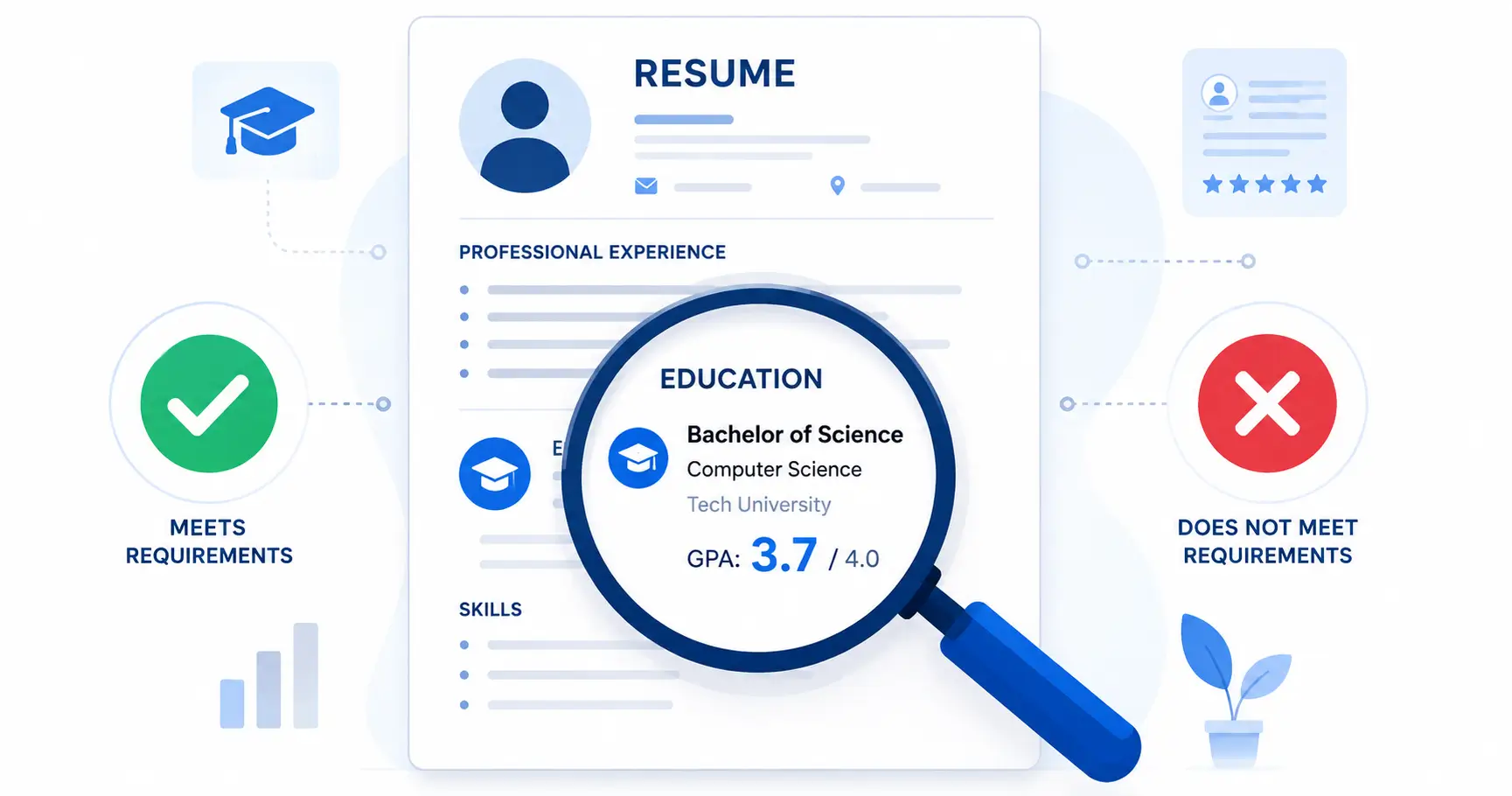
Few resume decisions cause more anxiety than this one: do you list your GPA, or leave it off? Ask ten career advisors and you'll get ten different answers — most of them based on gut feeling rather than evidence.
This article takes a different approach. We pulled recruiter survey data, hiring manager preferences, and industry benchmarks to give you a clear, numbers-driven answer. Whether you graduated last month or five years ago, you'll know exactly what to do with your GPA by the time you finish reading.
The GPA Debate: What the Numbers Actually Say
The conversation around GPA on resumes has shifted dramatically in recent years. According to NACE (National Association of Colleges and Employers), only about 42% of employers now screen candidates by GPA — a steep drop from 73% in 2019. That's nearly half the employers who used to care simply... stopping.
But that stat alone doesn't tell the full story. A more recent NACE survey found that 47% of employers plan to screen by GPA for entry-level roles specifically, suggesting a partial rebound for new graduate hiring. The takeaway: GPA screening isn't dead, but it's far less universal than it was five years ago.
What's replacing it? Employers increasingly prioritize internship experience, relevant projects, technical skills, and demonstrated problem-solving ability. Your GPA is one signal among many — and for most hiring managers, it's not the loudest one.
Industry Expectations: Where GPA Still Carries Weight
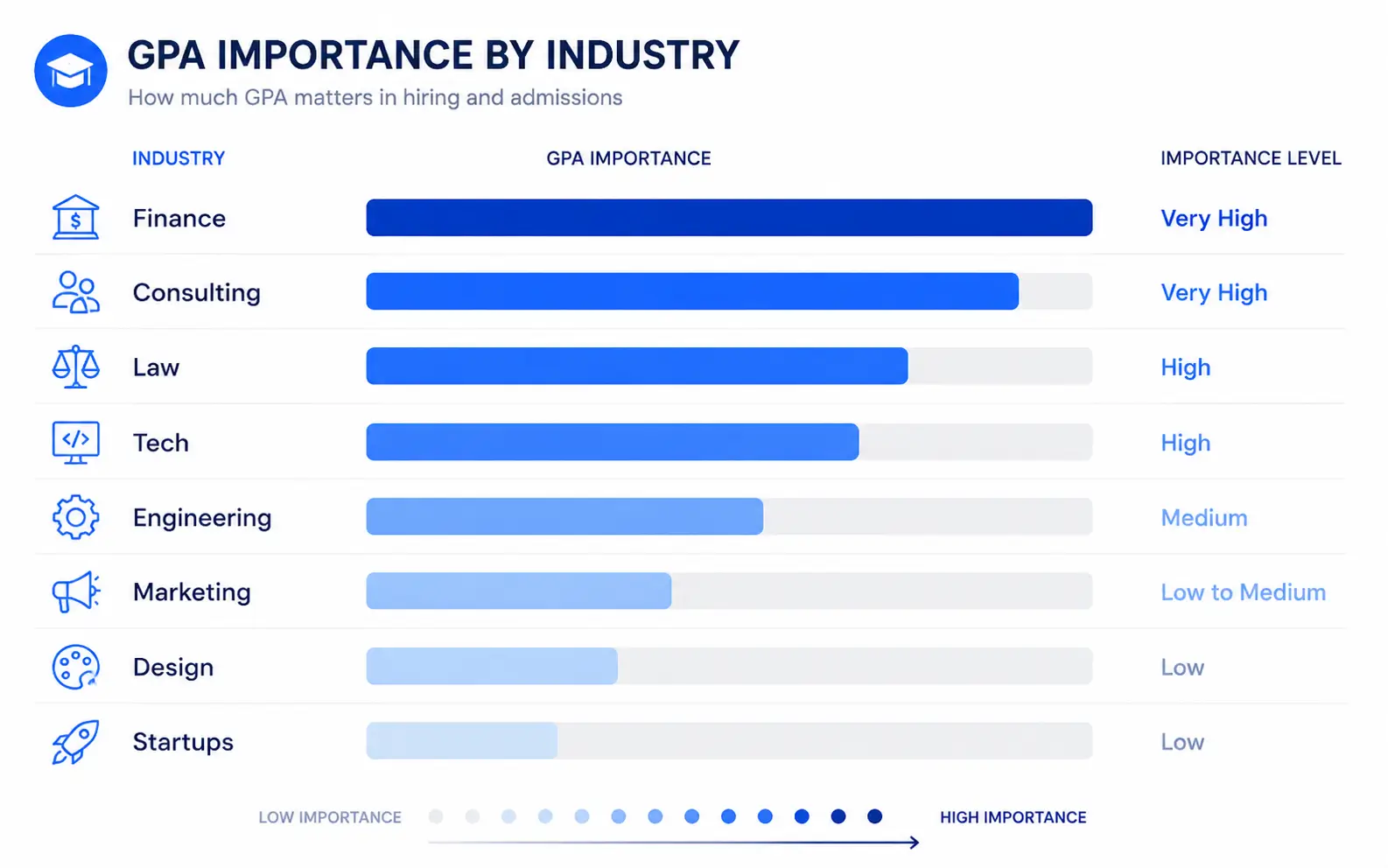
Not all industries treat GPA the same way. Here's what the data shows about which sectors still care — and which ones have moved on.
High-GPA Industries (GPA Frequently Screened)
Investment banking and finance. Wall Street remains one of the last strongholds of GPA screening. Many bulge-bracket banks and financial firms use 3.5 as a hard cutoff during campus recruiting. Some even filter applications automatically at that threshold before a human sees your resume.
Management consulting. McKinsey, BCG, and Bain — along with most mid-tier consulting firms — treat GPA as a baseline qualification. A 3.6 or higher is common among successful applicants, though it's rarely the deciding factor on its own.
Law and legal consulting. Law firms, particularly large ones, weigh GPA heavily during on-campus interviews. Your law school GPA matters even more than your undergraduate number.
Research and academia. Graduate programs and research positions expect GPA as standard. Leaving it off in these contexts looks like you're hiding something.
Moderate-GPA Industries (GPA Sometimes Considered)
Big tech. Google, Meta, and similar companies dropped formal GPA requirements years ago, but some teams — particularly in quant roles or new grad programs — still glance at it. A strong GPA won't hurt, but a missing one won't disqualify you either.
Engineering. Many engineering employers care more about project work and technical assessments than grades. That said, some defense contractors and aerospace firms still screen at 3.0.
Healthcare (non-clinical roles). Administrative and research positions in healthcare sometimes use GPA as a tiebreaker, especially for recent graduates.
Low-GPA Industries (GPA Rarely Matters)
Creative and design fields. Your portfolio is your resume. UX/UI, graphic design, content creation — none of these fields place meaningful weight on GPA.
Startups and small businesses. Smaller companies care about what you can do, not what grade you earned doing it. Skills, adaptability, and hustle matter more.
Sales and marketing. Results-driven roles focus on metrics and track records, not academic performance.
Skilled trades and operations. Certifications and hands-on experience outweigh academic credentials entirely.
If you're unsure where your target industry falls, run your resume through Seekario's AI Resume Assessment — it analyzes whether your education section is properly calibrated for the roles you're targeting.
The 3.5 Rule (and When to Break It)
You've probably heard some version of the "3.5 rule" — only include your GPA if it's 3.5 or above. It's decent general advice, but it oversimplifies the decision. Here's a more nuanced framework:
Include your GPA if:
- It's 3.5 or higher and you graduated within the last two years
- It's 3.0 or higher and the job posting specifically asks for it
- It's 3.0 or higher and you're applying to finance, consulting, or law
- Your major GPA is significantly higher than your cumulative GPA (list major GPA instead)
- You're a current student or recent graduate with limited work experience
Leave your GPA off if:
- It's below 3.0 and the posting doesn't require it
- You have three or more years of professional experience
- You have strong work achievements that demonstrate competence better than grades
- You're in a creative, trade, or portfolio-driven field
- You completed a non-traditional education path (bootcamp, self-taught, etc.)
The major GPA strategy. If your cumulative GPA is a 3.1 but your major GPA is a 3.7, list the major GPA. Format it as "Major GPA: 3.7/4.0" and you're telling a more accurate story about your capabilities in your field. Most recruiters accept this approach — just be prepared to explain if asked.
Alternatives to GPA That Impress Recruiters
If your GPA doesn't make the cut — or you've been working long enough that it's irrelevant — focus on these alternatives that recruiters consistently rank higher than grades:
Dean's List or Latin honors. "Magna Cum Laude" communicates academic excellence without attaching a specific number. If your honors designation was strong, use it instead.
Relevant coursework. For recent graduates, listing three to four targeted courses shows academic depth without relying on a single number. This works especially well when the courses directly map to the job requirements.
Certifications and credentials. A Google Analytics certification, AWS Solutions Architect badge, or PMP credential tells employers more about your current capabilities than a GPA from years ago. Check out our guide on how to list certifications on a resume for formatting tips.
Projects and portfolio work. A capstone project, open-source contribution, or freelance engagement demonstrates applied knowledge. Employers would rather see what you built than what grade you received.
Quantified achievements. Once you have work experience, metrics replace grades. "Increased pipeline conversion by 23%" says more than "3.8 GPA" ever could.
Seekario's AI Resume Builder helps you structure these alternatives so they fill the gap a missing GPA might leave — especially useful for career changers or candidates returning to the workforce.
How to Format GPA on Your Resume
If you've decided to include your GPA, placement and formatting matter. Here's what works.
Standard format:
```
Bachelor of Science in Computer Science
University of Michigan, Ann Arbor — May 2025
GPA: 3.7/4.0
```
Major GPA format:
```
Bachelor of Arts in Economics
Boston University — May 2025
Major GPA: 3.8/4.0
```
With honors:
```
Bachelor of Science in Finance, Magna Cum Laude
NYU Stern School of Business — May 2024
GPA: 3.75/4.0
```
A few formatting rules to follow. Always include the scale (write "3.7/4.0" not just "3.7"). Place GPA on the same line as or directly below your degree. Don't bold or enlarge it — GPA should be a supporting detail, not a headline. If your school uses a different scale (like 10.0 or percentage-based), convert it or clarify the scale.
For international candidates, note that GPA formats vary by country. UK students might list a "First Class Honours" designation. Indian universities often use a percentage system. If you're applying to U.S. companies, consider including a conversion or using a credential evaluation service.
When to Remove GPA From Your Resume
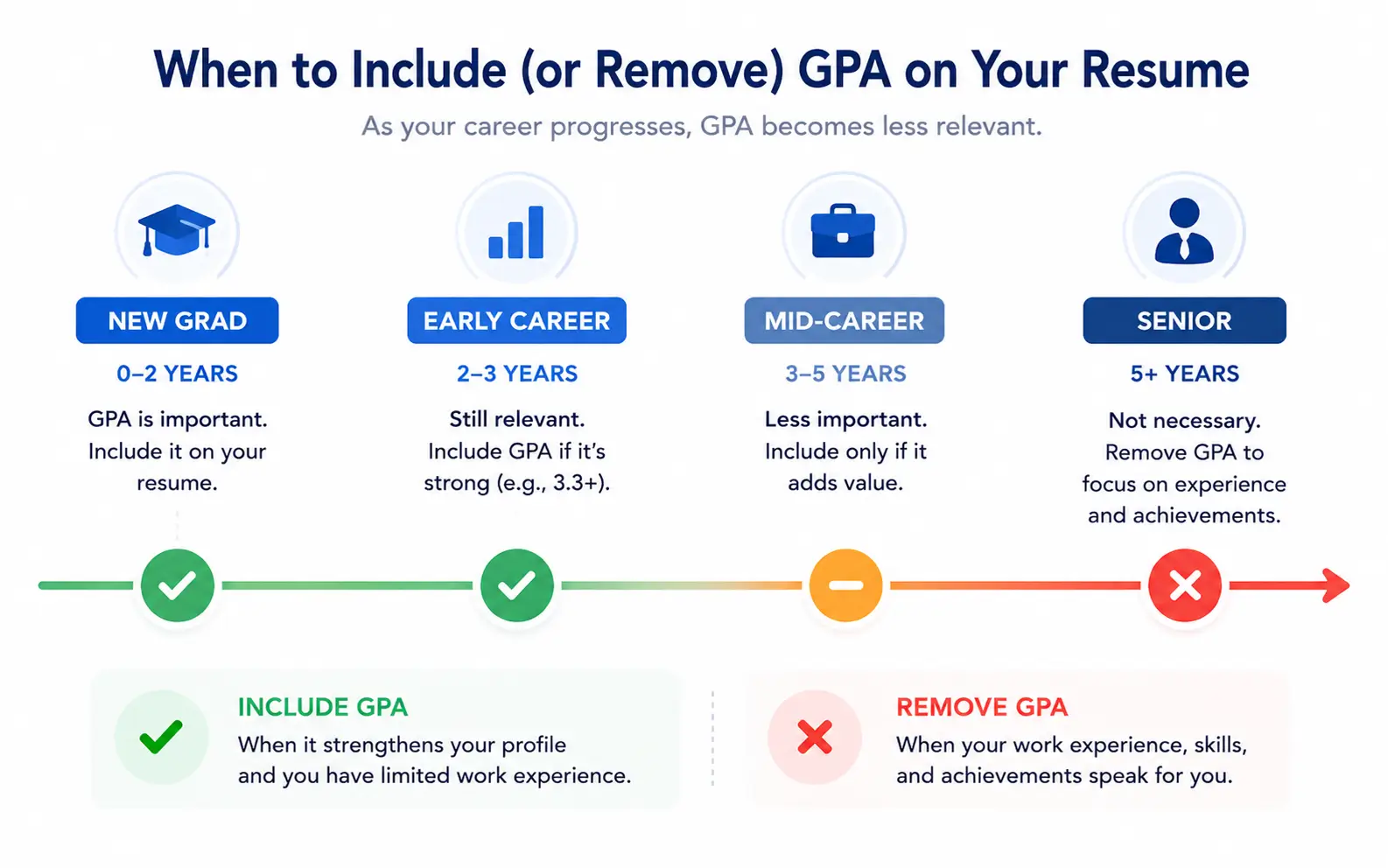
This is the question most mid-career professionals need answered. Here's the straightforward timeline:
0-2 years after graduation: Include if it's strong (3.5+ generally, 3.0+ for industries that screen). You don't have enough professional experience yet for employers to fully evaluate you without academic signals.
2-3 years after graduation: Optional. If you have solid work achievements and your GPA is average (3.0-3.4), drop it and reclaim that resume space for a bullet point about something you accomplished at work.
3-5 years after graduation: Remove it unless you're in academia, law, or finance. By now your work history tells the story. Keeping a GPA on your resume at this stage can actually signal inexperience — it looks like you're still relying on school achievements.
5+ years after graduation: Take it off. No exceptions outside of academia. A VP of Engineering who lists their undergraduate GPA looks out of touch with professional norms.
The shift is simple: early in your career, GPA fills an evidence gap. Once you have a track record of professional results, it becomes noise. Use Seekario's AI Resume Assessment to check whether your education section is appropriately weighted for your experience level.
Frequently Asked Questions
What is the minimum GPA to put on a resume?
The widely accepted minimum is 3.0 for most industries. Below that threshold, listing your GPA is more likely to hurt than help. Exceptions exist if the employer specifically requests it — in that case, omitting it looks worse than a lower number. For competitive fields like investment banking or consulting, the effective minimum is closer to 3.5.
Should I include my GPA if I went to a prestigious university?
A prestigious university name carries its own weight, but it doesn't replace a strong GPA in fields that screen for one. If you graduated from an Ivy League school with a 2.8, the school name helps, but the GPA could still be a filter. List it if it's strong; leave it off if it's not. The school's reputation doesn't change the math.
Can I list my major GPA instead of cumulative GPA?
Yes, and many career advisors recommend it when your major GPA is meaningfully higher (at least 0.3 points above your cumulative). Label it clearly as "Major GPA" so there's no confusion. Recruiters understand this approach and generally view it favorably — it shows stronger performance in your area of expertise.
Do employers verify GPA?
Some do, especially in finance, consulting, and government roles. Background check companies can request your official transcript. Misrepresenting your GPA is a fireable offense — even years after being hired. If you list it, make sure it's accurate. Rounding up from 3.47 to 3.5 is common practice; claiming 3.8 when you earned a 3.4 is not.
Should I include my graduate school GPA?
If you completed a master's or MBA, include that GPA if it's strong (3.5+) and you're applying to roles where the graduate degree is relevant. For PhD candidates, publications and research output matter more than GPA, but including it is standard during the early career phase.
Stop Second-Guessing Your Resume
The GPA question is really about one thing: does this number strengthen your candidacy, or does it take up space that could showcase something better? Use the framework above to decide, and remember that as your career grows, what you've done matters far more than what you scored.
If you're not sure whether your education section is pulling its weight, Seekario's AI Resume Assessment gives you a detailed breakdown of every section — including whether your GPA is helping or hurting your chances. Upload your resume and get specific, actionable feedback in seconds.