Achievement-Based Resume: Show Impact, Not Just Duties (With Examples)

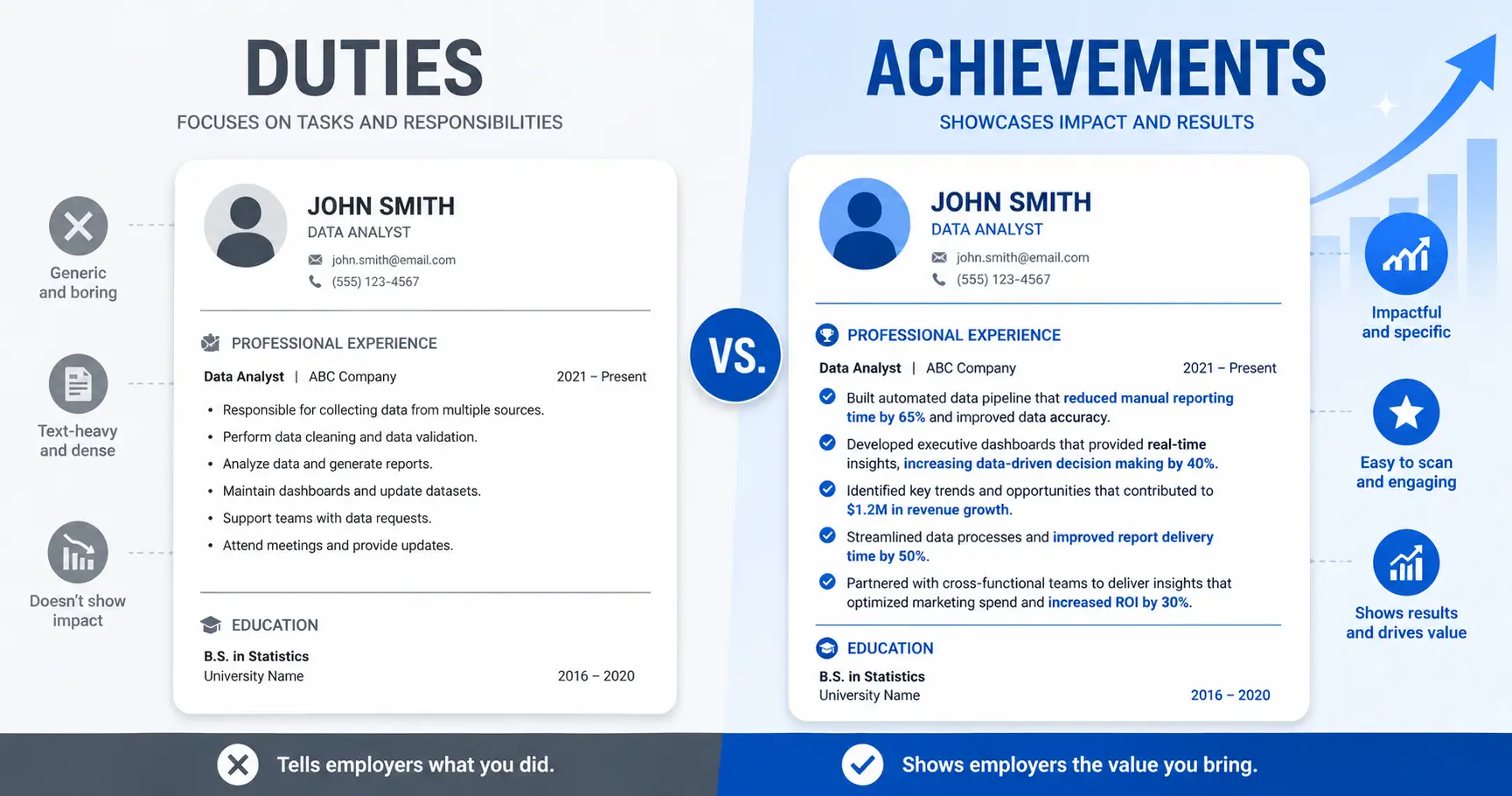
Here's a stat that should stop you mid-scroll: resumes with quantified achievements are 40% more likely to land on the shortlist. Yet 81% of job seekers never include a single number or percentage in their bullet points. That gap between what recruiters want and what candidates deliver? That's your opening.
An achievement-based resume replaces vague duty descriptions with specific, measurable results. Instead of telling a hiring manager what you were *supposed* to do, you show them what actually happened because you were in the role. This article walks you through five complete before/after resume sections — not just isolated bullet points — so you can see exactly how to rebuild your experience from the ground up.
What Separates a Duty From an Achievement
A duty is what the job description told you to do. An achievement is the proof that you did it well.
Consider this: "Managed social media accounts" tells a recruiter nothing about whether you were good at it, mediocre, or actively driving the accounts into the ground. It's the job title reworded as a sentence. Compare that with "Grew Instagram following from 2,400 to 18,000 in 8 months, generating 340 qualified leads through organic content." Same role. Completely different story.
Duties answer *what*. Achievements answer *so what*. And according to a recent survey, 75% of hiring managers specifically want to see quantifiable achievements in the work experience section. For 34% of recruiters, missing result statements is an outright dealbreaker.
The distinction matters because duties are interchangeable — anyone with your job title could copy-paste them. Achievements are yours. They prove you brought something specific to the table.
The Mindset Shift: From Job Description to Impact Statement
Most people write their resumes by opening their old job descriptions, rephrasing the bullet points slightly, and calling it done. This is the single most common resume mistake, and it's also the easiest to fix once you change how you think about your work history.
Stop asking: "What was I responsible for?"
Start asking: "What changed because I was there?"
That one question rewires everything. Even if you weren't in a leadership role, you had an effect. Maybe you processed invoices faster than the previous person. Maybe customers complained less on your shifts. Maybe the project you supported came in under budget.
Here's a simple three-step framework to find your achievements:
- Identify the situation. What was the state of things when you started — or before you took action? Was there a problem, a gap, a goal?
- Describe what you did. Not your job title responsibilities, but the specific actions you chose to take.
- State the result. What improved? By how much? Over what timeframe?
If you don't have exact numbers, estimate honestly. "Approximately 30%" is infinitely better than no number at all. Recruiters understand that not every result comes with a dashboard attached.
Tools like Seekario's AI Resume Tailor can help you identify achievement-worthy bullet points by analyzing job descriptions and highlighting where your experience aligns with measurable outcomes.
Five Complete Before/After Resume Transformations
This is where most guides fall short — they show you one or two bullets in isolation. But a real resume section has 4–6 bullets that need to work together. Below are five complete work experience sections, transformed from duty-based to achievement-based.
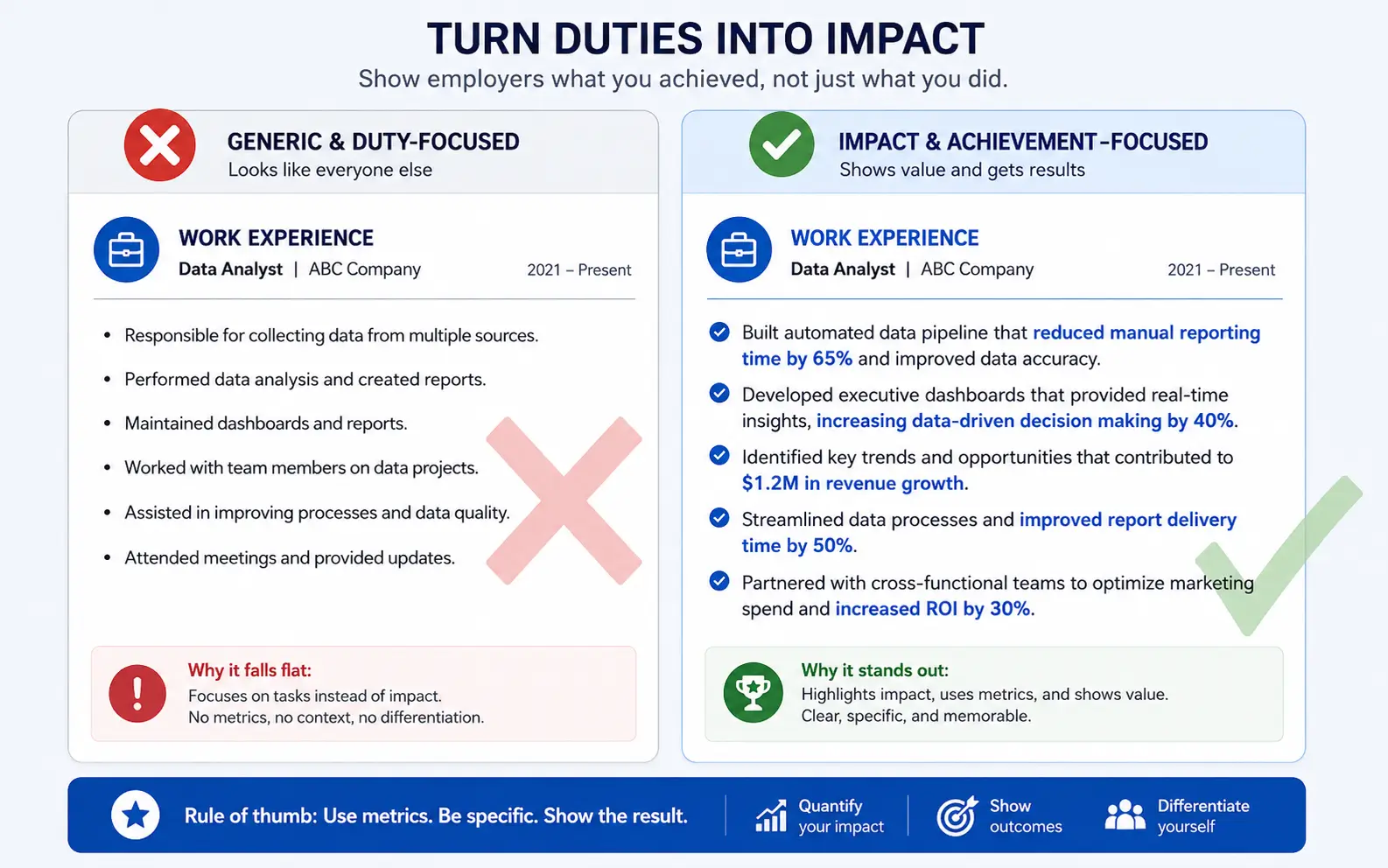
Transformation 1: Marketing Manager
Before (Duty-Based):
Marketing Manager | Greenline Solutions | 2023–2025
- Managed all digital marketing channels
- Created content for social media platforms
- Oversaw email marketing campaigns
- Coordinated with the design team on branding materials
- Reported on marketing performance to leadership
After (Achievement-Based):
Marketing Manager | Greenline Solutions | 2023–2025
- Increased organic website traffic by 145% in 14 months by restructuring the SEO and content strategy across blog, YouTube, and LinkedIn
- Grew email subscriber list from 4,200 to 19,500 while maintaining a 28% open rate, generating $380K in attributable pipeline revenue
- Launched a rebranding initiative that improved brand recall by 35% in post-campaign surveys (n=1,200)
- Reduced cost per lead by 42% ($86 to $50) by shifting budget from paid search to organic and referral channels
- Presented quarterly marketing ROI reports to the C-suite, securing a 25% budget increase for FY2025
What changed: Every bullet now has a number, a direction (increased, reduced, grew), and enough context that a hiring manager can picture the scale of the work. The "coordinated with design team" bullet — which added zero value — was replaced with a concrete rebranding result.
Transformation 2: Software Engineer
Before (Duty-Based):
Software Engineer | DataStream Inc. | 2022–2025
- Wrote code for backend services
- Participated in code reviews
- Fixed bugs and resolved production issues
- Attended sprint planning meetings
- Worked with product managers on feature requirements
After (Achievement-Based):
Software Engineer | DataStream Inc. | 2022–2025
- Architected and deployed a real-time data pipeline processing 2.3M events per day, reducing data latency from 45 minutes to under 90 seconds
- Identified and resolved a recurring memory leak that had caused 12 production outages in Q3, achieving 99.97% uptime in the following two quarters
- Reduced API response times by 60% through query optimization and caching, improving NPS scores for the platform's enterprise clients by 8 points
- Mentored 3 junior engineers through a structured onboarding program, cutting their ramp-up time from 12 weeks to 7
- Collaborated with product to scope and deliver a self-service analytics feature adopted by 74% of enterprise accounts within 3 months of launch
What changed: "Wrote code" became a specific system with measurable throughput. "Fixed bugs" became a real problem solved with real uptime data. Even "attended sprint planning" — which is just showing up — was replaced with a tangible product collaboration result.
Transformation 3: Operations Coordinator
Before (Duty-Based):
Operations Coordinator | NorthStar Logistics | 2021–2024
- Processed incoming orders and managed inventory
- Communicated with vendors and suppliers
- Maintained spreadsheets and tracking documents
- Assisted the operations manager with scheduling
- Handled customer inquiries and complaints
After (Achievement-Based):
Operations Coordinator | NorthStar Logistics | 2021–2024
- Streamlined order processing workflow, reducing fulfillment time from 4.2 days to 2.1 days and cutting backlog by 68%
- Renegotiated contracts with 5 key suppliers, saving $127K annually while maintaining on-time delivery rates above 96%
- Built an automated inventory tracking system in Google Sheets and Apps Script that eliminated 6 hours of weekly manual data entry
- Redesigned the shift scheduling process, reducing overtime costs by 22% ($34K annually) and improving employee satisfaction scores by 15 points
- Resolved an average of 45 customer escalations per month with a 94% first-contact resolution rate, contributing to a 12-point NPS increase
What changed: This transformation shows that achievement-based writing works for any level — not just directors and VPs. An operations coordinator absolutely has achievements; you just have to look for efficiency gains, cost savings, and process improvements.
Transformation 4: Human Resources Generalist
Before (Duty-Based):
HR Generalist | Apex Financial Group | 2022–2025
- Handled recruiting for open positions
- Conducted employee onboarding
- Managed benefits administration
- Addressed employee relations issues
- Maintained HR records and compliance documentation
After (Achievement-Based):
HR Generalist | Apex Financial Group | 2022–2025
- Filled 38 roles across 6 departments in 2024, reducing average time-to-hire from 52 days to 31 days while keeping offer acceptance rates above 88%
- Redesigned the onboarding program based on new-hire survey data, improving 90-day retention from 71% to 89%
- Led the migration from a manual benefits enrollment system to BambooHR, reducing enrollment errors by 73% and saving the team approximately 20 hours per open enrollment cycle
- Mediated 15+ employee relations cases per quarter, maintaining zero escalations to external legal counsel over a 3-year period
- Passed two consecutive compliance audits with zero findings by implementing a quarterly self-audit checklist across all HR documentation
What changed: HR roles often feel hard to quantify, but every function in HR touches numbers — time-to-hire, retention rates, error rates, audit outcomes. The key is identifying the metric that matters for each responsibility.
Transformation 5: Sales Representative
Before (Duty-Based):
Sales Representative | CloudVault Technologies | 2023–2025
- Sold SaaS products to small and medium businesses
- Made outbound calls and followed up on leads
- Gave product demonstrations to prospective clients
- Maintained CRM records
- Attended trade shows and networking events
After (Achievement-Based):
Sales Representative | CloudVault Technologies | 2023–2025
- Exceeded annual quota by 118% in 2024 ($1.4M closed on a $1.19M target), ranking #2 out of 22 reps in the North American team
- Built a personal outbound pipeline worth $2.1M through a cold-calling and LinkedIn outreach strategy averaging 65 touches per day
- Closed the company's largest SMB deal ($187K ACV) by designing a custom onboarding package that addressed the prospect's integration concerns
- Maintained a 97% CRM data accuracy score, contributing to a forecasting model that improved quarterly revenue predictions by 14%
- Generated 23 qualified leads from 4 industry trade shows, converting 9 into closed deals worth a combined $412K
What changed: Sales is the easiest function to quantify — revenue, quota attainment, pipeline — yet many sales reps still default to "sold products" and "made calls." The after version tells a story of someone who performs at the top and knows their numbers cold.
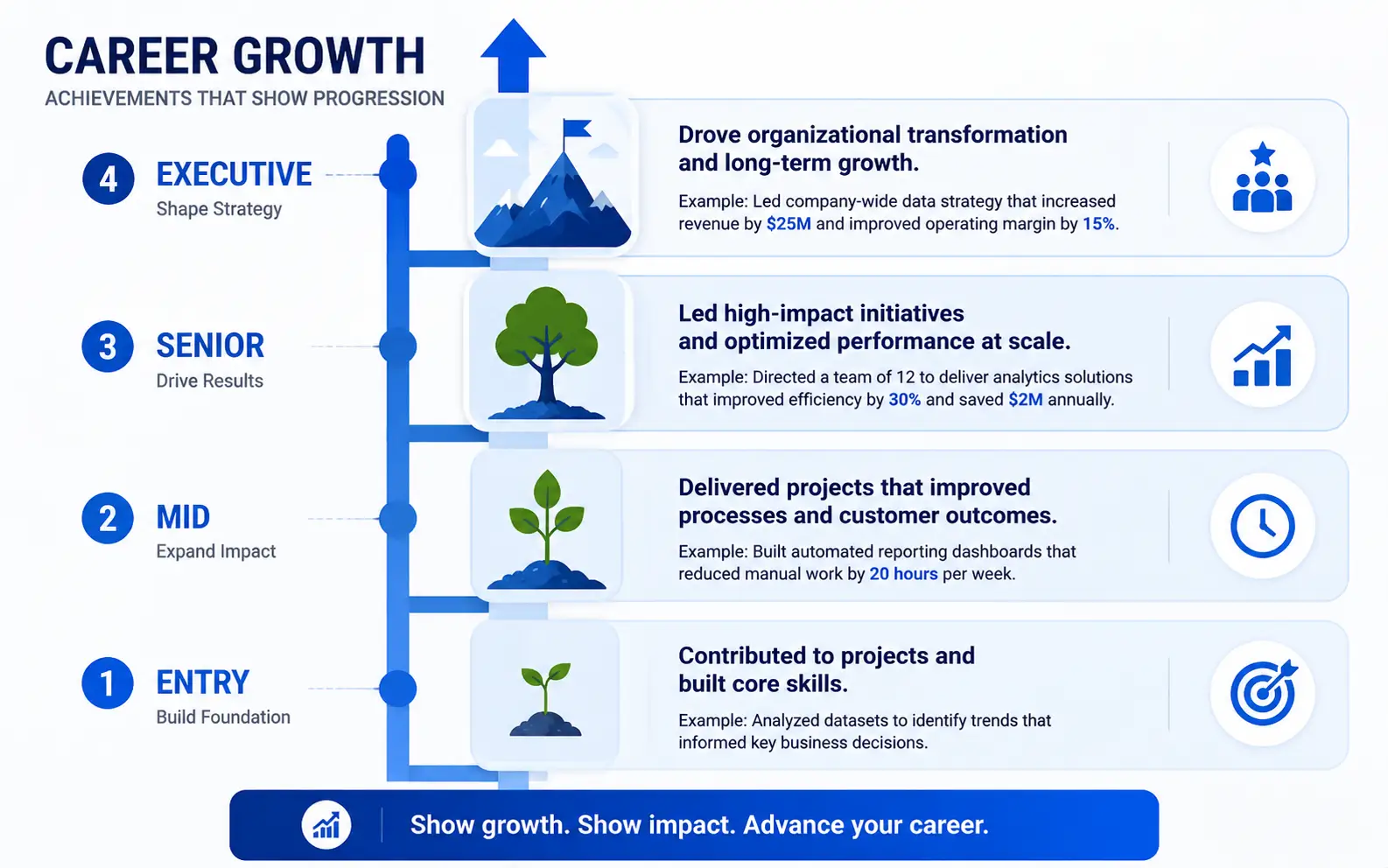
Achievement-Based Writing at Every Career Level
One common pushback: "I'm too junior for achievements" or "I'm too senior to list bullet points." Neither is true.
Entry-level and early career: You may not have revenue numbers, but you have project outcomes, efficiency improvements, and learning speed. "Completed a 12-week onboarding program in 8 weeks and was assigned client-facing responsibilities 4 weeks ahead of the standard timeline" is an achievement. So is "Processed 200+ customer tickets per week with a 4.8/5.0 satisfaction rating."
Mid-career professionals: This is the sweet spot. You have enough tenure to show trends (year-over-year improvements), enough scope to show scale (team size, budget managed), and enough context to show strategic thinking. Focus on progression: what got better over time because of your sustained effort?
Senior and executive level: Shift from individual achievements to organizational impact. "Led a division-wide restructuring that consolidated 4 teams into 2, reducing overhead by $2.4M while maintaining client satisfaction above 92%" speaks to the scale executives operate at.
Career changers: Use achievements from your previous field that demonstrate transferable impact. A teacher who "designed a curriculum adopted by 14 schools across the district, improving standardized test scores by 11%" has a perfectly compelling achievement for an instructional design or training role.
If you're unsure whether your bullets hit the mark, Seekario's AI Resume Assessment can evaluate your resume's achievement density and suggest where duty-based language needs upgrading.
When Duties Are Actually Okay
Not every single bullet point needs to be an achievement. There are a few situations where a straightforward duty statement earns its spot:
Scope and context bullets. Sometimes you need one bullet that establishes the playing field. "Managed a $3.2M annual marketing budget across 4 channels" is technically a duty, but it sets the scale for the achievements that follow. Use these sparingly — one per role, maximum.
Compliance and regulatory roles. If your job is to ensure nothing goes wrong, the achievement is that nothing went wrong. "Maintained 100% compliance across 14 quarterly FDA audits over a 3-year tenure" works even though it describes an ongoing duty, because the sustained result is the achievement.
Highly specialized technical roles. If you're one of three people in the country who operates a specific piece of equipment or works with a rare technology, stating that you did it can be sufficient. The skill itself is the differentiator.
The rule of thumb: if every bullet in a section is a duty, rewrite it. If one or two bullets provide context for the achievements around them, that's a reasonable structure.
Frequently Asked Questions
How many achievements should I include per job?
Aim for 4–6 bullets per role, with at least 3–4 of those being achievement-based. The remaining 1–2 can establish scope or context. If you've held a role for less than a year, 3–4 bullets total is fine.
What if I don't have exact numbers for my achievements?
Estimate responsibly. Use qualifiers like "approximately," "roughly," or "an estimated" before your figure. Recruiters expect some rounding — they care about the order of magnitude, not the decimal point. "Reduced support ticket volume by approximately 30%" is far stronger than "Helped reduce support tickets."
Should I include achievements from jobs that aren't relevant to what I'm applying for?
Yes, if the achievement demonstrates a transferable skill. A retail manager who "trained 15 new hires per quarter with a 92% 90-day retention rate" has relevant achievements for almost any management or training role. Focus on the skill the achievement proves, not the industry it happened in.
How do I write an achievement-based resume if I'm in a support or administrative role?
Support roles are full of quantifiable achievements — you just have to look for them. Track things like volume handled (tickets, invoices, calls), accuracy rates, turnaround time improvements, cost savings from process changes, and satisfaction scores. Even "maintained a 99.8% accuracy rate across 1,200+ monthly invoice entries" is a strong achievement.
Can I use an AI tool to help rewrite my duties as achievements?
Absolutely. Seekario's AI Resume Tailor can analyze your existing resume alongside a target job description and suggest achievement-oriented rewrites that match what the employer is looking for. It's particularly useful for identifying which duties have hidden metrics worth highlighting.
Make Every Bullet Prove Something
An achievement-based resume doesn't require a dramatic career or executive-level experience. It requires a shift in perspective — looking at your work history through the lens of *what changed* rather than *what you did*. The five transformations above prove that any role, at any level, has measurable results hiding in plain sight.
Start with your most recent role. Pick the duty-based bullet that bugs you the most. Ask yourself: what was the situation before, what did I do, and what improved? Write that down. Then do it again for the next bullet.
If you want to speed up the process, Seekario's AI Resume Tailor can help you identify weak duty-based bullets and rewrite them with quantified impact — matched to the specific job you're targeting. Upload your resume and a job description, and see the difference in minutes.