How to List Education on a Resume: Every Scenario Covered (2026)

Your education section seems straightforward until it isn't. Maybe you dropped out two credits short of a degree. Maybe your bootcamp certificate carries more weight than your bachelor's. Maybe you earned your MBA from a university in another country that American recruiters have never heard of.
The education section on a resume trips up more people than you'd expect — not because the formatting is hard, but because real careers don't follow neat templates. This guide walks through 15 specific scenarios so you can list your education on a resume with confidence, regardless of how messy your academic history looks.
For a full breakdown of every resume section and how they fit together, check out our Complete Guide to Resume Sections.
The Standard Education Format
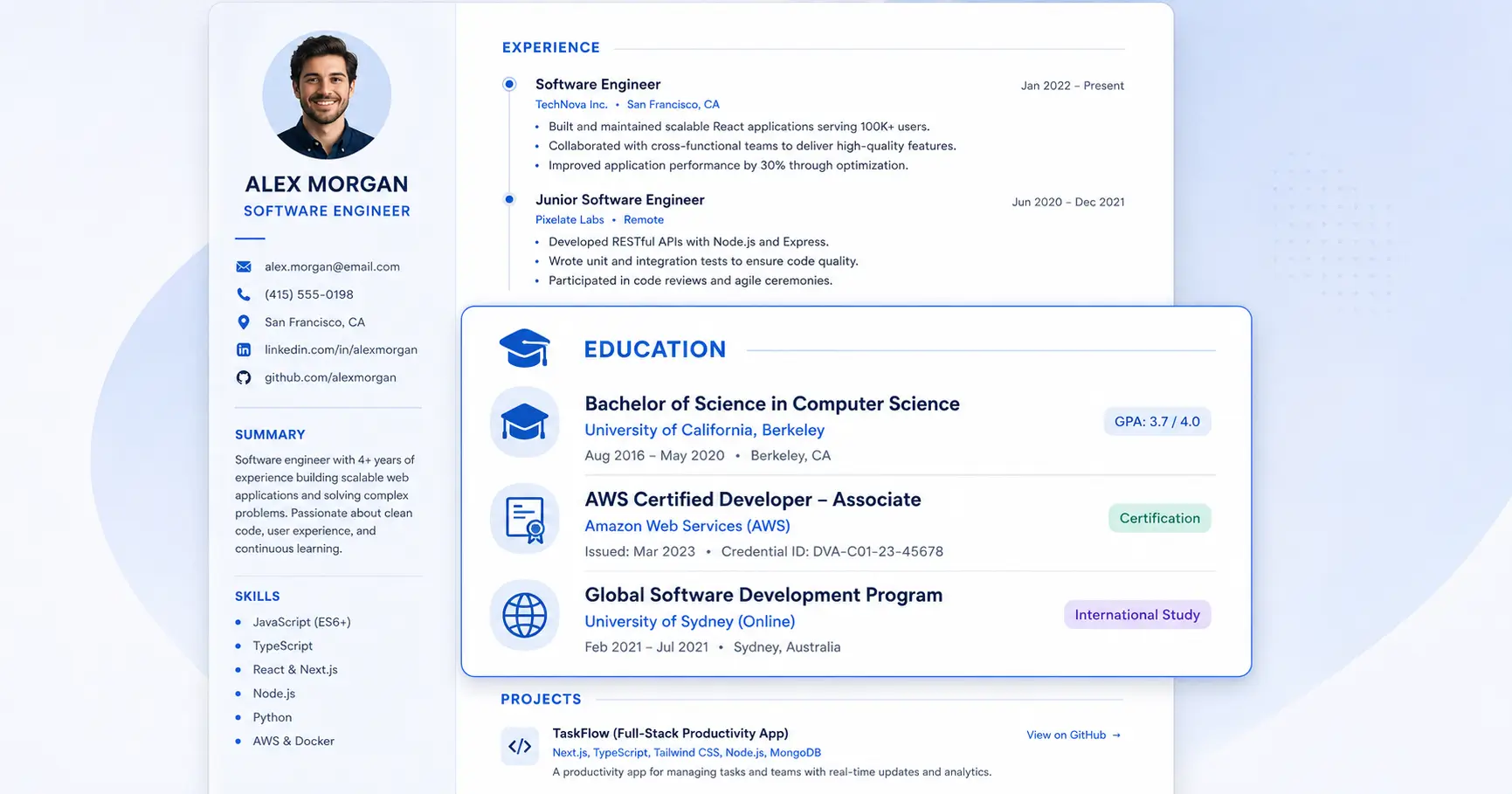
Every education entry needs four pieces of information, arranged consistently:
Degree Name — Major or Field of Study
University or Institution Name, City, State (or Country)
Graduation: Month Year
Here's what that looks like in practice:
```
Bachelor of Science in Computer Science
University of Michigan, Ann Arbor, MI
Graduated: May 2023
```
Keep it to this core format unless you have specific details worth adding — honors, a high GPA, or relevant coursework that directly maps to the role. Padding the section with filler coursework dilutes its impact.
One formatting rule that catches people: spell out the full degree name. "B.S." or "BA" can confuse ATS parsers. Write "Bachelor of Science" or "Bachelor of Arts" in full.
How Recent Graduates Should List Education
If you graduated within the last one to two years, your education section goes near the top of your resume — right after your professional summary. At this stage, your degree is likely your strongest qualification.
Recent grads benefit from adding:
- Relevant coursework (3-5 courses max) that directly relates to the target job
- Academic honors like Dean's List, cum laude, or departmental awards
- Capstone projects or thesis titles that demonstrate applied knowledge
- GPA if it's 3.5 or above (more on GPA decisions below)
Example:
```
Bachelor of Arts in Marketing
Boston University, Boston, MA
Graduated: May 2025
GPA: 3.7 | Dean's List (6 semesters)
Relevant Coursework: Consumer Behavior, Digital Marketing Analytics, Brand Strategy
```
The key is selectivity. Three targeted courses beat a laundry list of every class you took.
Where Education Goes When You Have Experience
Once you have three or more years of relevant work experience, education moves to the bottom of your resume. Your professional track record speaks louder than your degree at that point.
Experienced professionals should strip education entries down to the essentials:
```
MBA, Finance
Wharton School of Business, University of Pennsylvania
Graduated: 2018
```
No coursework. No GPA. No honors (unless they're exceptional and relevant). Recruiters spending six seconds on your resume will focus on your work experience section — your education just needs to confirm you have the credential.

How to Handle Incomplete Degrees
This is one of the most common education dilemmas, and the answer is simple: never pretend you finished a degree you didn't. But don't hide the coursework either.
If you're still enrolled:
```
Bachelor of Science in Accounting (In Progress)
Arizona State University, Tempe, AZ
Expected Graduation: December 2026
Completed: 90 of 120 credit hours
```
If you left and aren't returning:
```
Coursework in Business Administration (75 credit hours completed)
University of Texas at Austin, Austin, TX
2019 – 2021
```
Notice the framing — "Coursework in" rather than "Incomplete Bachelor's" or "Did not finish." You completed real academic work. Present it as what it is: relevant training.
If you're a few credits short: Some candidates list "Degree expected upon completion of [X] remaining credits." This works if you genuinely plan to finish.
Listing Coding Bootcamps and Professional Programs
Bootcamps and intensive certificate programs have earned serious credibility with employers — a 2025 HackerRank survey found that 72% of hiring managers consider bootcamp graduates job-ready for entry-level roles.
Where you place your bootcamp depends on your background:
No traditional degree: List the bootcamp in your Education section as your primary credential.
```
Full-Stack Web Development Certificate
General Assembly, Remote
Completed: March 2025
Technologies: React, Node.js, PostgreSQL, AWS
```
Have a degree but bootcamp is more relevant: List both in Education, bootcamp first (reverse chronological order).
Career changer using bootcamp as your bridge: Consider a dedicated "Technical Training" section above your traditional education.
Rules of thumb for bootcamp entries:
- Include specific technologies and frameworks covered
- Add a capstone project with a brief description and GitHub link
- Mention program length if it was substantial (12+ weeks)
- Skip bootcamps shorter than four weeks unless the certification is industry-recognized
International Degrees and Credentials
If you earned your degree outside the country where you're applying, the goal is clarity. Recruiters may not recognize your institution or understand your credential system.
Add context where needed:
```
Bachelor of Engineering in Electrical Engineering
Indian Institute of Technology Bombay, Mumbai, India
Graduated: June 2022
(Equivalent to U.S. Bachelor of Science in Electrical Engineering)
```
That parenthetical equivalency note saves the recruiter from guessing. For formal credential evaluation, services like WES (World Education Services) or ECE provide official equivalency reports — you can note "WES Evaluated" next to the entry if you've completed that process.
Tips for international education entries:
- Translate degree names to English (keep the original in parentheses if you prefer)
- Include the country in the location line
- Use the local grading scale with a U.S. equivalent if applicable: "First Class Honours (equivalent to 3.8 GPA)"
- Remove details specific to your country's system that won't translate, like "ATAR score" or "CGPA on 10-point scale" without context
Multiple Degrees: What to Include and What to Cut
List degrees in reverse chronological order. If you have a master's and a bachelor's, both go in. If you also have an associate degree that preceded your bachelor's, you can usually drop it — the bachelor's supersedes it.
Exceptions where you'd keep all degrees:
- The associate is in a different field and directly relevant to the job
- You're applying in healthcare, where every credential matters
- The associate is from a well-known technical program
For dual degrees or double majors:
```
Bachelor of Science in Computer Science & Bachelor of Arts in Economics
University of California, Berkeley, CA
Graduated: May 2024
```
Keep it on one or two lines. Dual degrees show breadth — don't bury that signal in formatting clutter.
The GPA Question: Include It or Leave It Off?
According to NACE's Job Outlook 2026 survey, only 42% of employers screen candidates by GPA — down from 73% in 2019. The relevance of GPA is declining, but context matters.
Include your GPA when:
- It's 3.5 or higher and you graduated within the past two years
- The job posting specifically asks for it
- You're applying to finance, consulting, or other GPA-conscious industries
- Your major GPA is significantly higher than your cumulative (list major GPA instead)
Leave it off when:
- You graduated more than two years ago
- It's below 3.5 (there's no rule saying you must include it)
- Your work experience and skills tell a stronger story
- You're in a creative or tech field where portfolios and projects matter more
If your GPA is borderline, Seekario's AI Resume Checker can analyze how your education section stacks up against similar candidates in your target industry.

Certifications, Online Courses, and Continuing Education
Online credentials from platforms like Coursera, edX, and LinkedIn Learning carry weight when they're relevant and from recognized institutions. The key is placement:
- Professional certifications (PMP, CPA, AWS Solutions Architect) get their own "Certifications" section
- University-issued online certificates (e.g., MIT MicroMasters) can go in Education
- Platform completion certificates (individual Coursera or Udemy courses) are better listed under "Professional Development" or woven into your Skills section
Don't list every online course you've ever taken. Pick three to five that directly support the role you're targeting.
Common Education Section Mistakes
Listing high school when you have a college degree. Drop it. Your bachelor's makes it redundant.
Including graduation year when it reveals age bias concerns. If you graduated 20+ years ago, it's acceptable to omit the year entirely and just list the degree and institution.
Overloading with irrelevant details. Your sorority membership and intramural soccer record don't belong here unless you're applying for roles where those affiliations are networking advantages.
Misrepresenting credentials. Calling a certificate a "degree" or inflating your completion status is grounds for immediate disqualification — and it's easier to verify than you think.
Build Your Education Section in Minutes
Getting the format right for your specific scenario shouldn't take hours of second-guessing. Seekario's AI Resume Builder formats your education section based on your career stage, handles edge cases automatically, and ensures ATS compatibility — so you can focus on what actually matters: landing interviews.
FAQ
What do I put for education on a resume if I didn't go to college?
List your highest completed education — a high school diploma, GED, trade school certificate, or professional training program. Add any relevant certifications, bootcamps, or continuing education courses. Employers care about qualifications, and formal college isn't the only path to demonstrating them.
Should I include study abroad on my resume?
Yes, if it's relevant. List it as a sub-entry under your degree with the host institution, location, and dates. Study abroad signals adaptability and cross-cultural competence, which is valuable for international roles or companies with global operations.
How do I list a degree in progress on a resume?
Write the degree name followed by "(In Progress)" or "(Expected [Month Year])." Include completed credit hours if you want to show how far along you are. This is straightforward and honest — recruiters see it regularly.
Can I list education before work experience?
Yes, if you're a current student, recent graduate (within one to two years of graduation), or you've just completed an advanced degree that's central to the role. Everyone else should place education after work experience.
How far back should I go with education on my resume?
List your highest relevant degree and any credentials that support the specific job. If your bachelor's is relevant, you don't need your associate degree or high school. For senior professionals, education entries from 15+ years ago can drop the graduation year to avoid age-related bias.