Resume Bullet Points: How to Write Them for Maximum Impact

Recruiters spend an average of 6–11 seconds on their first scan of your resume. In that window, your bullet points are doing all the heavy lifting. Eye-tracking research shows that short, quantified bullets attract 2.3x more visual fixation than text-only descriptions — meaning numbers and clear results literally pull a recruiter's eyes to your resume.
Yet most job seekers still write bullets like miniature job descriptions: "Responsible for managing social media accounts." That tells a hiring manager nothing about whether you were any good at it.
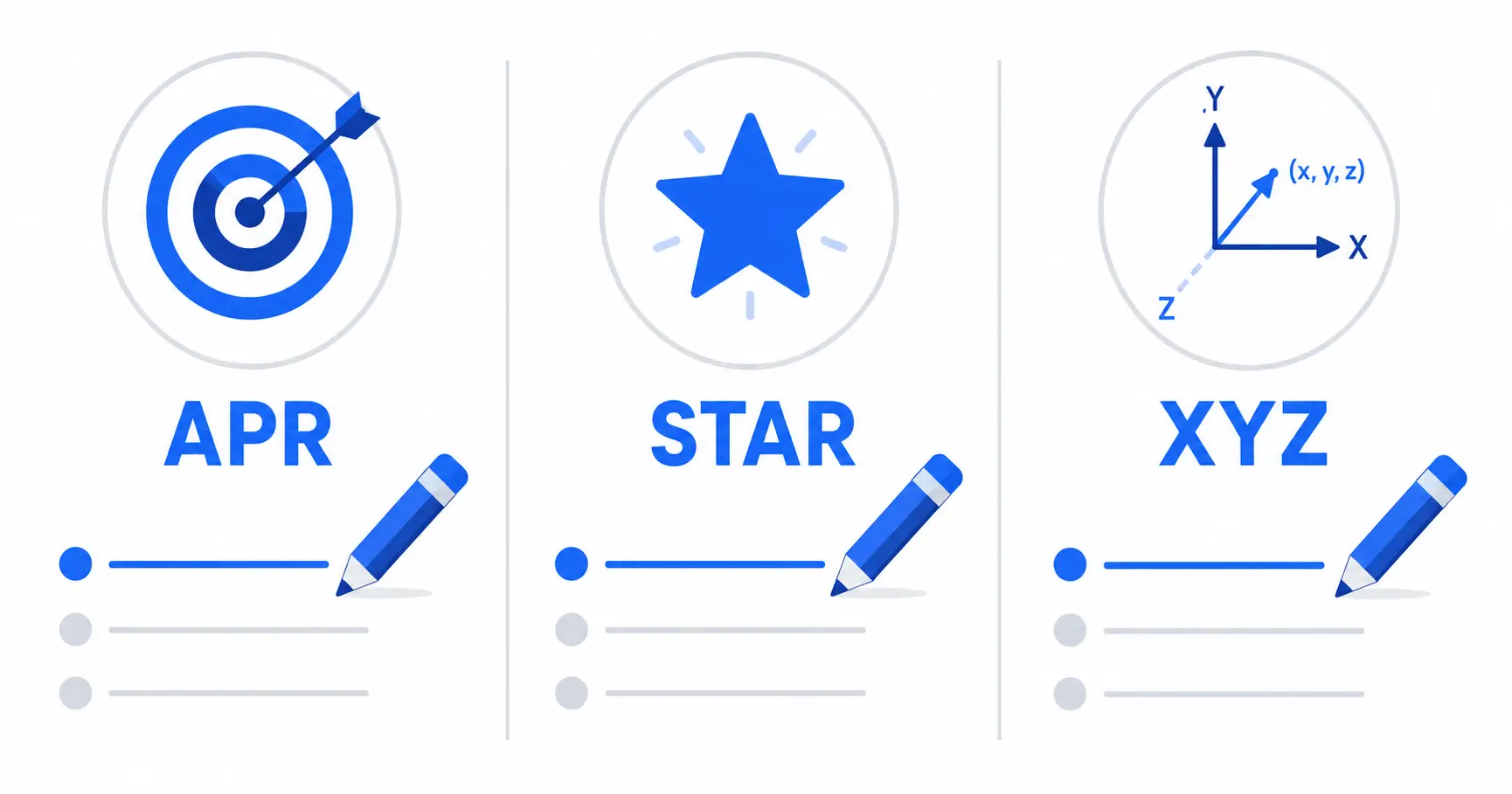
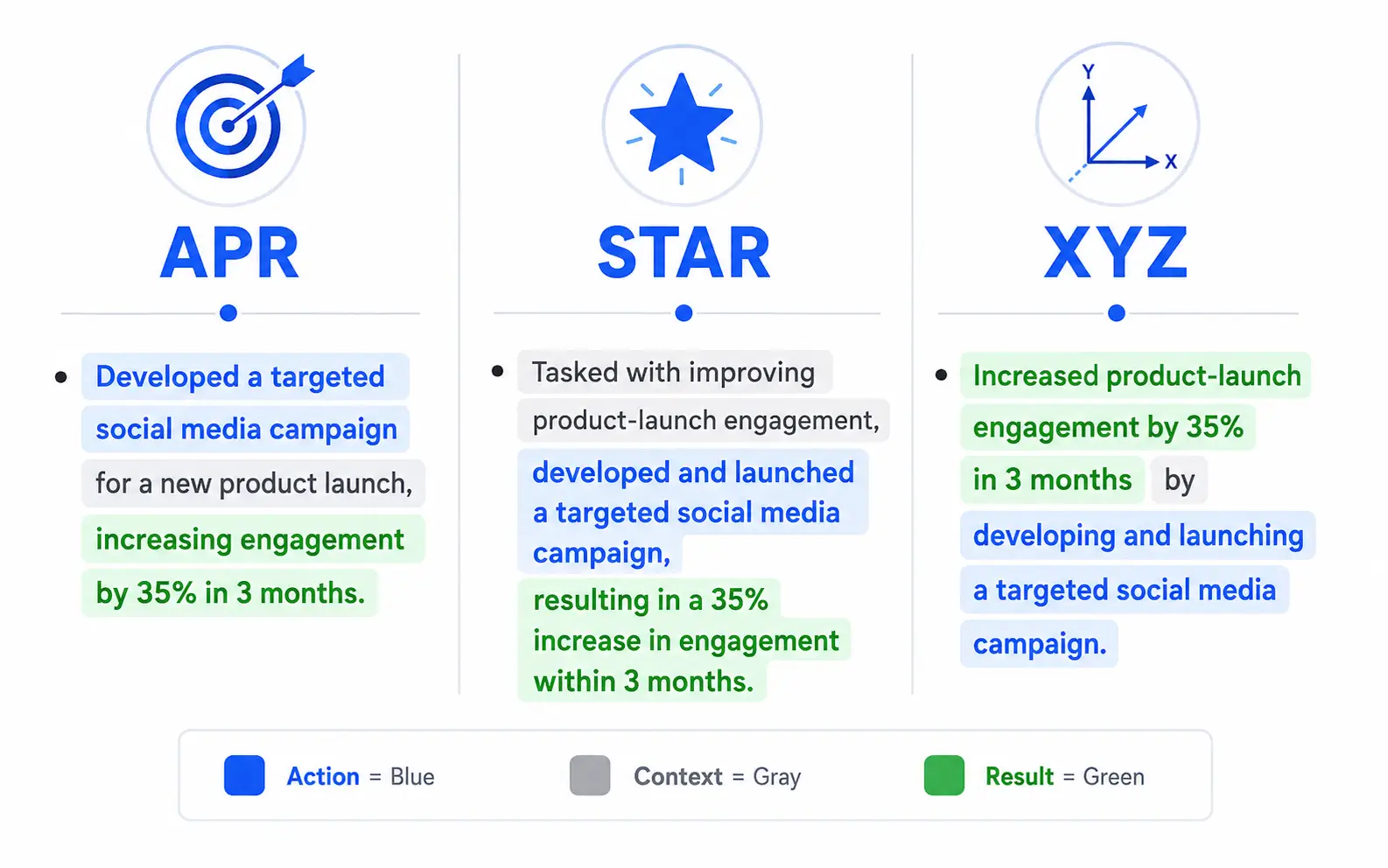
This guide breaks down three battle-tested frameworks — APR, STAR, and Google's XYZ — applies the same scenario to each so you can compare them side by side, and gives you 20 before/after transformations across industries. Pick the framework that clicks, rewrite your bullets, and watch your interview rate climb.
Why Resume Bullet Points Matter More Than You Think
Your resume has two audiences: an ATS (Applicant Tracking System) and a human. Both reward specificity.
ATS software parses your bullets for keywords, context, and measurable outcomes. Modern systems like Workday and iCIMS use AI-based semantic matching — they don't just scan for exact keyword hits. They evaluate whether your bullets demonstrate relevant experience in context. That means a well-structured bullet with a clear result does double duty: it passes the algorithm and impresses the person reading it.
On the human side, hiring managers are pattern-matching. They're scanning for evidence that you can do the job, and bullet points are the fastest format for delivering that evidence. Research from Tufts University's career center confirms that paragraphs reduce scan time — recruiters skip them. Bullets get read.
The bottom line: weak bullets get you filtered out before a human ever sees your resume. Strong bullets get you into the "yes" pile within seconds.
The APR Framework: Action + Project/Problem + Result
APR is the most straightforward of the three frameworks. It works well when you want clean, punchy bullets that get straight to the point.
The formula: Start with an action verb, describe the project or problem, then state the result.
Structure: [Action Verb] + [What You Did / The Problem] + [Measurable Result]
Here's how it looks in practice:
Marketing Manager:
- Launched a multi-channel brand awareness campaign targeting Gen Z audiences, increasing social media engagement by 47% and driving 12,000 new email subscribers in Q3
Software Engineer:
- Refactored the payment processing pipeline to eliminate redundant API calls, reducing average transaction latency from 800ms to 210ms
Customer Success Manager:
- Designed and rolled out a proactive outreach program for at-risk accounts, cutting quarterly churn by 18% and recovering $340K in annual recurring revenue
APR works best for experienced professionals who have clear, measurable wins to highlight. It's direct, easy to scan, and leaves no ambiguity about what you accomplished.
When to use APR: Mid-career and senior roles where your results speak for themselves. If you have strong metrics, APR is your fastest path to a compelling bullet.
The STAR Framework: Situation + Task + Action + Result
STAR is the framework most people know from interview prep. On a resume, you compress it — you're not writing four sentences. Instead, you weave all four elements into one or two lines.
The formula: Briefly set the context (situation/task), describe your action, and quantify the result.
Structure: [Context/Challenge] → [Your Specific Action] → [Quantified Outcome]
Here's how the same scenarios look using STAR:
Marketing Manager:
- Facing declining engagement among 18–24 demographics, launched a TikTok-first campaign strategy with influencer partnerships, boosting Gen Z engagement by 47% and adding 12,000 subscribers in one quarter
Software Engineer:
- Identified a bottleneck in the payment pipeline causing 800ms transaction delays; refactored the architecture to batch API calls, cutting latency to 210ms and improving checkout completion rates by 9%
Customer Success Manager:
- With quarterly churn trending upward, built a predictive outreach program using health score data to flag at-risk accounts, reducing churn by 18% and saving $340K ARR
STAR bullets are longer, but they tell a story. The context makes your achievement more impressive because the reader understands the challenge you overcame.
When to use STAR: Career changers (the context helps bridge experience gaps), anyone with a strong "against the odds" narrative, or roles where problem-solving is the core skill — think consulting, project management, and operations.
Google's XYZ Framework: Accomplished X, Measured by Y, by Doing Z
Google's recruiters popularized this formula, and it's become the gold standard in tech hiring. The key difference from APR: it leads with the accomplishment, not the action.
The formula: State what you accomplished, how it was measured, and the method you used.
Structure: "Accomplished [X] as measured by [Y], by doing [Z]"
Same scenarios, XYZ style:
Marketing Manager:
- Grew Gen Z social engagement by 47% and added 12,000 email subscribers in Q3 by launching a TikTok-first campaign strategy with targeted influencer partnerships
Software Engineer:
- Reduced payment transaction latency by 74% (800ms → 210ms) by refactoring the processing pipeline to batch redundant API calls
Customer Success Manager:
- Cut quarterly churn by 18%, recovering $340K ARR, by implementing a predictive outreach program that flagged at-risk accounts using health score data
Notice how XYZ puts the result first. This is powerful because recruiters scanning your resume see the impact before they see the method. If the number is impressive, they'll keep reading.
When to use XYZ: Tech roles, data-driven positions, and any job where quantifiable outcomes carry the most weight. Also excellent for senior roles where hiring managers care more about what you delivered than how you did it.
20 Before/After Bullet Point Transformations
Nothing teaches faster than seeing a weak bullet next to its stronger version. Here are 20 real-world transformations organized by industry.
Sales & Business Development
Before: Responsible for managing client accounts and meeting sales targets.
After (XYZ): Exceeded annual sales quota by 23% ($1.8M in new revenue) by building a consultative pipeline strategy that shortened the average sales cycle from 90 to 62 days.
Before: Helped increase revenue for the team.
After (APR): Generated $2.4M in net-new ARR by identifying and closing 14 enterprise accounts in the healthcare vertical within 8 months.
Software Engineering
Before: Worked on the backend team to improve system performance.
After (STAR): Inherited a legacy monolith with 12-second page loads during peak traffic; led the migration to a microservices architecture, reducing p95 latency to 1.2 seconds and eliminating all peak-hour outages.
Before: Wrote unit tests and fixed bugs.
After (XYZ): Increased code coverage from 34% to 91% by building a comprehensive testing framework for the payments module, reducing production incidents by 60% over six months.
Marketing & Communications
Before: Managed social media accounts for the company.
After (APR): Scaled the company's LinkedIn following from 8K to 45K in 10 months by creating a thought-leadership content series featuring C-suite interviews, generating 3x more inbound leads than paid campaigns.
Before: Created content for the blog and newsletter.
After (XYZ): Drove 140% increase in organic blog traffic (22K → 53K monthly visitors) by developing an SEO-first editorial calendar targeting 40 high-intent keywords.
Project Management
Before: Led cross-functional teams to deliver projects on time.
After (STAR): Tasked with delivering a $2.1M platform migration under a fixed regulatory deadline; coordinated 4 engineering squads and 2 vendor teams to launch 3 weeks early, avoiding $180K in potential compliance penalties.
Before: Managed project budgets and timelines.
After (APR): Delivered a 14-month ERP implementation 8% under the $3.2M budget by renegotiating vendor contracts and reallocating underutilized resources mid-project.
Healthcare
Before: Provided patient care in a busy hospital setting.
After (XYZ): Improved patient satisfaction scores by 22% (from 3.6 to 4.4/5) by redesigning the intake workflow to reduce average wait times from 45 to 18 minutes.
Before: Trained new nurses on procedures.
After (APR): Developed and led a 6-week onboarding program for 30+ new hires annually, reducing time-to-competency by 40% and cutting first-year turnover from 28% to 12%.
Finance & Accounting
Before: Prepared financial reports and analysis.
After (STAR): During a period of rapid acquisition growth, built an automated consolidation reporting system across 5 entities, cutting month-end close from 12 days to 5 and eliminating manual reconciliation errors.
Before: Managed accounts receivable.
After (XYZ): Reduced DSO from 58 to 37 days by implementing an automated collections workflow and tiered follow-up cadence, freeing up $1.2M in working capital.
Education
Before: Taught math to high school students.
After (APR): Redesigned the AP Calculus curriculum using project-based learning modules, raising the class pass rate from 62% to 89% and earning department recognition for highest year-over-year improvement.
Before: Participated in curriculum development.
After (XYZ): Boosted district-wide standardized test scores by 15% by co-developing a data-driven intervention program that identified and supported 200+ at-risk students across 8 schools.
Human Resources
Before: Handled employee recruitment and onboarding.
After (STAR): Facing a 45-day average time-to-fill across 80+ open roles, restructured the sourcing strategy to prioritize passive candidates and employee referrals, cutting time-to-fill to 28 days while improving 90-day retention by 16%.
Before: Managed employee benefits programs.
After (APR): Renegotiated the company's benefits package with 3 providers, saving $420K annually while adding mental health coverage that increased employee satisfaction scores by 11%.
Operations & Logistics
Before: Oversaw warehouse operations and inventory management.
After (XYZ): Reduced inventory carrying costs by 31% ($890K annually) by implementing a demand-forecasting model and switching to a just-in-time replenishment system across 3 distribution centers.
Before: Improved supply chain processes.
After (APR): Consolidated 12 regional suppliers into 4 strategic partnerships, reducing procurement costs by 22% and cutting average delivery lead times from 14 to 6 days.
Design & Creative
Before: Designed marketing materials and brand assets.
After (STAR): Following a company rebrand, led the visual identity rollout across 200+ touchpoints in 8 weeks, maintaining brand consistency at 98% audit compliance while increasing brand recall by 35% in post-campaign surveys.
Before: Created UX designs for the mobile app.
After (XYZ): Increased mobile conversion rate by 28% by redesigning the checkout flow from 5 screens to 2, validated through A/B testing with 15,000 users over 4 weeks.
Industry-Specific Bullet Point Patterns
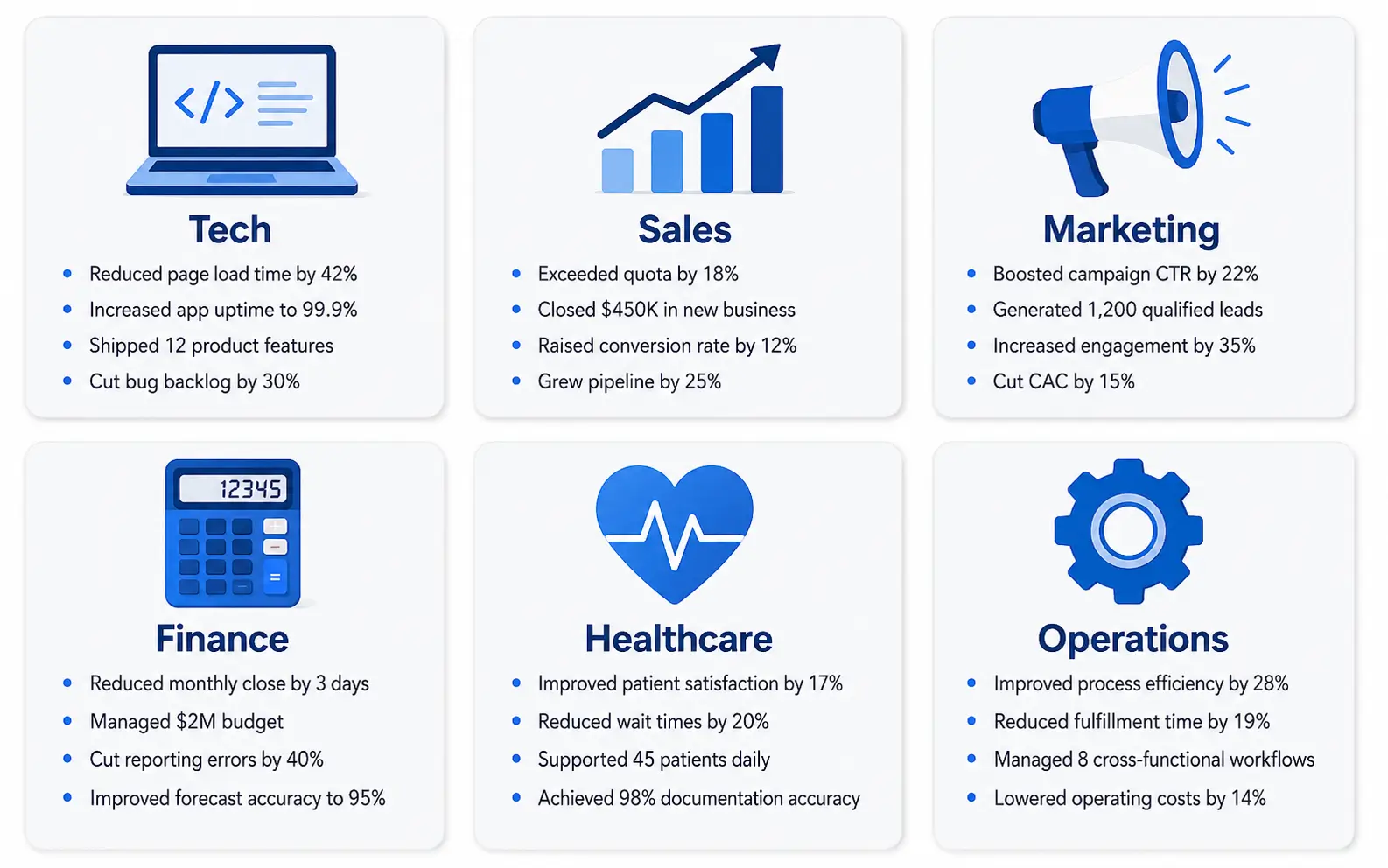
Different industries emphasize different metrics. Here's a quick reference for what to quantify in each field:
Tech & Engineering: Latency, uptime, code coverage, deployment frequency, users impacted, cost savings from infrastructure changes.
Sales & Business Development: Revenue generated, quota attainment, pipeline value, deal size, sales cycle length, client retention rate.
Marketing: Traffic growth, conversion rates, CAC (customer acquisition cost), engagement metrics, lead volume, ROI on campaign spend.
Finance: Cost savings, revenue impact, days sales outstanding, audit accuracy, close time, compliance metrics.
Healthcare: Patient satisfaction scores, wait times, readmission rates, staff retention, throughput improvements.
Education: Test score improvements, pass rates, student retention, program enrollment growth, grant funding secured.
Operations: Cost reduction, delivery times, error rates, throughput, inventory turns, process cycle times.
If you're unsure what metrics to highlight, Seekario's AI Resume Builder analyzes your experience and suggests achievement-oriented bullets with relevant metrics for your industry.
Common Bullet Point Mistakes (And How to Fix Them)
Starting with "Responsible for"
This phrase adds nothing. It tells the reader you had the job — not that you were good at it. Replace it with an action verb that shows what you actually did.
Writing duties instead of achievements
"Managed a team of 5" is a duty. "Managed a team of 5 that shipped 3 product features ahead of schedule, contributing to a 15% increase in user activation" is an achievement. Always ask yourself: "So what?" If your bullet doesn't answer that question, rewrite it.
Being vague about impact
"Improved efficiency" means nothing without a number. Even estimates work — "Improved team efficiency by approximately 20% by automating the weekly reporting process" is far stronger than the vague version.
Cramming too much into one bullet
If a bullet runs past two lines, split it. Each bullet should communicate one clear accomplishment. Recruiters skip bullets that look like paragraphs.
Using the same action verb repeatedly
Starting five bullets with "Managed" signals a limited vocabulary and lazy editing. Vary your verbs: led, orchestrated, spearheaded, directed, coordinated. For 50+ categorized action verbs, check our guide on resume action verbs.
Ignoring ATS formatting
Modern ATS systems handle standard bullet characters (•) well, but avoid fancy symbols, icons, or multi-column layouts that can confuse parsers. Stick to clean formatting. You can test your bullets through Seekario's AI Resume Checker to see how well they parse.
Too many (or too few) bullets per role
The sweet spot is 3–5 bullets for your most recent role, tapering down to 2–3 for older positions. More than 6 per role overwhelms the reader. Fewer than 2 looks like you didn't accomplish much.
How to Write Strong Bullets When You Don't Have Big Numbers
Not every role comes with million-dollar revenue figures or dramatic percentage improvements. Here's how to write compelling bullets without headline-grabbing metrics:
Use scope instead of percentages. "Managed onboarding for 150+ new employees across 3 office locations" communicates scale without requiring a before/after comparison.
Highlight frequency and consistency. "Produced 4 client-facing reports weekly with zero revision requests over 18 months" shows reliability and quality.
Reference team size and stakeholder level. "Presented quarterly forecasts to a C-suite audience of 8 executives" signals your level of responsibility.
Estimate conservatively. If you streamlined a process but don't have exact data, estimate: "Reduced manual data entry by approximately 5 hours per week by building a spreadsheet macro." Hiring managers understand that not everything is tracked to the decimal.
Focus on what you built or created. "Built the company's first employee handbook, adopted across 4 departments and 200+ staff" shows initiative even without a percentage attached.
If you need help transforming duty-based bullets into achievement-focused ones, Seekario's AI Resume Tailor can rewrite your bullets to match a specific job description while highlighting your strongest accomplishments.
FAQ
How many bullet points should I put on my resume per job?
Aim for 3–5 bullets for your current or most recent role, and 2–3 for older positions. Your most recent experience deserves the most detail since it's the most relevant. If you're going back more than 10 years, 1–2 bullets (or just a title and dates) is sufficient. Total bullet count across your entire resume should typically stay between 15–25.
Should resume bullet points have periods at the end?
No — the standard convention is to skip periods on resume bullet points. Since bullets are fragments rather than complete sentences, periods aren't grammatically required. More importantly, omitting them gives your resume a cleaner visual appearance. Just be consistent: either all periods or no periods across your entire resume.
Which framework is best — APR, STAR, or XYZ?
There's no single winner. APR is fastest to write and works well for straightforward achievements. STAR is strongest when the context or challenge matters (career changers, problem-solving roles). XYZ leads with results and works best in data-driven fields like tech and finance. You can mix frameworks within the same resume — use whichever fits each individual bullet best.
How do I write bullet points if I'm entry-level with no work experience?
Draw from academic projects, internships, volunteer work, and extracurricular leadership. The frameworks still apply. "Organized a 200-person campus fundraiser that raised $8,500 for local nonprofits" is a perfectly strong XYZ bullet. Focus on transferable skills like communication, organization, analysis, and teamwork. Seekario's AI Resume Builder can help you frame limited experience as compelling achievements.
Can I use the same bullet points for every job application?
You can keep your base bullets, but you should tailor them for each application. Adjust keywords, reorder bullets to lead with the most relevant ones, and tweak your metrics emphasis to match the job description's priorities. A bullet that leads with "revenue growth" should move to the top when applying for a sales role but might sit lower for an operations position.
Make Every Bullet Count
Your resume bullets are your 6-second pitch. Each one needs to earn its spot on the page by answering a simple question: "What did you do, and why should anyone care?"
Pick a framework — APR for speed, STAR for storytelling, XYZ for impact-first — and rewrite your weakest bullets right now. Lead with action verbs, attach numbers wherever possible, and cut anything that reads like a job description copy-paste.
If you want to pressure-test your bullets before you hit "apply," try Seekario's AI Resume Builder. It scores your bullet points, suggests stronger action verbs, and helps you quantify achievements you might be underselling. Because in a stack of 250 resumes, the ones with sharp, specific bullets are the ones that get pulled out of the pile.