What Actually Happens in the First 30 Seconds of a Resume Review

Everyone quotes the same statistic: recruiters spend six to seven seconds on a resume before deciding. It's true as far as it goes, and it's also close to useless on its own. Six seconds tells you that you have very little time. It doesn't tell you where those seconds go, what ends the read early, or what buys you the next twenty.
So we asked nine people who screen resumes for a living to narrate their own first pass. Not their general advice — their actual sequence. What their eye lands on first, what makes them close the file, what makes them keep going.
The answers varied more than expected, and in one respect they broke sharply from standard resume advice. Three of the nine read the resume backwards, starting at the oldest job on the page. Their reasoning is worth sitting with: the top of a resume is designed, and the bottom isn't. One founder framed it as the difference between how you want to be seen and where you were willing to start before anybody was watching.
Where they converged was less comfortable. Almost every respondent named the same reason they stop reading, and it wasn't formatting, typos, or employment gaps. It was a summary paragraph that could sit on anyone's resume. Several said their eye now skips those without any conscious decision. And the thing that reliably bought a candidate more time was the same across nearly every response: one concrete, unglamorous, specific detail. A named system. A headcount. A number the person owned.
Nine reviewers, nine different first passes:
- Hook Readers Above the Fold
- Read Origins Before Ambition
- Scan Dates, Titles, Then Scope
- Test Practical Skills Beyond Resumes
- Let Personality and Work Lead
- Require Exact Technical Credentials
- Trace Career Growth Backward
- Verify Must-Have Experience First
- Eliminate Candidates From the Bottom Up
Hook Readers Above the Fold
I first look at the top of the resume—I go to the headline area looking for a hero statement, headline, or something that will draw me in to read the rest. If, in this top section, there is one glimmer of a keyword that relates back to the job I am looking to fill, I dig in deeper into their experience—likely their most recent job. Does this person have the job title that I am looking for, e.g., "Partnership Manager"? If they have had the same/similar title or target title that I am looking for, I'll scan the bullets of that most recent job. Are there any actionable results, "brought in xx new partners within xx months," or something like that? If I can see real tangible experience, I move to: how long has this person been working in this type of work? Example: I'm looking for 7 years total experience in this kind of role—does this person have that? Is it in one job? 10 jobs?
I make a decision at this point—likely took all but 20-30 seconds—to reach out and book a call with them or discard. This is the whole point of a resume: to get someone to call you, and THEN you get to tell your good career experience stories. If you can't tell me why I need to talk to you all ABOVE THE FOLD—meaning before the middle of your resume—you will likely get passed over because I'm not spending an hour reading your entire resume to make a call to reach out to you and speak with you directly. I hope this makes sense! Good luck!
Joanne Acri, Partner & Executive Recruiter, Junction Collective
Read Origins Before Ambition
I read them backwards.
The first thing I look at is the earliest job on the page, then I work up. People design the top of a resume, so the top tells me how they want to be seen. The bottom tells me where they started and what they were willing to do before anybody was watching. Someone who spent two years on a call center floor and then climbed is a different proposition to someone whose first line is already a manager title.
Second pass, a few seconds: company sizes. I run a small bootstrapped software company, and a page of large-company names tells me this person has had a legal team, an IT team and a recruiter down the hall for their whole working life. It leaves me with a question I have to ask them about.
What stops me reading is a page with no specifics in it. If I finish a whole role and still cannot tell what this person personally did, I close it, and it takes under 30 seconds to know.
What moves someone forward is one line I can pull into a reply. Something they decided, something that went sideways, a number they owned. I answer maybe one in ten, almost always because of a single concrete sentence that gave me something to ask about.
For senior roles, I flip it and read the top first, because at that level how you frame your own work is part of the job.
Dane Maxwell, Founder, Paperless Pipeline
Scan Dates, Titles, Then Scope
The dates pull my eye before anything else does. Then the titles, then whoever they worked for. I have not read a bullet yet, and 8 seconds are gone. The bullets get the next 20.
What stops me is scope with no object in it. A line about owning the marketing strategy tells me nothing about how big it was or who else touched it. What moves you forward is a noun I can picture: a named report, a channel, a headcount. The number does not have to be impressive.
For junior roles, I slow down, because there is less to skim and the read is mostly about whether someone can describe their own work. Anything senior, I am reading the gaps between jobs and how the scope moved. At 60 people, a senior hire changes more here than at 600. The dates still go first.
Sahil Agrawal, Founder, Head of Marketing, Qubit Capital
Test Practical Skills Beyond Resumes
For me as a CEO of an international recruitment agency hiring hundreds of Filipino virtual assistants for global companies, I am a witness to how hiring has changed over the years. While we are strict with our own screening process, our first 30-second pass across a resume is fast, direct, and increasingly skeptical of traditional formatting.
Here's a breakdown:
In the first 5 seconds, our talent acquisition team checks the career trajectory. We ignore the summary, objective, and skills tags at the top. When anyone can simply prompt AI to write these sections, like the summary, it offers zero signal to us. My eyes go straight to the work history timeline to check stability and whether their career shows growth over the past 3 to 5 years.
Then, in the next 15 seconds, we check the environment and scope. I look at the context of their recent roles: whether they worked directly inside modern business tools or if they were siloed inside traditional and heavily managed setups. In hiring virtual assistants, I want to see direct ownership and stakeholder interaction rather than isolated task execution.
In the next 15 to 25 seconds, I make a decision. If the resume reveals disjointed timelines, inflated buzzwords without substance, or irrelevant experience, it's an immediate pass for a virtual assistant. However, if the applicant for the virtual assistant position shows genuine ownership and career progression, they advance to the next stage.
The reality job seekers and virtual assistant applicants need to know is that surviving the 30-second scan does not win the job yet, because at this point AI makes everyone look exceptional on paper. For us, a strong resume merely qualifies a candidate for a practical test and simulation. That's where we measure what truly matters.
In our experience, while we have a lot of affordable talent coming from the Philippines who are highly skilled and English-proficient, we place fewer than 1 in 500 applicants. The true story here is not cost but selectivity. For example, in traditional BPOs, virtual assistants are built on repetitive tasks, but in offshore employment, this is not the case. Employers want highly skilled workers who are familiar with their own tools. For us, the resume no longer proves how well a virtual assistant can do the job, only that they know how to prompt an AI. Because of this, we no longer rely on resumes as the primary filter, but we are now selecting them based on practical, real-world task simulations.
Alon Pearl, Founder & CEO, VA Masters
Let Personality and Work Lead
For me, the first 30 seconds actually starts with the cover letter, not the CV. I'm hiring people I'm potentially going to spend a huge amount of time with, so I want to get an immediate sense of who they are.
The quickest way to lose me is to sound like everyone else. Applicants tend to become incredibly formal, and I see the same clichés repeatedly: we're their dream company, they've always admired our work, they're incredibly passionate about the opportunity. It can feel more like vacuous flattery than personality, and it tells me very little about the person.
Instead, I want a cover letter I genuinely enjoy reading. Make me laugh, tell me something interesting, explain why this particular role makes sense for you, or just write like an actual human being. I'm essentially asking myself, "Could I work with this person every day?"
If the answer is yes, I'll dig into the CV and, for our creative roles, quickly move onto their portfolio or showreel. At that point, the work carries far more weight than qualifications or a perfectly formatted employment history.
So my first pass is probably less conventional than most: personality first, work second, CV third. Technical skills can be developed, but finding someone talented who also adds something to the team is much harder.
Ryan Stone, Founder & Creative Director, Lambda Films
Require Exact Technical Credentials
As president at Kelley & Dawson Service, I review every technician resume that comes in for HVAC and plumbing roles.
In the first pass, I scan straight for NATE certification and Trane or Daikin experience listed at the top.
I stop reading if those details are missing or if the work history shows no hands-on furnace repair or indoor air quality service.
Candidates advance when their background matches the exact inspection checklists and maintenance steps we publish on our site.
Michelle Maes, President, Kelley & Dawson Service
Trace Career Growth Backward
My process starts by ignoring the résumé entirely for the first few seconds and looking at the email address and LinkedIn link instead. It sounds small, but professional presentation upfront tells me whether someone treated this application seriously.
After that, I jump straight to the experience section and read backward, oldest role first instead of most recent. That's uncommon, I know, but it shows me the trajectory, whether someone's been growing into bigger responsibility or just moving sideways between similar jobs.
What makes me stop reading is a lack of progression. If someone's title and scope look identical across three different companies, that raises a real question for me. I'm looking for growth over time, not just a list of places someone has worked.
Will Yang, Head of Growth, Chronicle Technologies
Verify Must-Have Experience First
The first thing I look at is your experience. I go straight to the experience section because every role has must-haves, right?
So I'm looking at your experience and asking, do you actually have the experience we're looking for? Do you check the boxes for the must-have requirements of the role?
That's really my first pass. I'm not trying to read your entire resume in the first 30 seconds. I'm looking for the things that tell me whether you have the experience needed for this specific role.
And if you do have those must-haves, then you're moving to the next round.
Friddy Hoegener, Co-Founder, SCOPE Recruiting
Eliminate Candidates From the Bottom Up
I read from the bottom up, and the first pass is about elimination rather than merit.
For a front desk or medical assistant opening, the order is this: how long they stayed in the last two jobs, how far they live from us, then whether anything on the page was written by a person rather than assembled. That is most of it. Distance matters more than candidates think for a role that starts at seven thirty in the morning, and a long commute is the most reliable predictor I have of somebody leaving inside a year.
What stops me reading is a summary paragraph that could sit on anyone's resume. My eye now skips those without my deciding to. What moves a person forward is one concrete, unglamorous detail: the systems they used, named; the size of the practice; how many clinicians they supported. Specifics are what somebody who did the work has to hand.
For a clinical role the order changes. Licence and certification first, then the settings they have worked in, because a hospital floor and a small outpatient practice are different jobs sharing a title.
Our last opening drew 61 applications and most got under a minute. That is not carelessness, it is arithmetic. If you want longer than a minute, put the specific thing high, where the eye lands first.
Anna Evans, Founder, Interlinked Wellness
What the Nine Passes Have in Common
Read together, these responses undercut the idea of a single universal resume format. An HVAC company screening for NATE certification and a creative studio screening for personality are running genuinely different filters, and a resume optimized for one will fail the other. That's the case for tailoring, not for a perfect template.
But four things showed up almost everywhere.
The summary section is dead weight, and reviewers know why. Two respondents said outright that they skip it. One named the reason: anyone can prompt an AI to write it, so it carries no signal. If your resume opens with three lines about being a results-driven professional, you have spent your most valuable real estate on the one section experienced reviewers have trained themselves to ignore.
Specificity is the whole currency. Every reviewer who described what moves a candidate forward described the same thing in different words. A number they owned. A noun you can picture. A named system, a headcount, the size of the practice. Notably, several said the number doesn't need to be impressive. It needs to be real, because a real detail is what somebody who actually did the work has to hand.
Placement beats polish. Two respondents landed on the same instruction from opposite reading directions: put the specific thing high, where the eye lands. If your strongest concrete detail is the fourth bullet of your second role, it may as well not exist.
Trajectory is being read even when you're not showing it. Three reviewers explicitly traced career shape from the bottom of the page upward. What they're testing for is movement — growth into bigger scope rather than lateral drift between similar titles. If your last three roles look identical in title and scope, expect that to become the first question, or the reason there's no question at all.
And one warning that sits behind all of it: surviving the scan is not winning. As one CEO put it, AI now makes everyone look exceptional on paper, which is precisely why his firm has moved to practical task simulations and places fewer than 1 in 500 applicants. A resume's job is to buy you a conversation. It was never going to get you the offer.
Turning This Into an Actual Resume
The advice above is consistent, and it's also hard to execute on your own. Most people know their achievements are vague but can't see it in their own writing, and almost nobody has the appetite to rebuild their resume for every application when the must-haves shift from one job description to the next.
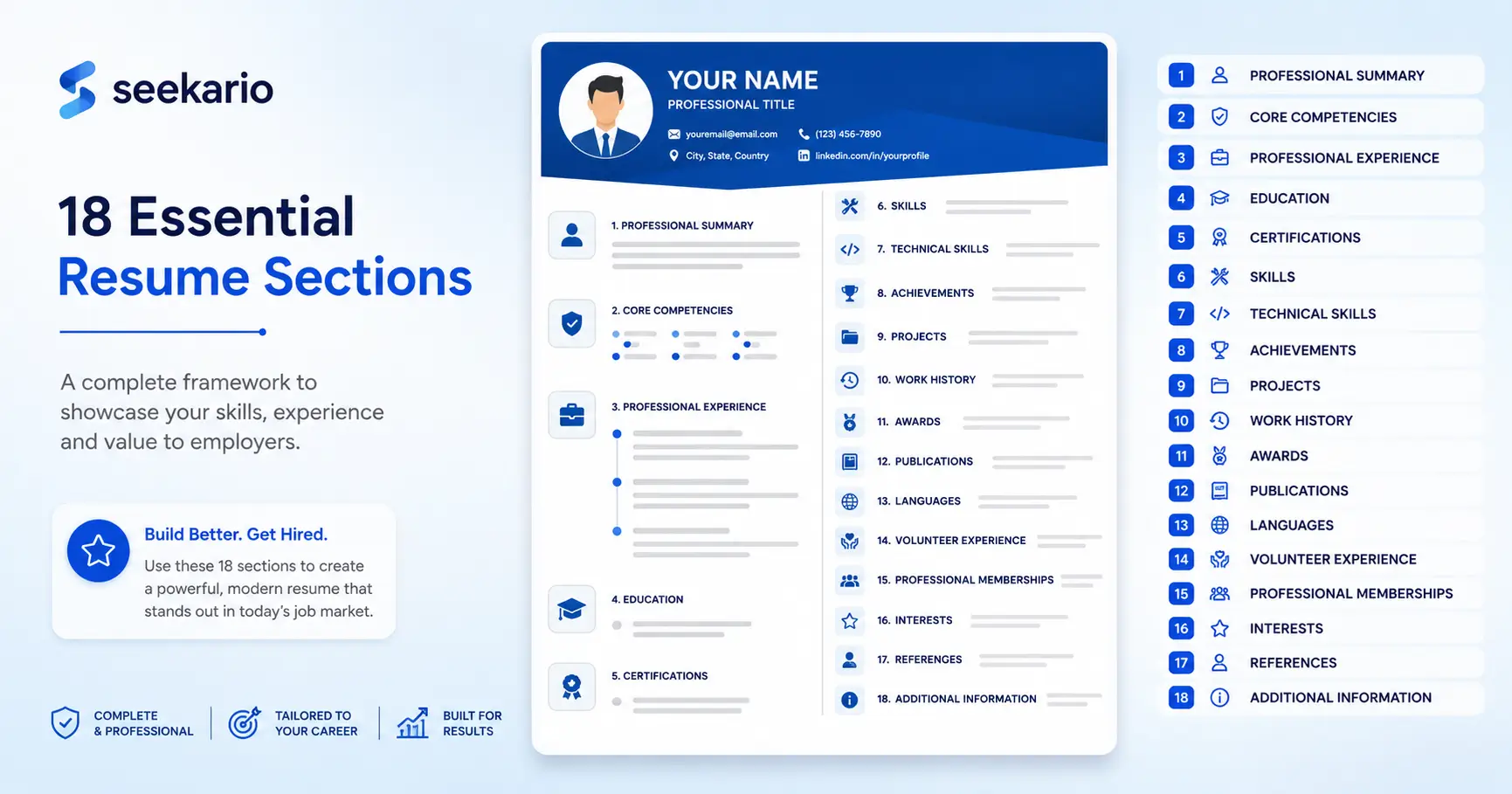
That gap is what Seekario is built for. It's an AI job-application platform designed around how hiring actually works — the ATS parse, the recruiter's few-second skim, the shortlist, then the interview — with a tool for each stage rather than a single generic chatbot.
Three of its tools map directly onto what these nine reviewers described:
- AI Resume Builder — the fix for the specificity problem. It uses the STAR method to turn job duties into achievement statements with real scope and numbers attached, instead of handing you a template and leaving you to find the words. If your bullets currently describe responsibilities rather than results, this is where to start.
- AI Resume Tailor — the fix for the must-haves problem Friddy Hoegener described. It customizes your resume against a specific job description in seconds, surfacing the relevant experience high on the page where Joanne Acri and Anna Evans both said the eye lands.
- AI Resume Checker and AI Role Assessment — recruiter-level feedback before you send. You get a read on ATS readability, keyword coverage, and the strength of your impact statements, plus a match score against any role, so you find the weak bullet before a hiring manager does.
Seekario also covers the parts of the search that these nine reviewers touched on but a resume can't solve. Ryan Stone's first pass starts with the cover letter, and the AI Cover Letter Generator writes personalized ones tailored to the role rather than the clichés he described. Will Yang's first few seconds go to the LinkedIn link, which the AI LinkedIn Profile Builder turns into a keyword-optimized profile. And when the resume does its job and buys you a conversation, the AI Interview Assistant generates role-specific questions from your resume and the job description, with instant feedback on your answers.
Over 100,000 job seekers use the platform, which has produced more than 900,000 resumes and tracked over 2 million applications. There's a free plan with 5 AI credits and a job application tracker that stays free forever — no card required.
The Bottom Line
Nine reviewers, nine different reading orders, and one shared message: they are looking for a reason to keep reading, and they will only look for a few seconds. Give them a concrete, specific, unglamorous detail, and put it where the eye lands first. That's most of the game.
Everything else — the polished summary, the perfect formatting, the carefully chosen adjectives — is being skipped by people who have read too many resumes to be persuaded by any of it.