How to Include Volunteer Experience on a Resume (And When It Helps)

Here's a stat that should change how you think about your resume: 82% of hiring managers say they prefer candidates who list volunteer experience, according to Deloitte's Volunteerism Survey. Yet only about 30% of applicants actually include it.
That gap is your opportunity. Whether you organized a neighborhood food drive, mentored students through a nonprofit, or built websites for a charity, that work developed real skills — skills that employers want to see. The question isn't whether volunteer experience matters. It's knowing *when* it strengthens your resume, *where* to place it, and *how* to frame it so it carries the same weight as paid work.
This guide walks you through all three, with real scenarios where volunteer experience outperformed traditional employment history on a resume.
When Volunteer Experience Belongs on Your Resume
Not every volunteer stint deserves resume space. Adding your one-time park cleanup from 2019 won't move the needle. But in the right context, volunteer work can be your strongest card.
Include it when any of these apply:
- The role matches the job you want. You volunteered as a grant writer and you're applying to a fundraising coordinator position? That's directly relevant experience, paid or not.
- You're light on professional experience. Students, recent graduates, and career changers often have more volunteer hours than paid hours in their target field. Use them.
- You need to cover an employment gap. Consistent volunteer work during a layoff or career break shows you stayed active, built skills, and contributed to something beyond yourself.
- The skills transfer directly. Leading a volunteer team of 15 people demonstrates leadership whether you were paid $80,000 or $0.
- It signals culture fit. Applying to a mission-driven company or a B Corp? Volunteer experience in a related cause shows genuine alignment with their values.
Skip it when:
- The experience is completely unrelated and your resume is already full of relevant paid work.
- It was a one-time event with no measurable contribution.
- You're past the two-page mark and need to cut content.
How to Format Volunteer Experience on Your Resume
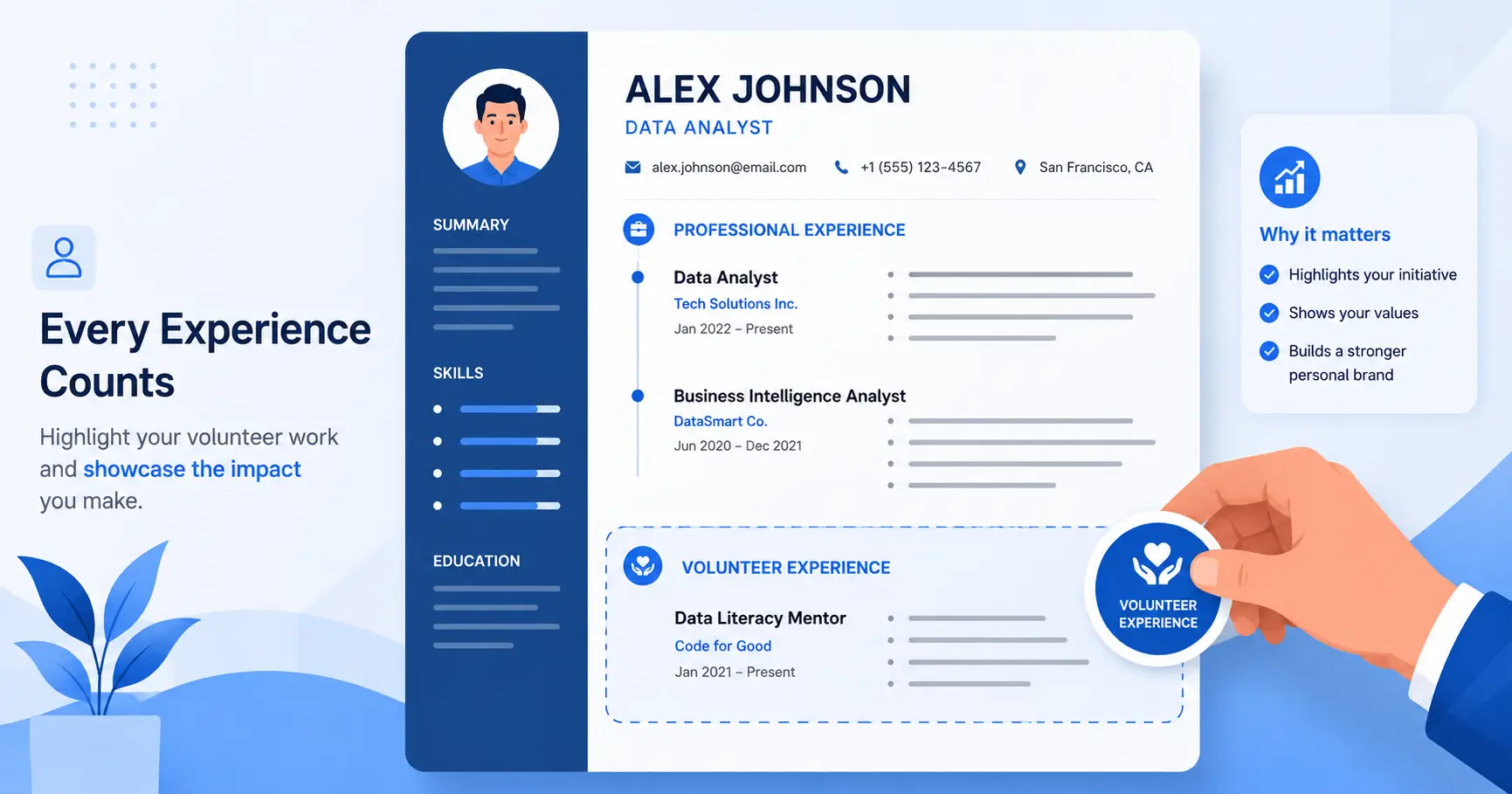
Format volunteer entries the same way you'd format any job. Hiring managers shouldn't have to squint to figure out what you did — give them the same structure they're used to scanning.
Each entry needs four elements:
Role Title — Organization Name
City, State (or Remote) | Start Date – End Date
- Achievement-focused bullet point with quantified impact
- Second bullet highlighting a transferable skill
- Third bullet (optional) connecting the work to a relevant outcome
Example:
Volunteer Marketing Coordinator — Habitat for Humanity, Austin Chapter
Austin, TX | January 2024 – Present
- Designed and executed a social media campaign that increased volunteer sign-ups by 34% over six months
- Managed a $2,500 quarterly marketing budget, producing print and digital materials for three fundraising events
- Coordinated with a five-person team to launch the chapter's first email newsletter, reaching 1,200 subscribers within eight weeks
Notice how this reads exactly like a paid marketing role. That's the goal. If you strip away the word "volunteer," the entry should still feel like professional experience.
Tools like Seekario's AI Resume Builder can help you structure volunteer entries using the same achievement-focused format as your work experience, so every section of your resume looks polished and consistent.
How Volunteer Work Fills Employment Gaps
Recruiters notice gaps. A six-month or year-long break between jobs raises questions — not because gaps are bad, but because unexplained gaps create uncertainty. Volunteer experience answers that uncertainty before the recruiter even has to ask.
Scenario: Sarah left her project management role in March 2025 to care for a family member. During that time, she volunteered with a local nonprofit, coordinating their annual fundraiser.
Without volunteer experience:
> Project Manager — Acme Corp | 2021 – March 2025
> *(Then nothing until the current application)*
With volunteer experience:
> Project Manager — Acme Corp | 2021 – March 2025
> Volunteer Event Coordinator — Community Arts Foundation | April 2025 – January 2026
The second version tells a story: Sarah stayed engaged, kept her coordination skills sharp, and contributed to her community. That's a much stronger narrative than silence.
Key formatting tip: Place the volunteer entry in the same experience section as your paid roles when it's filling a gap. Separating it into its own section makes the gap more visible, not less.
When Volunteer Experience Should Be Your Primary Experience
Sometimes volunteer work isn't just supplementary — it's the main event. Here are five real scenarios where leading with volunteer experience is the right move.
1. Recent Graduates Entering a Competitive Field
A 2025 communications graduate with two summer internships might have 800+ hours of volunteer work — managing a campus magazine, running a student org's social media, organizing charity events. Those roles often involve more responsibility than entry-level paid positions. Put them front and center.
2. Career Changers Building New Credentials
If you're moving from accounting to UX design and you've been volunteering to redesign a nonprofit's website, that project is more relevant than your ten years of tax preparation. List it prominently.
3. Returning to Work After Extended Leave
Parents returning after years away from the workforce, military spouses who've relocated frequently, people recovering from illness — all may have substantial volunteer portfolios that demonstrate current, active skills.
4. Professionals Targeting Nonprofit or Social Impact Roles
When the employer is a nonprofit, your volunteer history isn't a backup — it's proof that you understand the sector. Hiring managers at nonprofits actively seek candidates who've worked in resource-constrained, mission-driven environments.
5. Freelancers and Gig Workers Filling Consistency Gaps
If your paid work is a patchwork of short-term contracts, a sustained volunteer commitment shows stability and long-term dedication that freelance entries sometimes lack.
In each of these cases, consider placing volunteer experience in your main "Experience" section rather than in a separate section. The distinction between paid and unpaid matters less than relevance and impact.
Volunteer Experience Examples by Industry
Different industries value volunteer work differently. Here's how to frame your experience depending on where you're applying.
Technology
What works: Open-source contributions, hackathon participation, coding bootcamp mentoring, tech skills workshops for underserved communities.
Example bullet: "Contributed 50+ pull requests to an open-source accessibility tool used by 12,000 developers, focusing on screen-reader compatibility improvements."
Healthcare
What works: Hospital volunteering, health education outreach, crisis hotline staffing, medical mission trips.
Example bullet: "Staffed a crisis text line for 200+ hours, de-escalating an average of 15 conversations per shift while maintaining a 96% caller satisfaction rating."
Education
What works: Tutoring, mentoring programs, curriculum development, after-school program coordination.
Example bullet: "Designed and delivered a 12-week SAT prep curriculum for 30 first-generation college students, with participants averaging a 140-point score improvement."
Business and Finance
What works: Pro-bono consulting, nonprofit board service, financial literacy workshops, fundraising campaigns.
Example bullet: "Served as Treasurer on a nonprofit board, managing a $180,000 annual budget and reducing operating costs by 12% through vendor renegotiation."
Marketing and Communications
What works: Social media management for nonprofits, event planning, newsletter creation, brand strategy for community organizations.
Example bullet: "Rebranded a community food bank's visual identity and launched an Instagram strategy that grew their following from 400 to 3,200 in four months."
When you're unsure whether your volunteer experience aligns with a specific job posting, Seekario's AI Resume Tailor can analyze the job description and suggest which volunteer entries to highlight and how to reword them for maximum relevance.
Common Mistakes to Avoid
Even strong volunteer experience can fall flat if you present it poorly. Watch out for these pitfalls.
Listing responsibilities instead of achievements. "Helped at food bank events" tells a hiring manager nothing. "Sorted and distributed 2,000 lbs of food weekly to 150 families" tells a story of scale and impact.
Using vague dates. "2023–2024" is fine. "A few years ago" is not. Be specific so recruiters can place the experience on your career timeline.
Overloading your resume with every volunteer role. Two or three well-described entries beat eight one-liners. Focus on depth over breadth.
Hiding it at the bottom. If volunteer experience is your strongest qualification for a role, don't bury it below hobbies and references. Place it where it gets seen — in or near your main experience section.
Forgetting to tailor. The same volunteer work can sound completely different depending on what you emphasize. Coordinating a charity run? For a marketing role, highlight the promotional campaign. For an operations role, highlight the logistics. For a finance role, highlight the budget management. Same experience, three different framings.
Need a quick check on whether your volunteer section is working? Run your resume through Seekario's AI Resume Assessment to see how well your volunteer entries align with the job you're targeting.
Frequently Asked Questions
Does volunteer experience count as real work experience?
For resume purposes, yes — when you frame it correctly. Deloitte research shows 82% of hiring managers view volunteer work favorably, and many consider it equivalent to paid experience. The key is presenting it with the same structure and achievement focus as any professional role: title, organization, dates, and quantified accomplishments.
Where should I put volunteer experience on my resume?
It depends on how relevant it is. If the volunteer work directly relates to the job or fills an employment gap, place it in your main experience section alongside paid roles. If it's supplementary, create a dedicated "Volunteer Experience" or "Community Involvement" section after your work experience and education.
How many volunteer experiences should I include?
Stick to two or three entries that are most relevant to the job. Each should include specific, measurable achievements. Quality beats quantity — one well-described volunteer role with clear impact is worth more than five vague mentions.
Should I include volunteer work if I have plenty of paid experience?
Yes, if it adds something your paid experience doesn't. Board membership shows leadership breadth. Pro-bono consulting in a new industry signals a career interest. Volunteer work in the employer's mission area demonstrates cultural alignment. If it doesn't add new information, leave it off to save space.
Can I list volunteer work from many years ago?
Generally, keep volunteer experience within the last 10–15 years, similar to paid work. Exceptions include highly prestigious roles (like serving on a notable board), ongoing commitments, or experiences that directly relate to the target job regardless of when they occurred.
Make Every Section of Your Resume Count
Volunteer experience isn't a filler section — it's a strategic asset when you know how to use it. The professionals who land interviews aren't the ones with the longest resumes. They're the ones who make every entry, paid or unpaid, tell a clear story of impact.
If you're ready to build a resume that treats your volunteer work with the same polish as your professional history, Seekario's AI Resume Builder helps you structure, format, and optimize every section — so nothing you've accomplished goes to waste.
For a deeper look at how all resume sections work together, check out our Complete Guide to Resume Sections.