Resume Objective Examples for Every Career Level (Entry, Mid, Senior)

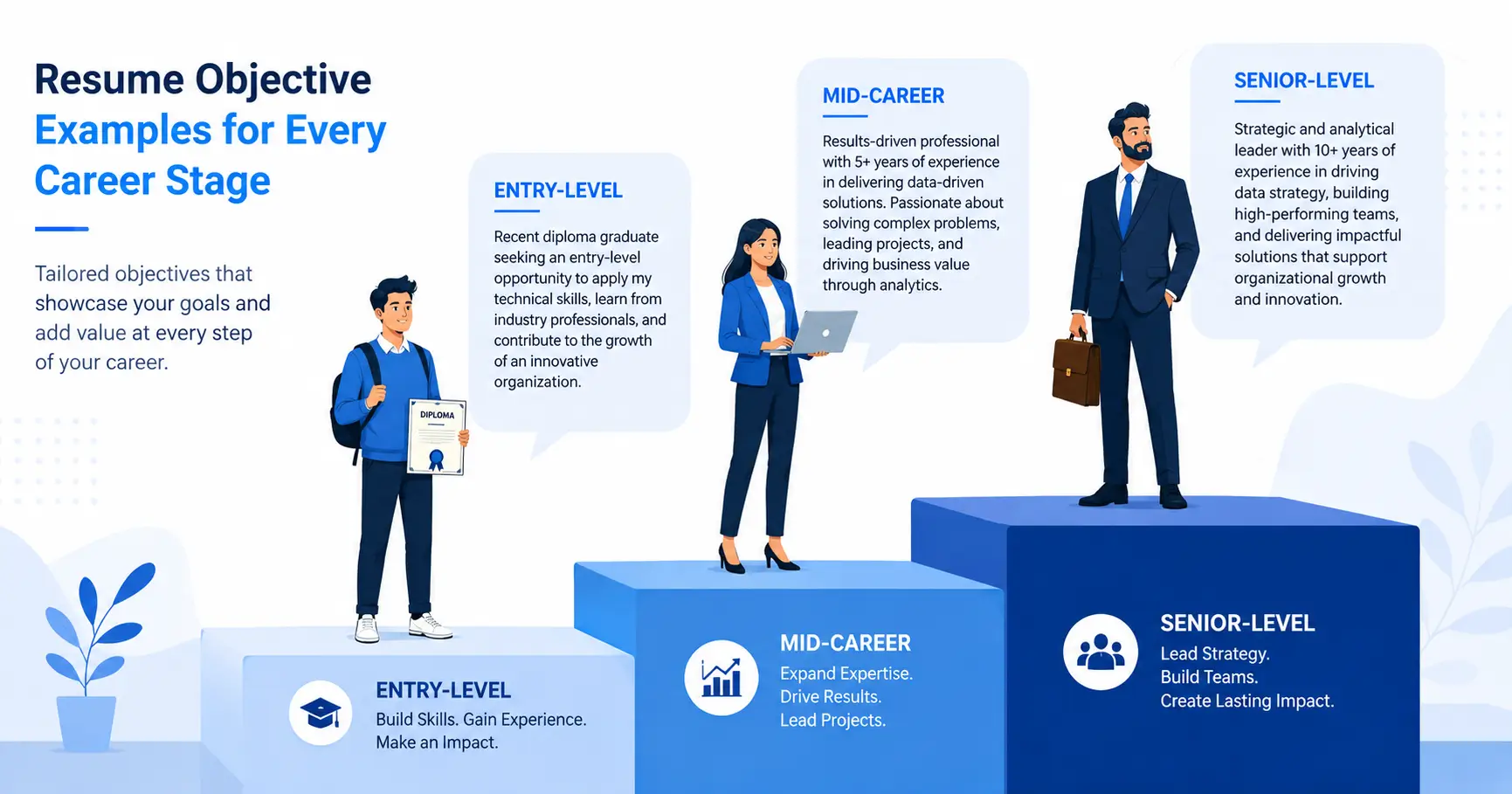
A resume objective tells a hiring manager exactly what you're after and why you're worth a closer look — in two to three sentences. But here's the catch: most resume objective examples floating around online are vague, self-serving, and instantly forgettable. A weak objective can actually hurt your chances more than having no objective at all.
This guide gives you 40+ resume objective examples organized by career level, with side-by-side good versus bad comparisons so you can see exactly what separates a forgettable opener from one that earns a second glance. Whether you're writing your first objective as a new grad or crafting one for a career pivot, you'll find a template that fits.
When You Actually Need a Resume Objective
Resume objectives aren't for everyone. If you have five years of relevant experience and a clear career trajectory, a professional summary will serve you better. (Not sure which to use? Check out our breakdown of resume summary vs objective.
An objective makes strategic sense when:
- You're entering the workforce — recent graduates, bootcamp completers, or anyone with limited professional experience who needs to signal direction rather than recap achievements.
- You're changing careers — your work history tells one story, but your objective bridges the gap between where you've been and where you're headed.
- You're re-entering after a gap — whether you took time off for caregiving, health, or education, an objective reframes the narrative around what's next.
- The role is a stretch — if you're applying slightly above your current level, an objective shows intentionality and self-awareness.
If none of these apply, a professional summary is likely the stronger choice. For a full breakdown of where the objective fits among all resume components, see our complete guide to resume sections.
Entry-Level Resume Objective Examples
New graduates and early-career professionals benefit most from objectives because they compensate for a thin work history. The key: be specific about the role, mention a relevant skill or credential, and state what you'll contribute — not just what you want.
Technology
Bad: "Looking for a software engineering position where I can use my skills and grow my career."
Good: "Computer science graduate with hands-on experience building full-stack applications in React and Node.js during two internships. Seeking a Junior Software Engineer role at [Company] to contribute to product development and deepen my backend architecture skills."
Bad: "Seeking an entry-level IT position."
Good: "CompTIA A+-certified IT support specialist with 6 months of help desk experience supporting 200+ users. Eager to join [Company] as a Tier 1 Support Technician and reduce average ticket resolution time."
Business & Finance
Bad: "Recent graduate seeking a role in finance to start my career."
Good: "Finance major with a 3.7 GPA and CFA Level I candidacy, plus internship experience building DCF models at a boutique advisory firm. Seeking an Analyst position at [Company] to support M&A due diligence and client deliverables."
Bad: "Hardworking individual looking for an accounting opportunity."
Good: "Accounting graduate with QuickBooks and Excel proficiency, seeking a Staff Accountant role at [Company] to apply month-end close experience gained during a Big Four internship."
Marketing & Communications
Bad: "Creative person looking for a marketing job."
Good: "Marketing graduate who grew a university club's Instagram following from 400 to 3,200 in one semester through targeted content strategy. Seeking a Social Media Coordinator role at [Company] to drive engagement and brand awareness."
Healthcare
Bad: "Nursing graduate seeking a hospital position."
Good: "BSN graduate with 800+ clinical hours across med-surg and pediatric units, plus BLS and ACLS certifications. Seeking an RN position at [Hospital] to deliver evidence-based patient care on a high-acuity floor."
Education
Bad: "Passionate about teaching and want to make a difference."
Good: "Elementary education graduate with student teaching experience across K-3 classrooms and Reading Specialist endorsement. Seeking a 2nd Grade Teacher position at [School] to implement differentiated literacy instruction for diverse learners."
Career-Change Resume Objective Examples
When you're pivoting industries, your objective does the heavy lifting. It connects your transferable skills to the target role and explains the "why" behind your move without sounding apologetic.
Bad: "Seeking a new opportunity in a different field where I can apply my skills."
Good: "Former high school science teacher with 6 years of curriculum design and data-driven instruction experience, transitioning into Instructional Design. Seeking a role at [Company] to apply learning science expertise and Articulate 360 skills to corporate training programs."
Bad: "Career changer looking to break into tech."
Good: "Operations manager with 8 years of process optimization experience and a newly completed data analytics certificate from Google. Seeking a Data Analyst role at [Company] to apply SQL, Tableau, and statistical modeling skills to supply chain decision-making."
Bad: "Sales professional interested in moving into HR."
Good: "B2B account executive with 5 years of experience managing client relationships and negotiating contracts, plus SHRM-CP certification. Seeking an HR Business Partner role at [Company] to leverage conflict resolution and stakeholder management skills in employee relations."
Bad: "Want to transition from retail to corporate."
Good: "Retail store manager who led a team of 25 and increased annual revenue by 18%, now pursuing project management. Seeking a Project Coordinator role at [Company] to apply PMP training and cross-functional leadership skills to enterprise initiatives."
Bad: "Military veteran seeking civilian employment."
Good: "Army logistics officer with 6 years managing $12M+ supply chains across three continents, holding a Secret clearance and PMP certification. Seeking a Supply Chain Manager role at [Company] to optimize distribution operations and reduce procurement costs."
Seekario's AI Resume Tailor can help you rewrite your objective to match the specific language in a job posting, which is especially useful when your background doesn't obviously align with the role.
Mid-Career Resume Objective Examples
Mid-career professionals rarely need objectives — a summary is almost always the better call. But there are exceptions: you're targeting a specific niche, pivoting within your industry, or moving from individual contributor to management (or vice versa).
Bad: "Experienced professional seeking a management position."
Good: "Front-end developer with 7 years building consumer-facing web applications, seeking a transition into Engineering Management at [Company] to apply technical depth and mentorship experience leading a growing team of 8 direct reports."
Bad: "Looking for a senior role with better compensation."
Good: "Product marketing manager with 6 years launching B2B SaaS products, seeking a Senior PMM role at [Company] to lead go-to-market strategy for the enterprise segment and drive pipeline growth."
Bad: "Dedicated worker hoping for a new challenge in my field."
Good: "Registered dietitian with 5 years in clinical nutrition and a newly completed MBA in healthcare administration. Seeking a Nutrition Program Director role at [Hospital] to scale community health initiatives and reduce readmission rates."
Bad: "Seeking a position that matches my qualifications."
Good: "Cybersecurity analyst with 4 years of SOC experience and CISSP certification, seeking a Security Engineer role at [Company] to architect zero-trust frameworks and lead incident response for cloud-native infrastructure."
What Makes Good Objectives Good (and Bad Ones Bad)
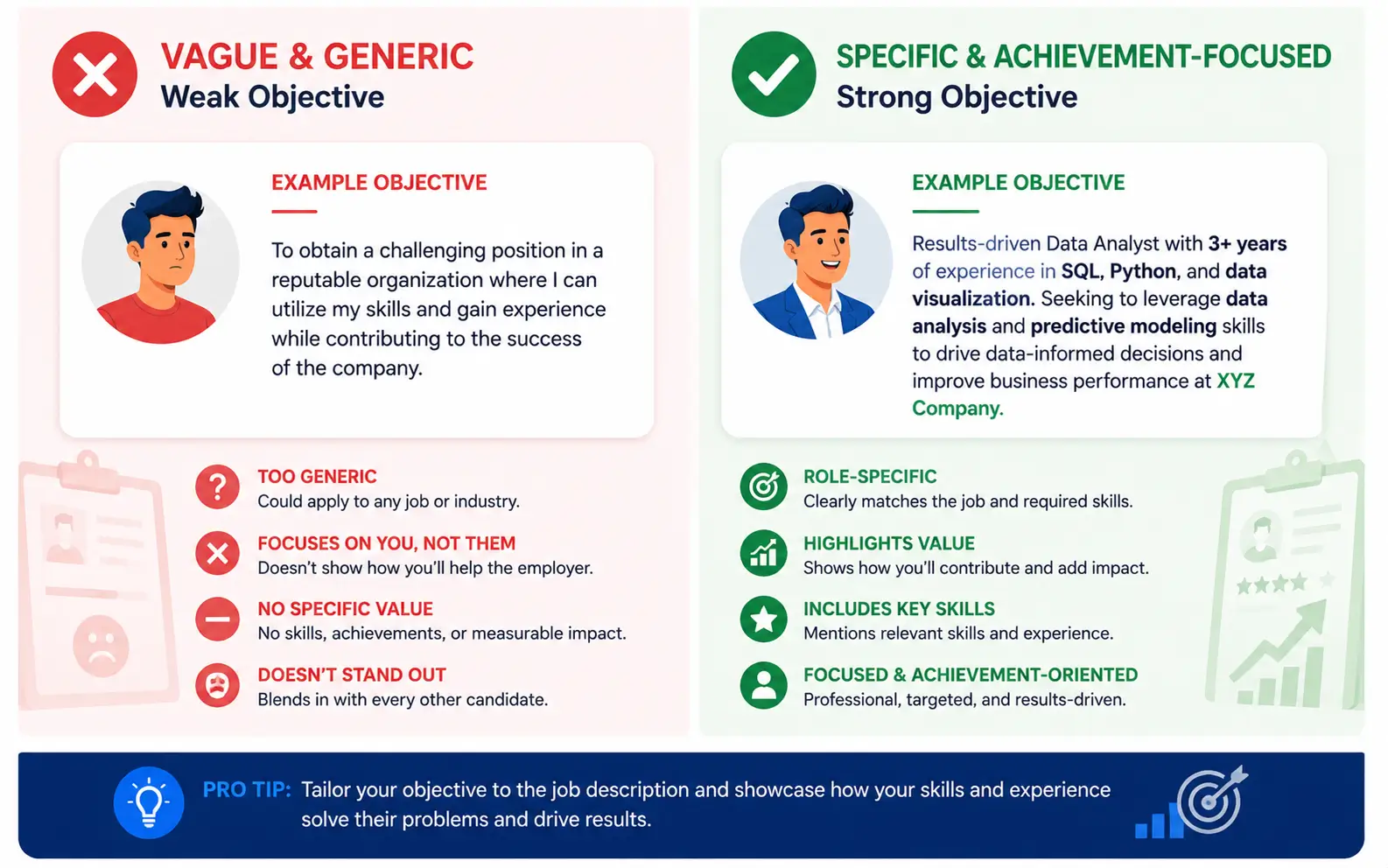
After reading 30+ comparisons above, patterns emerge. Here's the framework that separates effective objectives from the ones recruiters skip:
The Anatomy of a Strong Objective
Every effective resume objective has three components:
- Identity + Proof — Who you are, backed by a credential, metric, or specific experience. "Marketing graduate who grew Instagram following from 400 to 3,200" beats "creative person" every time.
- Target + Specificity — The exact role and ideally the company name. "Seeking a Junior Software Engineer role at Stripe" tells the recruiter you're intentional, not mass-applying.
- Value Proposition — What you'll contribute, not just what you'll gain. "To reduce average ticket resolution time" is concrete. "To grow my career" is about you, not them.
Red Flags That Kill an Objective
- "Hardworking," "passionate," "dedicated" — Empty adjectives that every applicant claims. Replace them with evidence.
- No mention of the role or company — Signals you're copy-pasting the same resume everywhere.
- Focusing on what you want — "Seeking a role with growth opportunities and competitive pay" tells the employer nothing about your value.
- Being too long — Three sentences maximum. If it's a paragraph, it's a summary pretending to be an objective.
Writing ATS-Friendly Resume Objectives
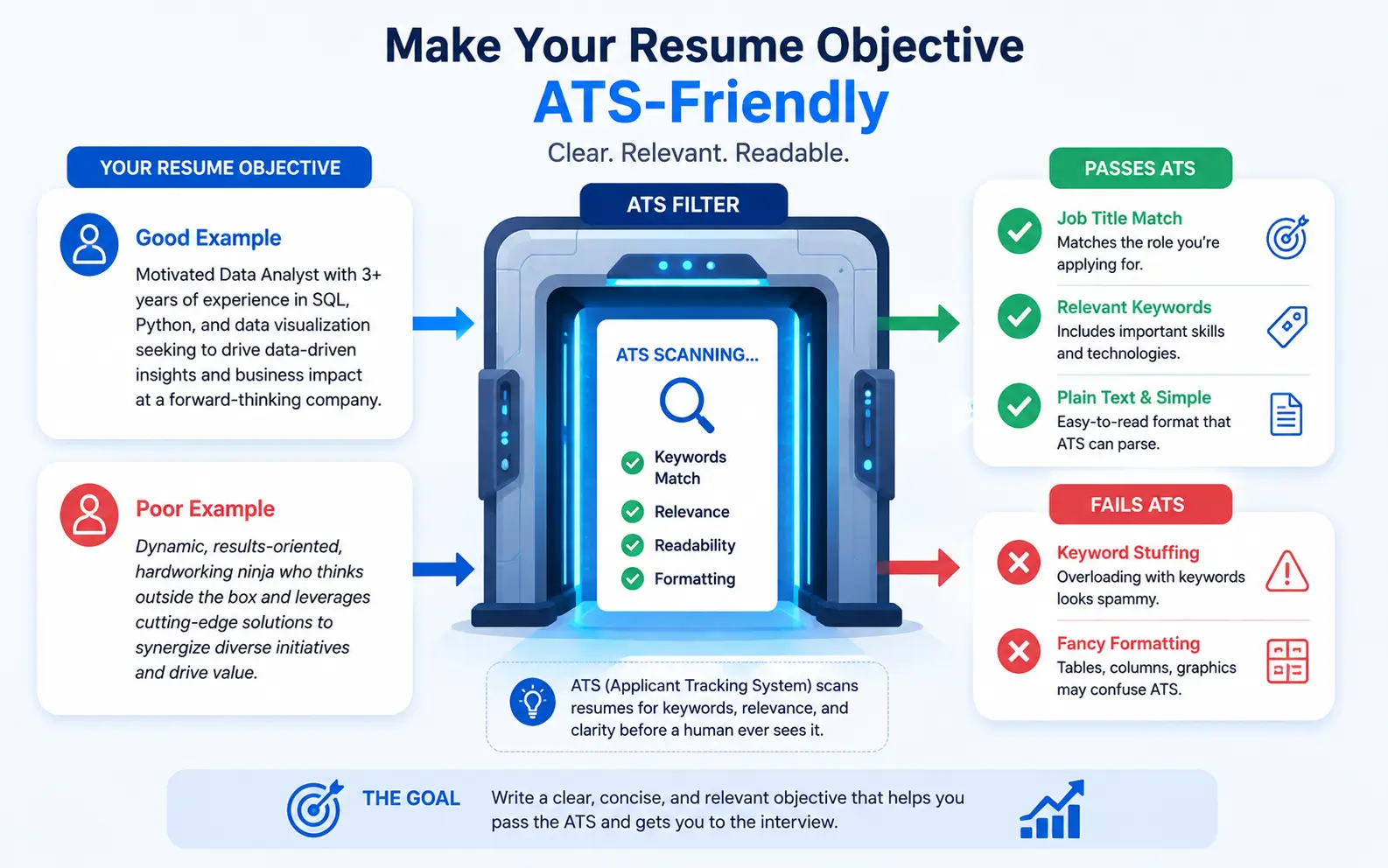
Your objective won't matter if applicant tracking systems filter your resume before a human reads it. Here's how to make sure it survives the scan:
Use the job title from the posting. If the listing says "Marketing Coordinator," don't write "Marketing Specialist" or "Marketing Associate" in your objective. Match the exact title.
Include one or two hard skills. ATS systems parse for specific keywords. Mentioning "Python" or "Salesforce" in your objective gives you an early keyword match, especially for entry-level roles where your skills section may be shorter.
Skip the fancy formatting. Objectives that use icons, special characters, or unusual punctuation can confuse ATS parsers. Stick to plain text.
Don't keyword-stuff. Writing "Data analyst data analytics data science data visualization" is obvious to both ATS algorithms and humans. Use keywords naturally within a complete sentence.
Seekario's AI Resume Builder generates ATS-optimized objectives tailored to specific job descriptions, so you get the right keywords in a natural-sounding statement without the guesswork.
FAQ
Are resume objectives outdated in 2026?
Not entirely — but their use case has narrowed. Most experienced professionals should use a professional summary instead. Objectives remain effective for recent graduates, career changers, and anyone whose work history doesn't obviously match the target role. The key is writing a targeted, value-driven objective rather than a generic one.
How long should a resume objective be?
Two to three sentences, or roughly 30 to 50 words. Anything longer starts functioning as a summary. Your objective should be the shortest section on your resume — just enough to establish direction and relevance.
Should I include the company name in my resume objective?
Yes, when practical. Including the company name signals that you've written a tailored application, not a mass-blast. If you're applying to dozens of roles and can't customize each one, at minimum include the specific job title.
Can I use a resume objective if I have experience?
You can, but in most cases a professional summary will serve you better. The exception is when you're making a significant pivot — switching industries, moving from IC to management, or targeting a role that doesn't obviously connect to your background. In those situations, an objective bridges the gap.
What's the biggest mistake people make with resume objectives?
Writing about what they want instead of what they offer. "Seeking a challenging role with growth potential" tells the employer nothing useful. Every word in your objective should answer the recruiter's real question: "Why should I keep reading this resume?"
Make Your Objective Count
A resume objective is prime real estate — it's the first thing a recruiter reads after your name. The difference between the good and bad examples above comes down to specificity, evidence, and a clear value proposition.
If you're unsure whether your objective hits the mark, Seekario's AI Resume Builder can generate a targeted objective statement based on your background and the job description you're applying to. It takes the guesswork out of keyword optimization and helps you nail the tone — whether you're a new grad writing your first objective or a career changer bridging two different worlds.
For more on structuring every part of your resume, visit our complete guide to resume sections.