How to Add Projects to Your Resume (Students, Career Changers & Freelancers)

Your work experience section tells recruiters where you've been. Your projects on resume tell them what you can actually *do*. For students without corporate experience, career changers building proof in a new field, and freelancers juggling multiple clients, a well-structured resume projects section can be the difference between a callback and radio silence.
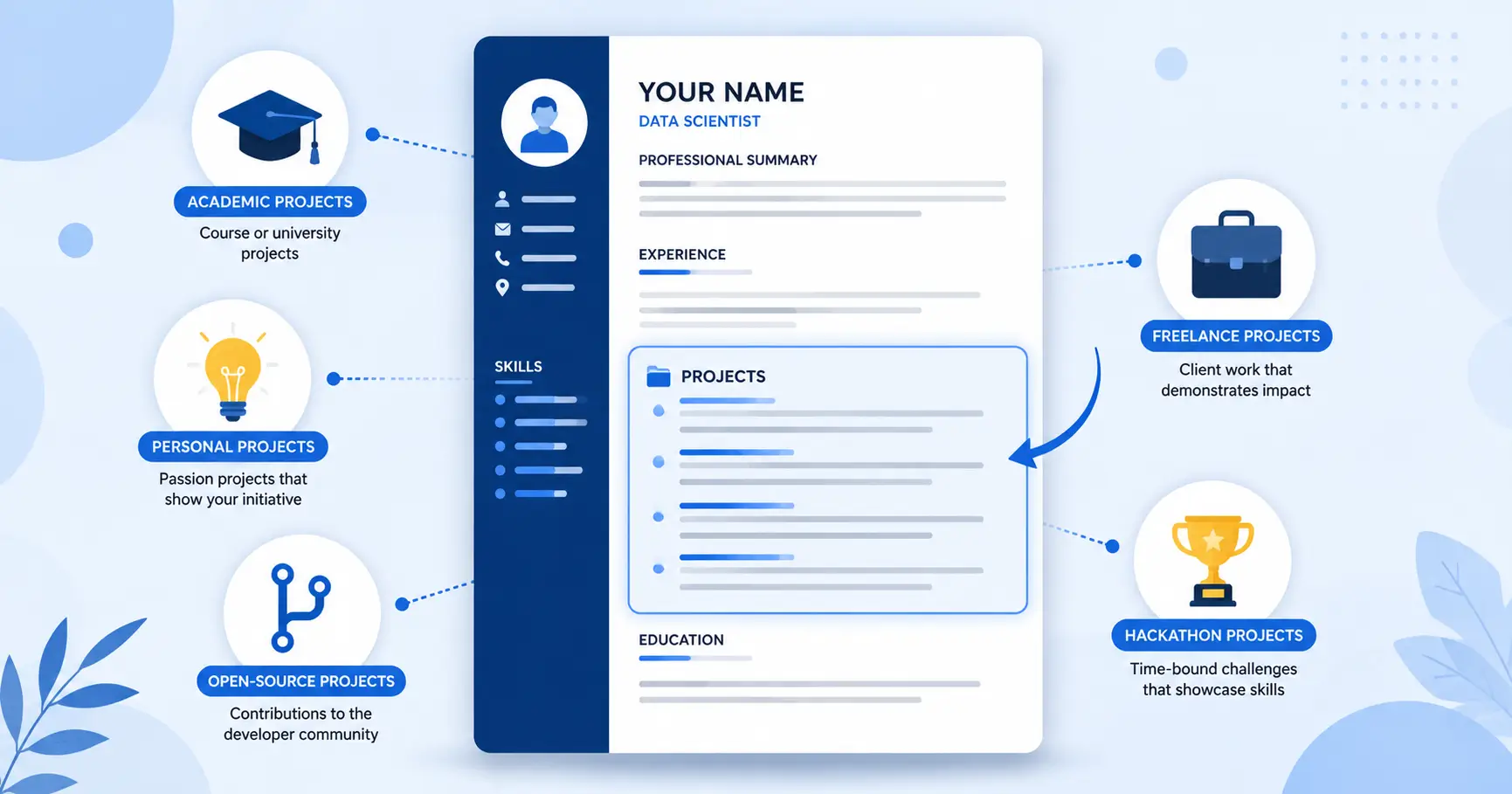
Here's the problem: most resume advice treats projects as an afterthought — a dumping ground for anything that didn't fit elsewhere. That approach wastes valuable space. This guide breaks down five distinct project types — academic, personal, open-source, freelance, and hackathon — with formatting templates you can copy and fill in today.
Why Projects Belong on Your Resume
Recruiters spend roughly 6-7 seconds on an initial resume scan. Projects grab attention because they prove capability rather than just claiming it. Saying you "know Python" is one thing. Showing you built an automated data pipeline that reduced reporting time by 40% is another.
Projects are especially powerful for three groups:
Students and recent graduates often lack the 2-3 years of experience that job postings demand. Academic and personal projects fill that gap by showing applied knowledge — not just coursework completion, but real problem-solving.
Career changers face the credibility gap. Your 8 years in marketing don't automatically convince a hiring manager you can handle data analytics. A portfolio project that uses SQL, Python, and Tableau to analyze a real dataset builds that bridge.
Freelancers and contractors may have done impressive work across dozens of clients, but their resume can look fragmented. A curated projects section ties scattered engagements into a coherent narrative.
Beyond these groups, projects signal initiative. They tell a recruiter you don't wait for someone to assign you work — you go find problems worth solving. That quality matters at every career stage.
Academic Projects: Turning Coursework Into Proof
Academic projects are the strongest weapon in a student's resume arsenal. But listing "completed capstone project" won't cut it. You need to frame classroom work like professional experience.
What counts as an academic project:
- Capstone or thesis projects
- Group research assignments with deliverables
- Lab experiments with measurable outcomes
- Case studies with real company data
- Class presentations that involved original analysis
Formatting template:
```
[Project Title] | [Course Name], [University] | [Semester/Year]
- [Action verb] + [what you did] + [tools/methods] + [result/outcome]
- [Action verb] + [scope or scale detail]
- [Action verb] + [collaboration or leadership element]
```
Strong example:
Customer Churn Prediction Model | Data Science Capstone, UC Berkeley | Fall 2025
- Built a gradient-boosted classification model using Python and scikit-learn that predicted customer churn with 89% accuracy on a 50,000-row telecom dataset
- Engineered 12 features from raw billing and usage data, improving model AUC from 0.76 to 0.91
- Presented findings to a panel of 3 industry mentors, receiving recommendation for publication
Weak example to avoid:
> Data Science Capstone — worked on a machine learning project for a class assignment
The difference? Specificity. Include the tools, the scale, and the result. If your project didn't produce hard metrics, describe the deliverable: a report, a prototype, a presentation to stakeholders.
Placement tip: If you graduated within the past 2 years, put academic projects directly under your Education section or in a dedicated "Projects" section above Work Experience. Once you have 3+ years of professional experience, academic projects can move lower or be removed entirely.
Personal Projects: Showing Initiative Beyond the Job
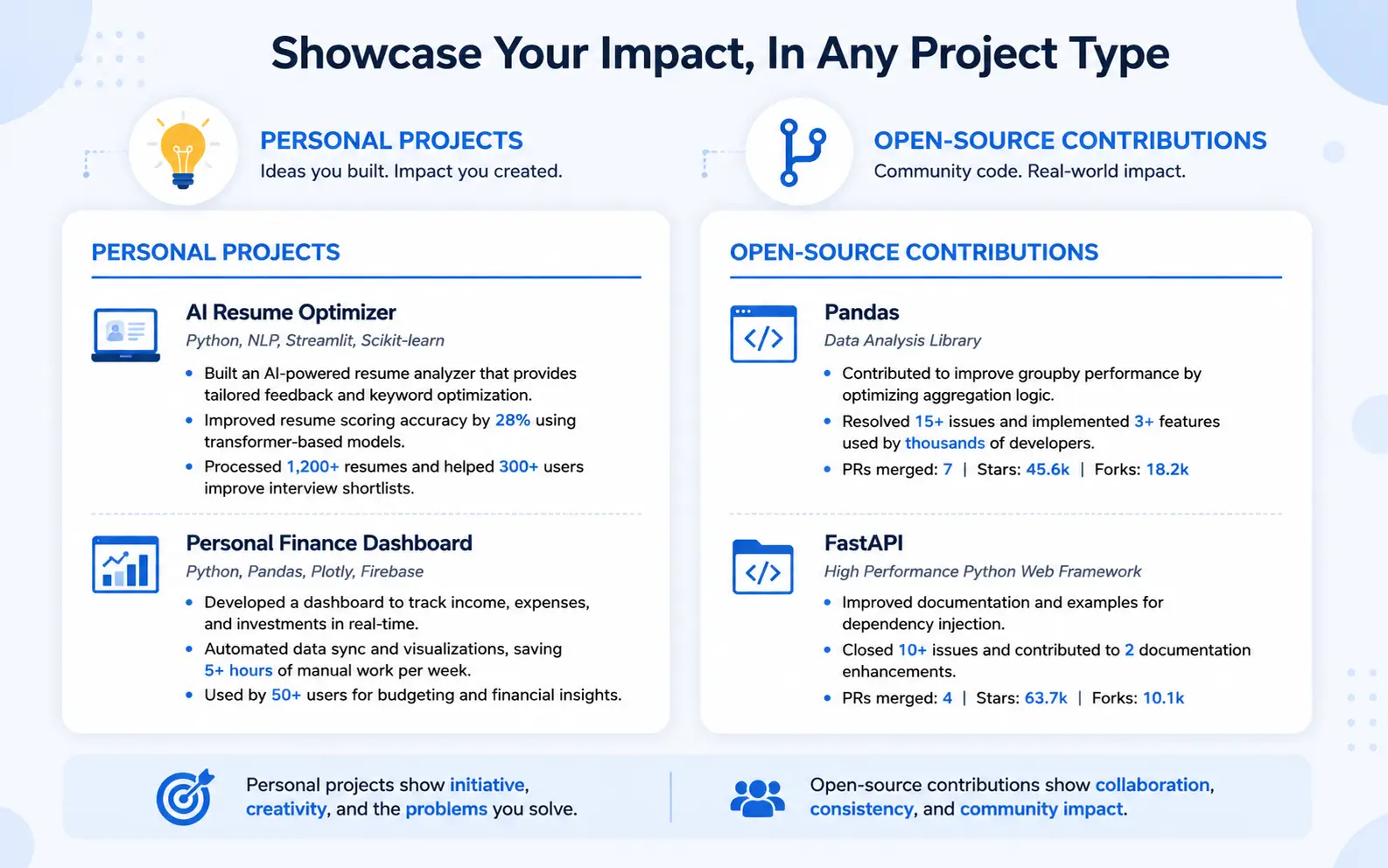
Personal projects — the things you build on nights and weekends because you're genuinely curious — carry outsized weight on a resume. They prove motivation that no employer assigned and no grade required.
What makes a personal project resume-worthy:
- It solves a real problem (even a small one)
- It uses skills relevant to your target role
- You can describe a clear outcome or deliverable
- It's something you can demo, link to, or explain in an interview
Formatting template:
```
[Project Title] | Personal Project | [Timeframe]
- [What you built and why]
- [Key technologies, tools, or methods used]
- [Outcome: users, downloads, performance metrics, or lessons learned]
```
Strong example:
Budget Tracker Web App | Personal Project | Jan–Mar 2026
- Designed and deployed a full-stack expense tracker using React, Node.js, and PostgreSQL, serving 200+ monthly active users
- Integrated Plaid API for automatic bank transaction imports, reducing manual data entry by 85%
- Open-sourced the codebase on GitHub, receiving 150+ stars and 12 contributor pull requests
What to skip: Incomplete projects with no deliverable, tutorials you followed step-by-step without modification, and projects using only outdated or irrelevant technologies. A half-finished to-do app built from a YouTube walkthrough doesn't help your case.
Career changer tip: Personal projects are your best friend. If you're moving from teaching to UX design, a personal project redesigning your school's parent portal shows applied skill better than any bootcamp certificate alone. Pair the project with your Seekario AI Resume Builder profile to ensure your projects section is formatted for ATS compatibility.
Open-Source Contributions: Proof You Can Collaborate at Scale
Contributing to open-source software shows three things employers care about: you can read other people's code, you can work asynchronously with distributed teams, and you can navigate code review processes. These skills transfer directly to any engineering or technical role.
What counts as a meaningful contribution:
- Merged pull requests (bug fixes, feature additions, documentation improvements)
- Maintaining a package or library others depend on
- Filing well-documented issues that lead to fixes
- Writing documentation or tutorials for existing projects
- Reviewing other contributors' pull requests
Formatting template:
```
[Project/Repository Name] | Open-Source Contributor | [Timeframe]
- [Your specific contribution and its impact]
- [Technologies involved]
- [Scale: stars, users, downloads, or team size]
```
Strong example:
FastAPI (github.com/tiangolo/fastapi) | Open-Source Contributor | 2025–Present
- Authored 4 merged pull requests fixing async middleware bugs affecting 500+ downstream applications
- Rewrote authentication documentation section, reducing related GitHub issues by 30% over 3 months
- Reviewed 15+ community PRs and participated in architectural discussions for v1.0 release
Important note: Don't inflate minor contributions. A single typo fix in a README isn't worth a bullet point. But consistent, meaningful engagement with a project — even a smaller one — shows real collaborative skills.
Non-technical open-source: Open-source isn't just for developers. Design systems (Figma community files), data sets (Kaggle), research papers (arXiv preprints), and educational content (freeCodeCamp curriculum) all count. If you contributed to something public that others use, it belongs here.
Freelance Projects: Client Work Without Compromising Confidentiality
Freelancers face a unique challenge: your best work might be under NDA. The solution isn't to skip your projects section — it's to present client work strategically while protecting confidentiality.
Three approaches to handling freelance projects:
- Named clients (with permission): If your client is comfortable being referenced, name them and describe the work as you would any other project.
- Anonymized clients: Describe the industry, company size, and project scope without naming the client. "Series B fintech startup" tells a recruiter everything they need without violating any agreement.
- Aggregated highlights: Group similar projects together. "Completed 15+ website redesigns for small business clients, averaging 35% improvement in page load speed."
Formatting template:
```
[Project Title or Client Description] | Freelance | [Timeframe]
- [Scope: what you were hired to do]
- [Your approach: tools, methods, process]
- [Results: metrics, deliverables, client outcomes]
```
Strong example:
E-Commerce Platform Redesign | Freelance for Mid-Size Retail Brand | Q3 2025
- Led end-to-end UX redesign of a Shopify Plus storefront serving 50,000+ monthly visitors
- Conducted 12 user interviews and A/B tested 3 checkout flow variants, reducing cart abandonment by 22%
- Delivered responsive designs in Figma with a component library of 80+ reusable elements
Freelancer resume strategy: Rather than listing every gig, select 3-5 projects that best align with the role you're targeting. Use your AI Resume Tailor to match your freelance project descriptions to specific job descriptions — the tool identifies which skills and keywords from the posting your projects should emphasize.
Hackathon Projects: Speed, Pressure, and Teamwork on Display
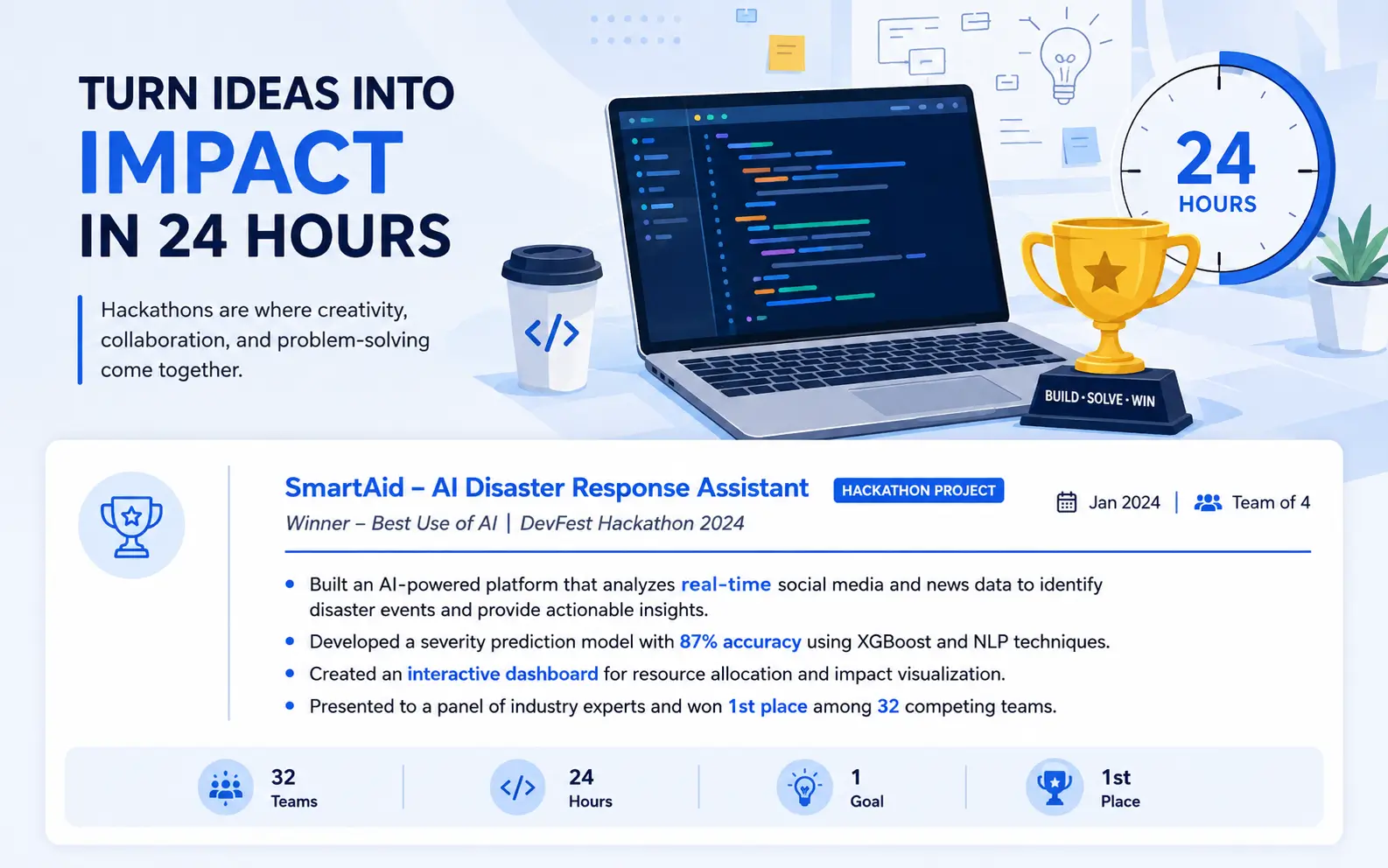
Hackathon projects punch above their weight on resumes. Building something functional in 24-48 hours under competitive pressure demonstrates rapid prototyping skills, creative problem-solving, and the ability to collaborate with strangers — all traits employers actively screen for.
What makes hackathon projects valuable:
- Time constraint proof: You shipped something in hours, not months
- Team dynamics: You collaborated with people you just met
- Judging/awards: External validation from industry professionals
- Innovation signal: You chose to spend a weekend building something instead of relaxing
Formatting template:
```
[Project Name] | [Hackathon Name] | [Date]
- [What you built and the problem it solved]
- [Your specific role and contributions]
- [Tech stack]
- [Result: placement, award, or post-hackathon traction]
```
Strong example:
MedConnect | Health Hack 2025 (Stanford) | Nov 2025
- Built an AI-powered patient triage chatbot in 36 hours that reduced ER wait-time estimates by matching symptoms to department availability
- Owned backend development: Flask API, GPT-4 integration, and PostgreSQL database serving 200+ simulated patient queries
- Won 2nd place out of 45 teams; invited to present at Stanford Health Innovation Summit
Even without winning: Not every hackathon project ends on a podium. That's fine. Focus on what you built, what you learned, and what you'd improve. A hackathon project that shows iteration — "post-hackathon, I continued developing the MVP and onboarded 50 beta users" — can be even stronger than a prize.
Formatting Your Projects Section: Placement, Order, and Length
Where you place your resume projects section and how you format it matters as much as the content itself.
Placement Rules
Dedicated "Projects" section works best when you have 3+ strong projects that don't fit naturally under Work Experience or Education. Place it:
- Above Work Experience if projects are your strongest qualification (students, career changers)
- Below Work Experience if you have solid professional history and projects supplement it
- Within Education if projects are academic and you have limited other experience
Integrated approach: Some projects fit better as bullet points under a relevant job or education entry. A freelance project completed during a full-time role can go under that role's bullet points.
Formatting Consistency
Regardless of project type, every entry should follow the same structure:
- Project title (bolded) + context (type, organization, or client) + date
- 2-4 bullet points starting with action verbs
- At least one metric or concrete deliverable per project
- Tools and technologies mentioned naturally within bullets
How Many Projects to Include
- Students: 3-5 projects (your projects section may be the largest section)
- Career changers: 2-4 projects focused exclusively on your target field
- Freelancers: 3-5 curated projects aligned with the target role
- Experienced professionals: 1-2 standout projects, if any
ATS Considerations
Applicant tracking systems parse projects sections well as long as you use standard section headers: "Projects," "Relevant Projects," or "Selected Projects." Avoid creative headers like "Things I've Built" or "My Playground." Use Seekario's AI Resume Assessment to check whether your projects section is being parsed correctly by ATS systems before you submit.
For a complete breakdown of all 18 resume sections and how they work together, see our Complete Guide to Resume Sections.
FAQ
Should I include projects on my resume if I have plenty of work experience?
Yes, but be selective. Even with 10+ years of experience, a single standout project — especially one showing emerging skills like AI/ML or a side venture — adds dimension. Keep it to 1-2 entries and place the section below Work Experience.
How do I list a group project without taking credit for everything?
Specify your role clearly. Use phrases like "Led frontend development for..." or "Owned data pipeline architecture within a 4-person team..." This gives you credit for your contribution while acknowledging collaboration.
Can I include projects from online courses or bootcamps?
Yes, if you've gone beyond the standard curriculum. A project where you followed a tutorial exactly as prescribed is essentially coursework, not a project. But if you extended the tutorial — added features, used different data, or applied the technique to a new problem — it qualifies. Frame it as a personal project rather than a "course project."
What if my project failed or was never completed?
Incomplete projects generally don't belong on your resume. The exception is if you learned something significant and can articulate it: "Built MVP that validated demand for X but identified Y as a blocker — pivoted approach for v2." This framing works better in interviews than on the resume itself.
How do I link to project demos or repositories?
Add a hyperlink directly in your project title or include a clean URL on a separate line. For GitHub repos, make sure the README is polished — recruiters will click through. For live demos, verify the link works before every application. A broken demo link is worse than no link at all.
Make Your Projects Section Work Harder
Your projects aren't just filler — they're evidence. Whether you're a student turning a capstone into a career launcher, a career changer building credibility from scratch, or a freelancer curating your best client work, the right projects section transforms your resume from a list of claims into a portfolio of proof.
Start by picking your 2-4 strongest projects. Format each one using the templates above. Then run your resume through Seekario's AI Resume Builder to make sure every project entry is optimized for both human readers and ATS systems — it'll flag missing metrics, weak action verbs, and formatting issues before a recruiter ever sees them.